
AI Lead Generation: The Complete 2026 Guide for B2B
AI lead generation, explained for B2B: how it works, the best tools by category, what the data really shows, and how to use AI without landing in spam.
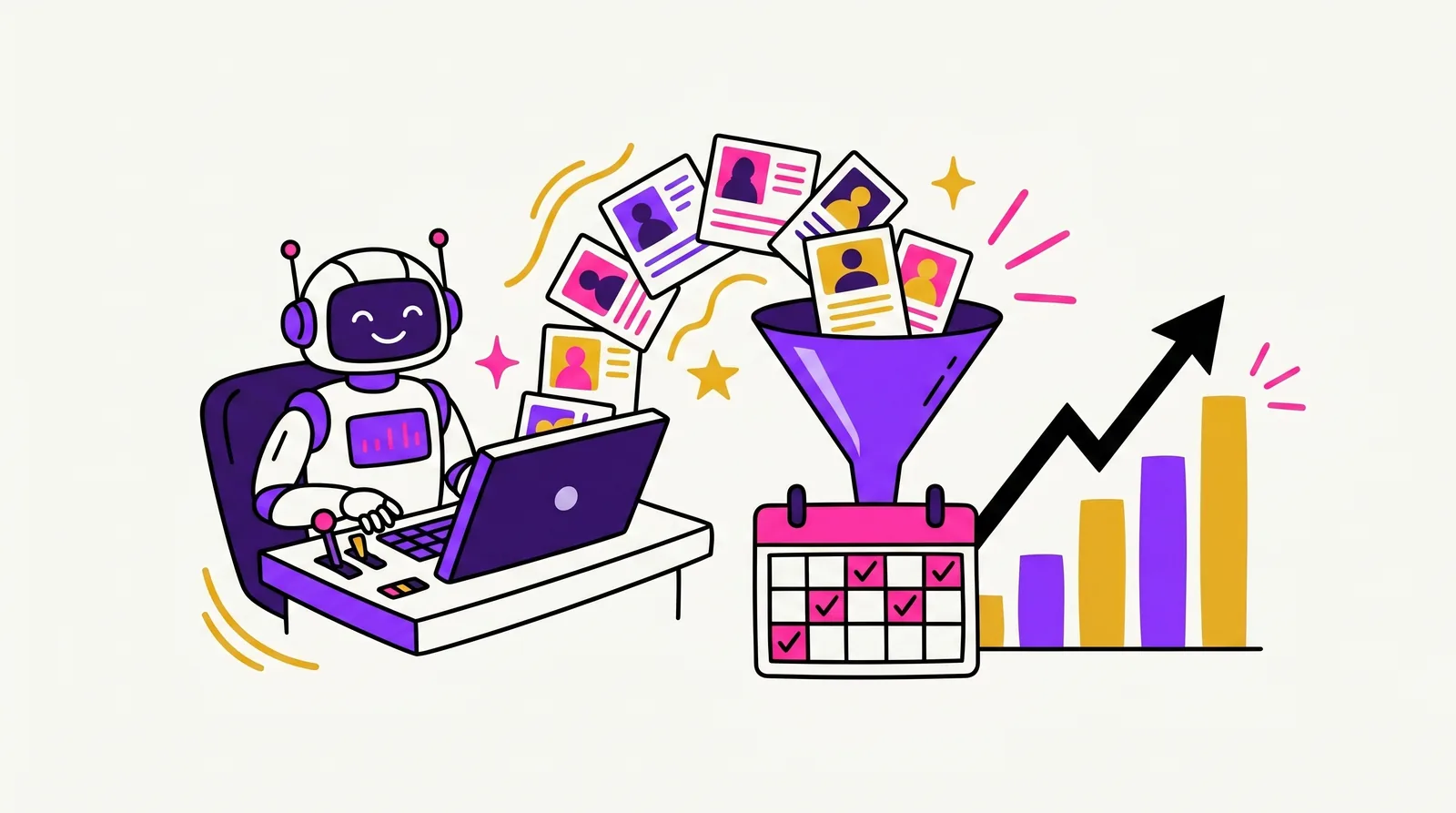
AI lead generation is the use of artificial intelligence to find, qualify, and engage B2B prospects with far less manual work. Instead of buying a static list and blasting it, AI surfaces in-market accounts, enriches and scores them against your ideal customer profile, personalizes the outreach, and routes the warm replies, so your team spends its time on conversations instead of busywork.
Here is the catch most guides skip: AI makes good outreach faster and bad outreach catastrophic. The same technology that lets you personalize 10,000 emails also lets you send 10,000 emails nobody asked for, and inbox providers have spent the last two years learning to punish exactly that.
This guide explains what AI lead generation actually is in 2026, how the pipeline works end to end, the main categories of tools and what they really cost, what the data says about results, and, most importantly, how to use AI to book more meetings without torching your domain. We run Ken AI, a done-for-you cold email service, so we will use our own numbers as a concrete example and be honest about where AI helps and where it quietly hurts.
What is AI lead generation?
AI lead generation is any lead-generation process where machine learning and generative AI do the heavy lifting: identifying prospects, gathering and verifying their data, scoring how well they fit your ideal customer profile, writing personalized outreach, and even handling the first round of replies. The goal is the same as it always was, turn strangers into booked meetings, but the path is faster, more data-driven, and far less manual.
The shift that defines 2026 is the move from spray-and-pray to signal-based selling. Older outbound bought a list and emailed everyone on it. Modern AI lead generation watches for buying signals, a funding round, a hiring surge, a job change, a spike in website activity, and reaches out when a prospect is actually in-market. Done well, that means fewer, better-targeted emails. Done badly, it just means more emails, faster.
| Traditional lead generation | AI lead generation |
|---|---|
| Static lists bought in bulk | Live prospect data refreshed from many sources |
| One message sent to everyone | Personalized per prospect, at scale |
| Manual research, hours per rep | Enrichment and scoring in seconds |
| Guessing who is in-market | Targeting real buying signals and intent |
| Reps chase every reply by hand | AI triages replies, humans close |
| Volume is the main lever | Relevance and timing are the levers |
How AI lead generation works, step by step
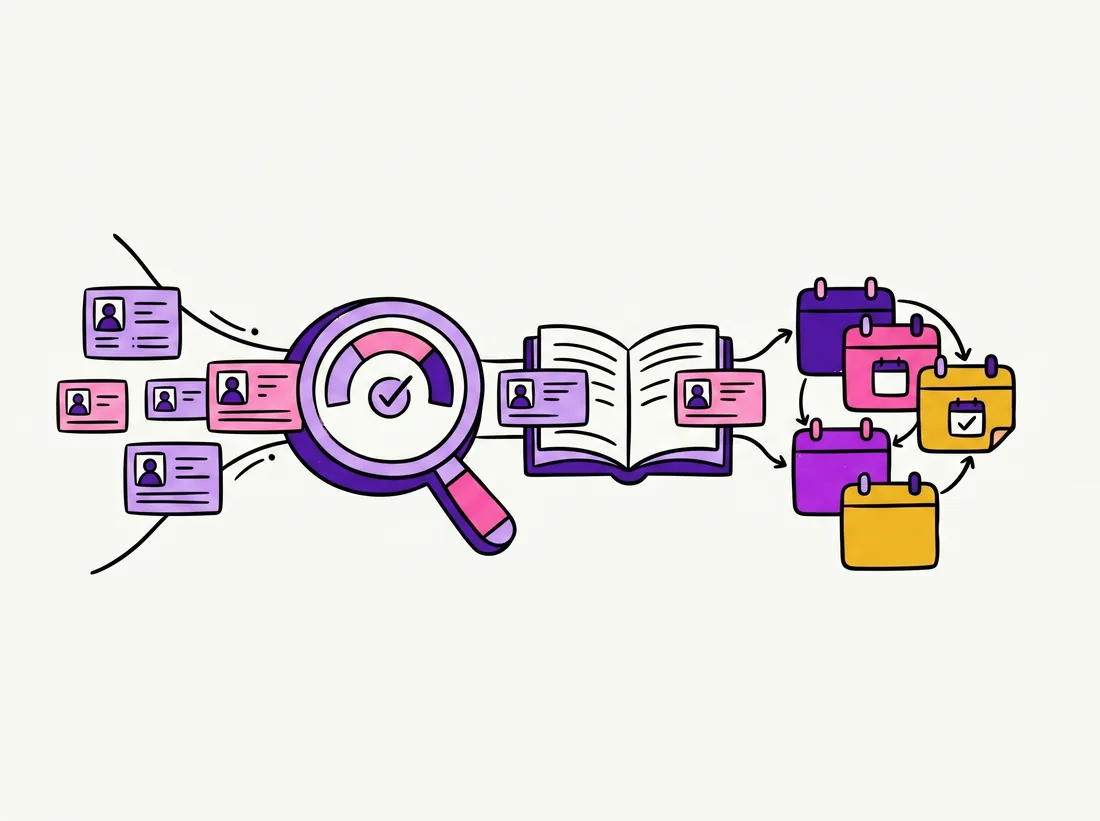
Under the hood, almost every AI lead generation system follows the same six stages. Each one is a place where AI either saves you hours or, left unsupervised, creates expensive problems.
- Identify. AI scans databases and real-time signals to surface companies and contacts that match your ideal customer profile, by firmographics, technology used, hiring activity, funding, or intent data.
- Enrich. For each prospect, the system pulls and verifies contact details and context, role, company news, LinkedIn activity, tech stack, so you are working from current data, not a list from 2019.
- Score and qualify. AI ranks each lead against your ICP, often on subjective criteria a basic filter cannot capture, so your team works the best-fit accounts first.
- Personalize. Generative AI drafts outreach tailored to each prospect, referencing real, relevant details rather than swapping in a first name.
- Send and sequence. The system delivers across email and LinkedIn, manages follow-ups, and rotates inboxes to protect deliverability.
- Handle replies. AI tags responses by sentiment, deals with out-of-office and wrong-person replies, and surfaces the genuinely interested ones for a human to close.
The AI lead generation tech stack: tools by category
There is no single AI lead generation tool. The market is a stack of specialized products, and most teams end up stitching several together. Here are the main categories and representative tools in each.
- Data and enrichment engines find and enrich prospect data. Clay (waterfall enrichment across 150-plus providers plus its Claygent AI), Apollo (an all-in-one database and sender), and ZoomInfo and Cognism (enterprise-grade, compliant data). These give you raw material, but you still need to send.
- Autonomous AI SDRs try to run outbound end to end. 11x (Alice), AiSDR, Artisan (Ava), Persana (Nia), and InstaSDR promise hands-off prospecting and sending. Powerful, but also where most unsupervised AI spam comes from.
- Intent and signal tools surface who is in-market right now. Warmly and Common Room track website visitors, buying signals, and account activity so you can reach out at the right moment.
- Inbound qualification tools use AI chat and routing on demand you already have. Qualified (Piper), Dashly, and Chili Piper qualify and book site visitors automatically.
- Personalization and sending tools generate per-prospect copy and deliver it. Lemlist and Sam.ai blend enrichment with multichannel sending, while deliverability platforms like Smartlead and Instantly handle the sending layer.
- Done-for-you managed services put a team on the entire stack, with humans owning quality. This is the path most teams actually want once they realize they do not want to become a deliverability expert. It is what we do at Ken AI.
What AI lead generation really costs
Tools look cheap on the pricing page and get expensive in practice. Most bill by usage, so the sticker price is rarely what you pay.
Clay is the clearest example. It charges credits per enrichment action, so cost scales with how much you do to each record. A light touch, enrich plus find-and-verify an email, runs roughly 5 to 10 credits per lead. A full pipeline that matches what a managed service does automatically, data scraping, LinkedIn and website enrichment, AI qualification, email finding, verification, and AI personalization, runs around 40 credits per lead. On a realistic 75,000-prospect project that yields about 10,000 contactable leads, that is on the order of $0.50 or more per usable contact for the data work alone, before you have sent a single email or paid anyone to operate the tool.
Then add the rest of the stack: a sender, a warmup tool, deliverability monitoring, and the operator whose job is to run all of it. For comparison, Ken AI is Core $597/mo or VIP $4,597/mo (5,000 leads, 1,000 emails/day, 5 LinkedIn seats included; extra volume add-on priced), and that price includes the data work, the sending infrastructure, deliverability, copywriting, reply handling, and the people. The point is not that tools are bad; it is that the real cost of doing it yourself is the whole stack plus a salary, not the line item on one tool's pricing page.
Does AI lead generation actually work?
Yes, with a large asterisk. Adoption is nearly universal: industry surveys in 2026 put the share of B2B marketing and sales teams using AI somewhere between two-thirds and almost all of them, and roughly 61% now use AI specifically for lead scoring. Teams that adopt it report real gains.
- Higher conversion rates, commonly reported in the 20 to 40% range versus manual processes.
- Lower cost per lead, with frequently cited reductions of roughly a third to a half.
- More accurate lead scoring, often around 40% more accurate than static, rule-based scoring.
- Faster pipeline, as reps stop spending hours per day on manual research and list-building.
The proof: same AI, opposite results
Treat the eye-watering numbers, the vendors advertising 451% more leads or 90% cost cuts, with healthy skepticism. They usually come from the company selling the tool. The honest version is simpler: AI reliably makes the research-and-qualify half of lead generation faster and cheaper, and it makes personalization possible at scale. Whether that turns into booked meetings depends entirely on the quality of the data and the human judgment around it.
Here is a first-party example we can stand behind. We ran the same copy to the same audiences across more than 500,000 emails, in three versions. No personalization scored a 12% engagement baseline. Standard AI personalization, the kind most tools ship by default, scored 25% worse than sending nothing personalized at all. Our approach, where human copywriters build the frameworks and AI fills in genuinely relevant detail, scored 127% higher than baseline. Same underlying AI. Wildly different results. The only variable was how it was used.
Run across our full client base, that approach produces a 3% reply rate against a roughly 0.8% industry average, 16% click rates, and about 7 meetings per 10,000 contacts versus an industry norm of one. AI does the scale. Humans keep it honest.
Why most AI lead generation fails
The uncomfortable truth about AI lead generation is that it is very good at producing more of whatever you feed it, including mistakes. The most common ways it goes wrong:
- Personalization that is obviously automated. The I-noticed-your-company-does-X openers and hollow compliments now read as AI to prospects. As our own test showed, bad AI personalization performs worse than none at all.
- Deliverability damage. Blast enough mediocre email from your primary domain and you train Google and Microsoft to file you under spam. In 2024 both rolled out stricter bulk-sender rules, required authentication, low spam-complaint thresholds, one-click unsubscribe, and AI that ignores them gets you blocked, not booked.
- Volume over relevance. The easiest thing to scale with AI is send volume, and send volume is the one thing that does not correlate with meetings. More emails to the wrong people is just faster failure.
- Garbage data in, garbage leads out. AI scoring and personalization are only as good as the underlying data. Stale or unverified records mean confident, well-written emails sent to the wrong person at a dead address.
- Hallucinated details. Generative models will happily invent a recent post or a company fact that is not true, and one fabricated detail in a cold email destroys credibility instantly.
- No human in the loop. Fully autonomous AI SDRs can send thousands of emails before anyone notices the angle is wrong. By then the damage to your domain and your brand is already done.
The model that works: AI personalization, human-managed
If unsupervised AI is the problem, the answer is not to abandon AI. It is to put humans where judgment matters and let AI do what it is genuinely great at. The winning model in 2026 is AI personalization at scale, managed by people who own the quality.
There are really three broken models AI lead generation tends to fall into, and one that works. The traditional lead-gen agency grabs a list, writes a generic email, and sends it with an off-the-shelf tool; it is cheap, and it shows. The pure AI SDR tool hands the whole motion to software and hopes, which mostly scales your mistakes. The DIY stack quietly turns you into a part-time data engineer and deliverability expert. The model that actually compounds is a managed system: human copywriters build the frameworks and voice, AI personalizes every message against real prospect data, and a dedicated team owns deliverability on infrastructure built for it.
That is the Ken Way, and the numbers earlier in this guide come from running it. You can see how the personalization, qualification, and deliverability pieces fit together on our features page, and what a fully managed program costs on our pricing page. One SaaS client using this model grew from about 260 to 370 active paying members; the difference was never the AI itself, it was the system around it.
How to choose your AI lead generation approach
AI is a means, not a strategy. The right setup depends on your team, your budget, and how much of the machinery you actually want to operate. A rough guide:
| If this sounds like you | The approach that usually fits |
|---|---|
| You have a technical operator and time to learn a stack | Buy and run the tools (Clay, Apollo, a sender) yourself |
| You want software to run outbound with minimal headcount | An AI SDR tool, but supervise it closely and watch deliverability |
| You have steady inbound traffic to convert | Inbound AI qualification (Qualified, Chili Piper) |
| You want booked meetings without operating anything | A done-for-you managed service |
| You tried tools and your domain reputation suffered | A managed service with its own sending infrastructure |
Two questions that settle it
Most of the decision comes down to two questions: do you have someone whose actual job is to run this every day, and can you afford for your primary domain to take a hit while you learn? If the answer to either is no, a managed service is usually the cheaper path once you count the operator's time and the cost of a burned domain.
If you want the full breakdown of the managed route, our complete guide to cold email agencies walks through what to expect, what it costs, and how to choose one without getting burned.
Frequently asked questions
What is AI lead generation in simple terms? It is using AI to do the slow parts of lead generation, finding prospects, enriching and scoring them, and writing personalized outreach, so your team can focus on conversations and closing instead of manual research and list-building.
Is AI lead generation worth it? For most B2B teams, yes, but the value comes from better targeting and faster qualification, not from sending more email. Teams that use AI mainly to send higher volumes of generic outreach usually see worse results, not better.
What are the best AI lead generation tools? It depends on the job: Clay and Apollo for data and enrichment, 11x and AiSDR for autonomous outreach, Warmly and Common Room for buying signals, Qualified for inbound. Most teams combine several, or hand the whole stack to a managed service.
Will AI replace SDRs? Not entirely. AI is taking over the manual, repetitive parts of the SDR role, research, list-building, first-draft copy, but human judgment still wins the deliverability, strategy, and relationship parts. The best results in 2026 come from AI plus people, not AI alone.
Does AI cold email land in spam? It can, easily, if you ignore the fundamentals. Sending AI-generated email in volume from your main domain, without proper authentication and warmup, is the fastest way to get filtered. Protecting deliverability matters more than the AI itself.
How is AI lead generation different from buying a lead list? A purchased list is a static snapshot that starts decaying the moment you buy it. AI lead generation works from live data and buying signals, qualifies each prospect against your ICP, and personalizes the outreach, so you reach the right people at the right time instead of emailing a spreadsheet.
See AI lead generation done right
AI is the best thing to happen to outbound in a decade, and the fastest way to ruin your domain if you point it at the wrong problem. The teams winning with it in 2026 use AI for scale and speed, and keep humans in charge of relevance, deliverability, and judgment.
That is exactly how we run Ken AI: AI-personalized, human-managed, on infrastructure we built ourselves. If you want booked meetings without becoming a part-time data engineer, book a 30-minute founder call with Cristian. You will see the backend, the data, and the campaigns closest to your ICP, and if it is not the right fit, we will tell you what is.