
Cold Emailing Recently Funded Companies: What Works After a Raise
Funded companies reply like any company their size, and the raise is weeks old when it's announced. Email the plan the money pays for, not the news.
Cristian Frunze · Nov 02, 2026 · 11 min read
- cold email recently funded companies
- funding round outreach
- sales trigger events
- SEC Form D
- signal-based outbound
- startup sales prospecting

In 2015, CB Insights announced a funding round from the National Science Foundation. In the two weeks after, CEO Anand Sanwal got 147 cold sales emails. He replied to 9. The most common subject line was some version of "Congrats."
Yes, cold emailing a company that just raised can work, but the raise isn't what gets the reply. In our campaign data, people at funded companies reply just as often as people at same-size companies with no funding (1.01x). What works is writing about the plan the money pays for, to the person running that plan, at a moment when your email isn't number 147.
I started this piece planning to write a timing guide. The data kept pointing somewhere else. Here's what we found:
- The money doesn't make people friendlier. Funded companies look like they reply half as often (0.46x). That gap is company size. Compare same-size companies and it's 1.01x.
- The news is old when you read it. Across 17 announced rounds we traced to SEC filings, the median announcement came 19 days after the first investor committed. One came 315 days after.
- Nobody agrees on timing. 14 published guides recommend windows from "within 48 hours" to "45-90 days." Even the most popular days sit inside only half of them.
- Press and filings mostly cover different companies. 71% of the US rounds TechCrunch covered had no matching company filing we could find. 77% of young tech companies that filed one still hadn't announced the raise by October.
If you remember one line, make it this one. A funding announcement is a press event, not a buying event. The money was committed weeks earlier, and it's meant to last about two years.
Do companies that just raised money reply more to cold email?
Companies that just raised money don't reply more in our data, at least not because of the money. We looked at contacts Kenso emailed across 17 workspaces between February and August 2026. About a quarter of them worked at a company with a funding round on record.
On the raw numbers, funded companies looked bad. Their people sent human replies at 0.46x the rate of everyone else (auto-replies don't count). That's the kind of number that ends with someone saying "stop targeting funded startups" in a team meeting.
But funded companies are bigger. 30% of the funded contacts worked at companies with 1,000+ employees, against 6% of everyone else. And bigger companies reply less, funded or not. People at companies with more than 200 employees sent human replies about a fifth as often as people at companies with 1-10.
So we compared each person with others in the same campaign at the same company size. The gap disappeared. Funded companies came out at 1.01x. The 95% confidence interval runs from 0.82x to 1.23x, so the true effect could be a little lower or higher, but "no difference" sits right in the middle. People first emailed from June onward, when our reply tracking is most complete, came out at 1.00x.
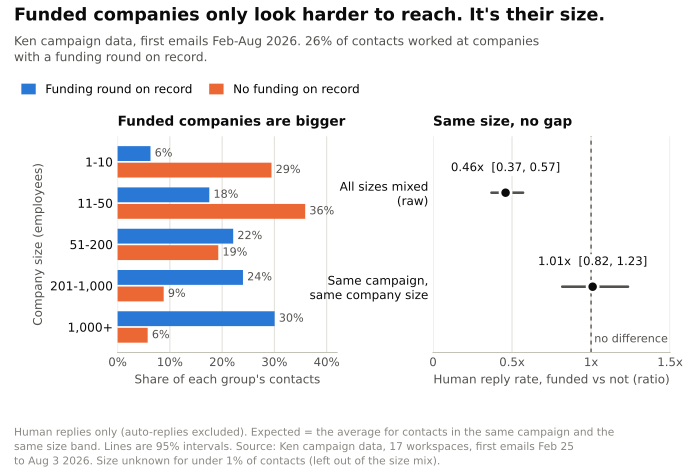
Source: Kenso campaign data, first emails Feb 25 to Aug 3 2026, 17 workspaces. Lines show 95% confidence intervals.
One honest limit. Our campaign database knows whether a company has raised, not when. So this compares "has raised" with "hasn't," not "raised last month" with "raised four years ago." It still shows that funding on its own is not a reply signal. If a fresh round helps, it's because of what the money is about to buy, and that's what your email should be about.
How old is a funding announcement by the time you see it?
A funding announcement is usually weeks old by the time you read it. US startups that raise money under the most common SEC exemptions have to file a short notice called a Form D. The SEC says to file it within 15 days after the first sale, and defines the first sale as the day the first investor is "irrevocably contractually committed to invest" (checked October 2026). In plain words, it's the day the first investor can't back out, which makes it the best public record of when a round really started.
So we ran a small experiment. We took every funding story TechCrunch published in August and September 2026, kept the 52 rounds raised by single US companies, and searched EDGAR, the SEC's free filing database, for each company's own Form D. We also drew a random sample of 39 young US tech companies that filed a Form D in July or August 2026 and searched the web for their announcements. That gave us 17 announced rounds where the filing clearly matched the round.
The median announcement came 19 days after the first investor committed. 12 of the 17 came within a month. Five took more than 60 days. The longest was a photo app's $21M Series A, which made TechCrunch 315 days after its first investor committed. TechCrunch found it the way anyone could have, in an SEC filing posted nine days earlier. In 9 of the 17 rounds, the Form D was public on or before announcement day.
The SEC's own Form D data for Q3 2026 shows the bigger picture. We kept the 916 new filings from US corporations that sold at least $1M, leaving out funds, real estate and banks. Of the 913 that list a first-sale date, 53% were filed within the 15 days. 18.5% came more than 90 days after the first sale, and 7.6% more than a year after.
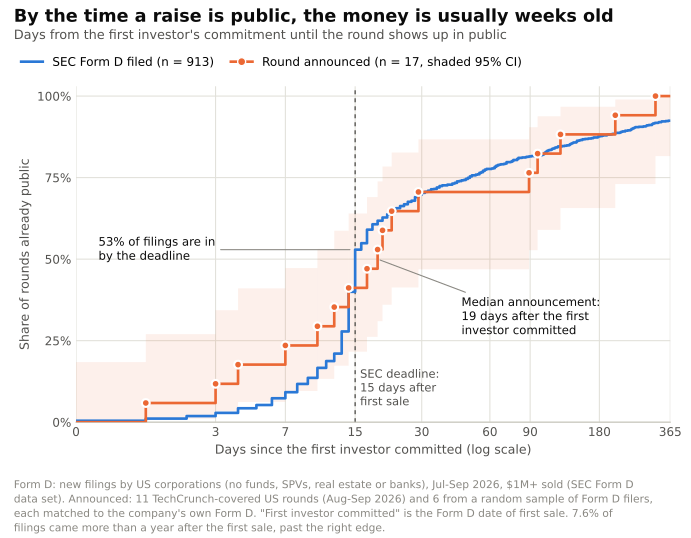
Source: SEC Form D data set, Q3 2026, n = 913 filings; 17 announced rounds (11 from TechCrunch, Aug-Sep 2026, 6 from a random Form D sample) matched to the company's own Form D. The shaded band is a 95% confidence interval.
This is why "email within 48 hours" is weaker advice than it sounds. You aren't 48 hours from the money. You're 48 hours from the moment every sales team with a funding feed found out, which is how one CEO ends up with 147 emails in two weeks. Sanwal said it himself: salespeople "should know how to find companies like us before these announcements."
When should you email a company after it raises?
Email a funded company when the plan the money pays for starts moving, which usually means when the hiring starts. The published advice can't agree on a day. I collected 14 guides that give a specific window, from data providers, sales tools, agencies and our own blog. Five say the first two or three days. Three say to start a month or more later. The other six fall in between. Even the most popular days, the first two, sit inside only 7 of the 14 windows.
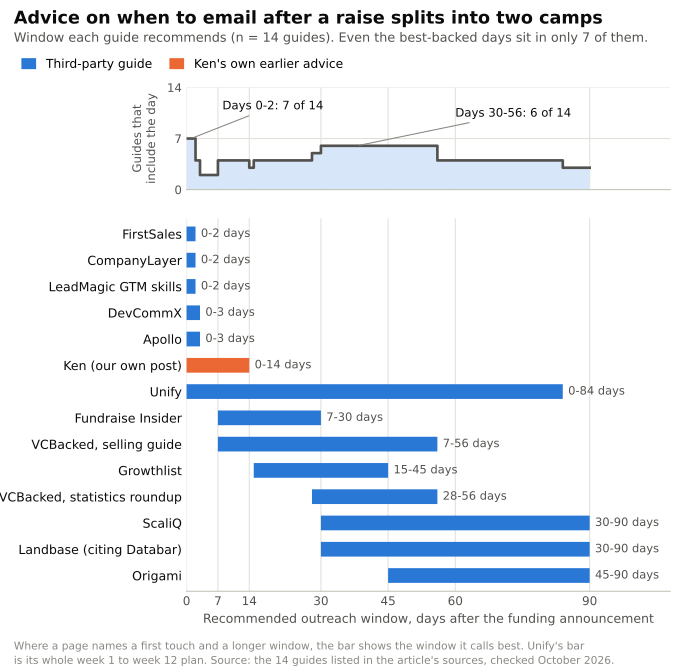
Source: 14 published guides that give a specific window, checked October 2026. Bars show each guide's window in days after the announcement. The top panel counts how many guides include each day.
Our own guide to signal-based outbound is in that chart. It says to write within 1-2 weeks for public events, "and only if you have an angle that is not the press release." I'd keep the second half. But every window in that chart, ours included, counts from the press release, and the money runs on a different clock.
Here's the math. The median Form D in our Q3 2026 set raised $5.5M. The standard advice, as Carta puts it, is that venture-backed companies "should expect to raise a new round of funding every 18-24 months." Carta's data on 9,843 US rounds puts the median gap between seed and Series A at 1.9 years in Q4 2025, about 23 months. So a typical raise has to last about two years. $5.5M over 18-24 months is roughly $230K to $310K a month. It doesn't get spent in week one. It turns into hires, and then the hires turn into purchases.
Research backs the "hires first" part. A 2002 Stanford GSB study of payroll data from 606 companies, covering 1994 to 2000, found that early-round money typically goes to hiring and to bringing salaries up to market. In later rounds, "growth happens both before and after the funding event." It's old data, so read it as a direction, not a forecast.
My rule of thumb:
- If the founder buys what you sell, which is usually true at the earliest stages, the first few weeks are fine. Just don't be email number 147.
- If a team buys it, wait for the team. Watch the job posts and the new leader's start date. A new VP of Sales is usually where a sales-tool purchase really starts. Our post on job-change outreach covers that 90-day window.
- If you sell to engineering or finance teams, follow their hiring, not TechCrunch.
Where do you find funded companies nobody else is emailing?
You find them in filings and hiring, not headlines. Press coverage and SEC filings overlap much less than you'd expect.
| Where we started | Rounds checked | Also found in the other source | Not found |
|---|---|---|---|
| US rounds covered by TechCrunch, Aug-Sep 2026 | 52 | 11 had a clear matching company Form D (4 more were unclear) | 37 (71%) |
| Random young US tech companies with a $2-50M Form D, Jul-Aug 2026 | 39 | 9 announced the raise themselves or got press | 30 (77%) |
Two caveats. Some companies file under a legal name we couldn't tie to the brand, and some raise under rules that don't require a Form D, so 71% overstates the real gap. And 6 of the 30 "quiet" raises did get coverage, but only on sites that republish SEC filings. Still, the press list and the filings list are mostly different companies.
The filings list is also far longer. In August and September 2026, TechCrunch covered 52 single-company US rounds, while 610 US corporations filed a new Form D for $1M or more. The slice we sampled, young US tech companies raising $2-50M, adds about 65 filings a month on its own. If three in four stay quiet, that's roughly 50 quiet raises a month.
The quiet group is where your email isn't number 147. Nobody sends "congrats" to a company that hasn't announced anything. EDGAR full-text search is free and lets you filter to Form D, and the date of first sale on each filing tells you how fresh the money is. Use funding as one filter on top of your ideal customer profile and lead list, not instead of them.
What should a cold email to a recently funded company say?
A cold email to a recently funded company should talk about their plan, not their raise. Sanwal found that 76% of the emails he got showed zero knowledge of his business. "Congrats" tells the reader you have a funding feed. So does everyone else's email.
Most announcements say what the money is for: expanding to Europe, growing the sales team, building out the platform. Job posts tell you the rest. Pick the one piece of that plan that touches what you sell, and write to the person who owns it. A simple shape:
- Their plan, in their words. "Your careers page lists four new sales rep roles this quarter."
- The problem that plan creates. "New reps usually spend their first month without anyone to call."
- What you do about it, in one sentence, with proof if you have it.
- A small ask.
Notice what's missing: the round size, the investors, and the word "congrats." The raise is why you picked them. It doesn't need to be in the email.
Who gets the email matters just as much. In our data, 54% of contacts at funded companies worked at companies with more than 200 employees. At that size the CEO isn't buying your tool. The VP who inherited the hiring plan is.
Frequently asked questions
Is it creepy to mention a company's SEC filing in a cold email?
It can feel that way, even though Form D filings are public. I'd use the filing to choose who to email and when, then write about their plans and hiring. Don't make the filing the hook.
How long does the window after a funding round stay open?
Much longer than the first week. Rounds are meant to last 18-24 months, and spending follows hires that land over months. The first week is the most crowded part of that window, not the only good part.
Should I email the founder or someone else after a raise?
At the earliest stages, usually the founder, because they still make most buying calls. At bigger companies, email the leader who owns the budget the new money is going into.
Does a funding round mean the company has budget for my product?
It means they have money, not a budget line for you. The raise pays for a plan. If your product isn't part of that plan, the round doesn't help, and in our data funding alone didn't lift replies.
The short version
Treat a raise as a reason to look closer, not a reason to send. Find companies through filings and hiring. Then write about the plan and send it to the person running it. Kenso runs cold email and LinkedIn outreach for B2B companies, done for you, on infrastructure we own, and your first campaign is free.