
Should Cold Emails Come from the Founder or an SDR?
Send as the founder, run by a team. A Founder title barely moved replies in our data or in randomized tests. What only a founder can say does.
Cristian Frunze · Nov 08, 2026 · 12 min read
- founder vs sdr cold email
- founder-led sales
- cold email sender name
- sdr outbound
- cold email reply rate
- outbound for founders
Most founders who try outbound hit the same fork early. Do the emails go out under your name, or do you hire someone to send them under theirs?
Send them as the founder, but stop writing and sending every one yourself. The title under your name barely moves reply rates. What moves them is an email only a founder could have written, and a founder who answers when someone writes back.
We read the signature on the first emails 16 companies sent through Kenso between February and August 2026. Emails signed "Founder" or "CEO" got 0.98 times the human replies of emails signed with just a name. A tie. Then I cut the same data four other ways and got anything from 0.65x to 5.6x. That spread is the most useful thing in this article. It shows how easily a confident "founders get 2-3x" gets made.
The word "Founder" doesn't get replies. Sentences only a founder can write do.
Do founder emails really get more replies than SDR emails?
Nobody has published a clean test. The claims online are confident and unsourced. A founder cold email playbook on skills.sh says "an email from the CEO gets 2-3x the reply rate of the same email from an SDR" and cites nothing. A vendor benchmark page says founder and expert emails "outperform BDR emails by 30-50%" with no table, sample size or method behind it.
The big datasets don't answer it either. They split replies by who receives the email, never by who sends it.
| Source (checked October 2026) | Size | Splits by sender title? | What it does show |
|---|---|---|---|
| Belkins | 7.5M emails, 2025 | No | Founders and owners were the most responsive recipients, 0.57% replies per email. VPs were the least, 0.32% |
| Sales.co | 2M+ emails, 2024 to 2026 | No | 2.09% of contacts replied, and 45.1% of those replies were auto-replies |
| Hunter | 31M emails, 2025 | No | Manually edited emails got 5.2% replies, fully automated ones 4.4% |
| Gong Labs | 1M+ executive sales cycles | No | C-level buyers were 30.2% less likely to reply than non-executives |
No large public dataset has measured founder-sent email against SDR-sent email. So we tried it with ours.
What did Kenso's own sending data show?
Kenso's database has no "sender role" field, so we read the title in the signature of each first email. The sample is first emails sent February 25 to August 3, 2026, by 16 companies using Kenso. We counted human replies only, not auto-replies or out-of-office messages.
Two things showed up right away. First, founders like to sign as founders. Eight of the 16 companies put a title like "Founder" or "CEO" under the name on at least 250 first emails. Only two did that with a sales title. Second, 81% of our sales-title emails came from one company, and the whole group had 28 human replies. That's under our floor of 30, so we won't give you a founder-vs-SDR number. Nobody should give you one from data shaped like ours.
What we could test is whether the word "Founder" beats signing your bare name. Here's that question asked five fair ways.
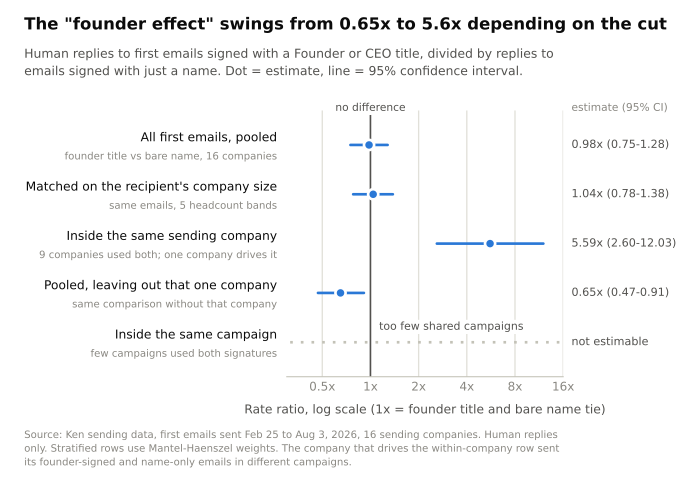
Source: Kenso sending data, first emails sent Feb 25 to Aug 3, 2026, 16 sending companies, founder-signed vs name-only first emails. Human replies only. Lines show 95% confidence intervals.
- Everything pooled. A founder title tied with a bare name, 0.98x.
- Matched on the recipient's company size. Still a tie, 1.04x.
- Inside each sending company. The number jumps to 5.6x. One company drives it. That company sent its founder-signed and name-only emails in different campaigns, and the name-only campaign got very few human replies.
- Leaving that company out. The pooled number flips to 0.65x, about a third fewer replies for the founder title.
- Inside the same campaign. Too little overlap to estimate. Companies pick one signature per campaign and keep it.
Five honest cuts, four different stories. The thing hiding behind all of them is the campaign.
How much does the campaign matter compared with the signature?
Far more. We took the 26 campaigns with at least 1,000 first emails each, at the five companies that ran two or more of them. We compared each campaign with a typical campaign at the same company, after taking out the random noise that small reply counts create. The middle half of those campaigns spread across a 2.5x range. A campaign in the top tenth got about 5.6 times the human replies of one in the bottom tenth. That held at size cutoffs anywhere from 500 to 3,000 emails.
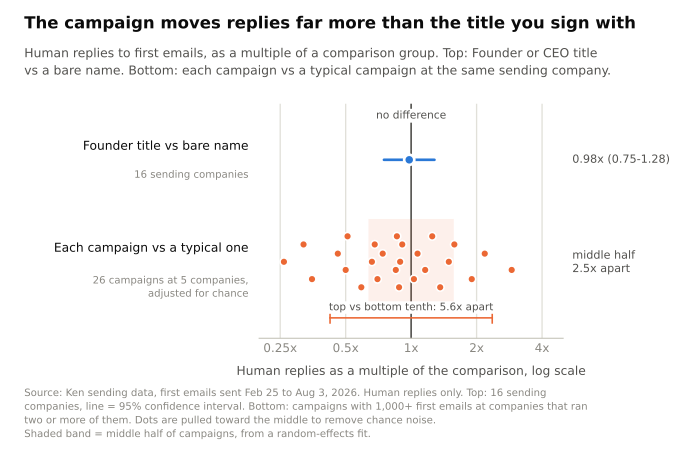
Source: Kenso sending data, first emails sent Feb 25 to Aug 3, 2026, human replies only. Top row: founder-signed vs name-only first emails at 16 sending companies, 95% confidence interval. Bottom row: 26 campaigns with 1,000+ first emails at 5 sending companies, adjusted for chance with a random-effects model.
That 5.6x should look familiar. It's about the size of the "founder effect" from the inside-each-company cut. A gap that big is exactly what separates a strong campaign from a weak one at the same company, whatever the signature says.
The title travels with everything else, including the offer, the list, the copy and the timing. Any founder-vs-SDR multiplier from real-world sending data mostly measures the campaign behind the signature, not the signature. If someone quotes you one, ask what else changed.
What do controlled experiments say about sender seniority?
The cleanest evidence comes from randomized tests. People are split at random, so the only difference between the groups is the thing being tested. Most of these tests are survey invitations, not sales emails, but the decision is the same. A stranger reads an unsolicited email and decides whether to do what it asks.
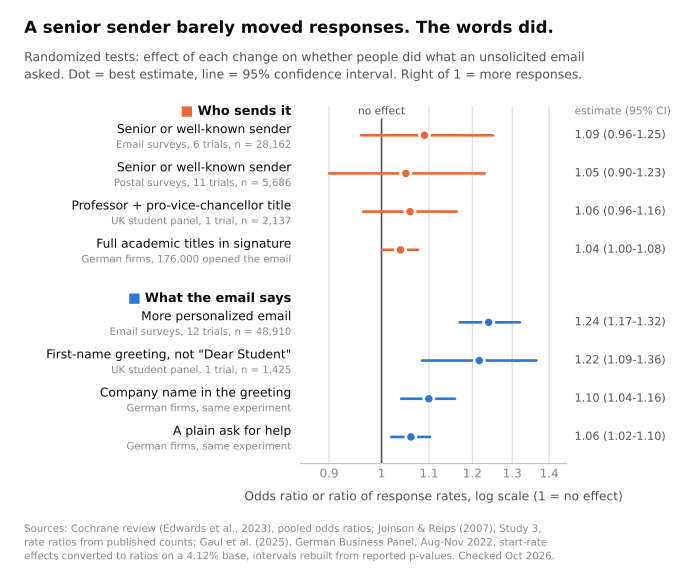
Sources: Cochrane review (Edwards et al., 2023); Joinson and Reips (2007), Study 3; Gaul et al. (2025), German Business Panel, Aug to Nov 2022. Lines show 95% confidence intervals, sample sizes are on each row.
- The big review. A 2023 Cochrane review pooled six email trials with 28,162 people. A more senior or better-known sender scored an odds ratio of 1.09. An odds ratio of 1 means no change, so 1.09 means about 9% better odds of a response. The 95% range ran from 0.96 to 1.25, which includes "no effect." Eleven paper-mail trials found the same. In the same review, a more personalized email scored 1.24, with a range of 1.17 to 1.32, across 12 trials and 48,910 people.
- The professor test. In a 2007 study with 2,137 Open University students, a "Professor, Pro-Vice-Chancellor" signature beat a plain name and department 46% to 44%, which wasn't significant. Changing "Dear Student" to "Dear John" moved response from 41% to 50%. The title mattered most on the personal email. "Dear John" from the professor got 53%, and from the plain name 47%. On "Dear Student," the title added two points.
- The business test. In a 2022 experiment, 176,000 German firms opened a survey invitation. Adding the senders' full academic titles to the signature raised starts by about 4%. Putting the company's name in the greeting raised them by about 10%. Titles worked best on the smaller half of firms, those with four employees or fewer. The bigger half responded more to seeing their company's name.
Sender status isn't zero. It's small, and in every one of these tests a change to the words did more. In the professor study, the title paid off mostly on an email that was already personal. That lines up with our data. The title is worth a nudge. The letter is worth more.
So why do founder emails seem to work better?
Founders tend to write different emails, to different people, and then handle the replies differently. None of that comes from the title.
Founders say things nobody else can. "I built this after two years of doing it by hand" is a reason to reply. An SDR can't write that sentence honestly. A founder can also offer a call with the person who sets the roadmap and the price.
Founders are the easiest people to reach. A founder-signed campaign aimed at other founders starts with an edge the title didn't earn. Founders and owners were the most responsive recipients in Belkins' data. In ours, from June to August 2026, founder, owner and C-level recipients had about 1.9 times the odds of a human reply as VPs, directors and managers in the same campaign. Holding company size fixed shrinks the gap to 1.4x, so a lot of the founder edge is really a small-company edge.
The reply lands with someone who can say yes. A founder can answer a pricing question, bend the offer or skip a step in the same thread. I think this is the biggest one, and it doesn't show up in reply-rate tables at all.
You can copy all three without the founder typing every email.
How much founder time does doing it yourself take?
Unify's SDR workflow guide, updated July 2026, estimates 15 to 18 minutes per prospect to research and write by hand. Here's that math at 15 minutes, before follow-ups and replies. The meeting columns are assumptions, so swap in your own booking rate.
| Prospects per week | Founder hours per week | Meetings a month if 1 in 200 books | If 1 in 100 books |
|---|---|---|---|
| 25 | 6 | 0.5 | 1 |
| 50 | 12.5 | 1 | 2 |
| 100 | 25 | 2 | 4 |
Twelve and a half hours a week for one or two meetings a month. Hand-written founder outbound is a great way to learn your market and a bad way to grow.
Jason Lemkin of SaaStr writes that "founder-led sales generally stops scaling around $1m-$2m ARR." If you're reading this, you're probably close to that line. SaaSRise's founder hit it before he came to us. He was sending about 10K cold emails a month himself, finding leads, enriching data, writing campaigns and checking replies, and the work ate time he wanted for partnerships and strategy. The SaaSRise case study covers what happened next.
When does hiring an SDR make more sense?
Hire an SDR when you need someone on the phone and in live follow-up every day, and you already have a message that works. Hiring earlier means paying someone to discover what you haven't.
The Bridge Group's 2025 SDR report surveyed 351 B2B companies. Average ramp was 3.0 months and average tenure 1.9 years. Median on-target pay, base plus commission, was $80K. The median quota was 10 meetings held a month, and only 60% of SDRs hit quota. So an SDR is a two-year bet that starts paying around month four, and then you hire again. For the full cost math, see cold email agency vs in-house SDR.
An SDR signing their own name can work fine. Give them true, specific lines from the founder, and offer the founder on bigger calls.
Is it honest to send cold emails as the founder when a team runs them?
Sending as the founder is honest when the founder is real, involved and reachable. The test is simple. Is anything in the email false?
The law draws a similar line. The FTC's CAN-SPAM compliance guide, checked October 2026, says the From, To and Reply-To fields "must be accurate and identify the person or business who initiated the message." It also warns that if you hire another company to send for you, you "can't contract away your legal responsibility to comply with the law." This is general information, not legal advice.
What recipients react to is whether a real person seems to be behind the email. In two Cornell experiments published in Scientific Reports in 2023, people rated a chat partner more negatively when they suspected the partner was using AI-suggested replies, whether or not the partner actually was. Suspicion alone cost them.
Four rules keep "sent as the founder" honest:
- The founder approves the offer, the claims and the copy frameworks before anything sends.
- No invented personal moments. If the founder didn't see their talk or read their post, the email doesn't say so.
- Interested replies go to the founder, or to a named colleague through an honest handoff like "looping in my colleague who runs onboarding."
- The person who shows up to the meeting is the person the email promised.
What does "sent as the founder, run by a team" look like?
The founder keeps the parts that need a founder. The team runs everything else.
| Job | Founder | Team |
|---|---|---|
| Pick the customer and the offer | Decides | Brings data and lists |
| Copy frameworks | Approves, adds the lines only a founder can say | Drafts and tests |
| Find and verify contacts | Owns | |
| Domains, inboxes, warmup | Owns, never on your main domain | |
| Personalize each email | Owns, with a quality check | |
| Send and follow up | Owns | |
| Sort replies | Handles out-of-office and unsubscribes | |
| Answer interested replies | Owns, same day | Flags them fast |
| Take the meeting | Owns | Books it |
If you don't want to build the team column yourself, that's what Kenso does. We run cold email and LinkedIn outreach for B2B companies, done for you, on infrastructure we own. Human copywriters build the frameworks, AI fills them with real prospect data, an AI check reviews every email, and you approve before the first send. Nothing auto-sends, and your primary domain is never used for sending. More on handling cold email replies and on how we write and QA cold email at scale.
Frequently asked questions
Should the founder's title go in the signature at all?
Yes, if it's true. In our data it tied with a bare name, and in randomized tests a senior title added a few percent at most. It won't hurt a good email, and it won't save a weak one.
Can the founder's name go on several sending inboxes?
Yes, and it's normal. Spread the volume across a few inboxes on separate sending domains, all in the founder's name, and route replies to one place someone checks every day. Never send cold email from your main company domain.
How do I test founder vs SDR sending myself?
Split one list at random inside the same campaign, keep the copy and timing identical, and change only the name and title. To tell a 1% reply rate from 2% with an 80% chance of catching a real difference, you need about 2,300 contacts per side. To tell 0.5% from 1%, you need about 4,700.
Does a Founder title hurt when emailing big companies?
We found no reliable evidence either way, and our founder-title result stayed a tie when we matched on the recipient's company size. Big companies are just harder for every sender. In our June to August 2026 data, people at companies with over 1,000 employees sent about a quarter of the human replies their own campaign predicted.
The bottom line
Put the founder's name on it, keep the founder-only parts for the founder, and hand off the rest. The signature won't carry the email for you, but the founder's knowledge and the founder's replies will. If you want to see that on your own market, your first campaign is free.