
Why Your Cold Email List Is Smaller Than You Think
The funnel math behind list building: most raw leads never survive enrichment, verification, and qualification. So a good list gets built 5 to 10 times big...
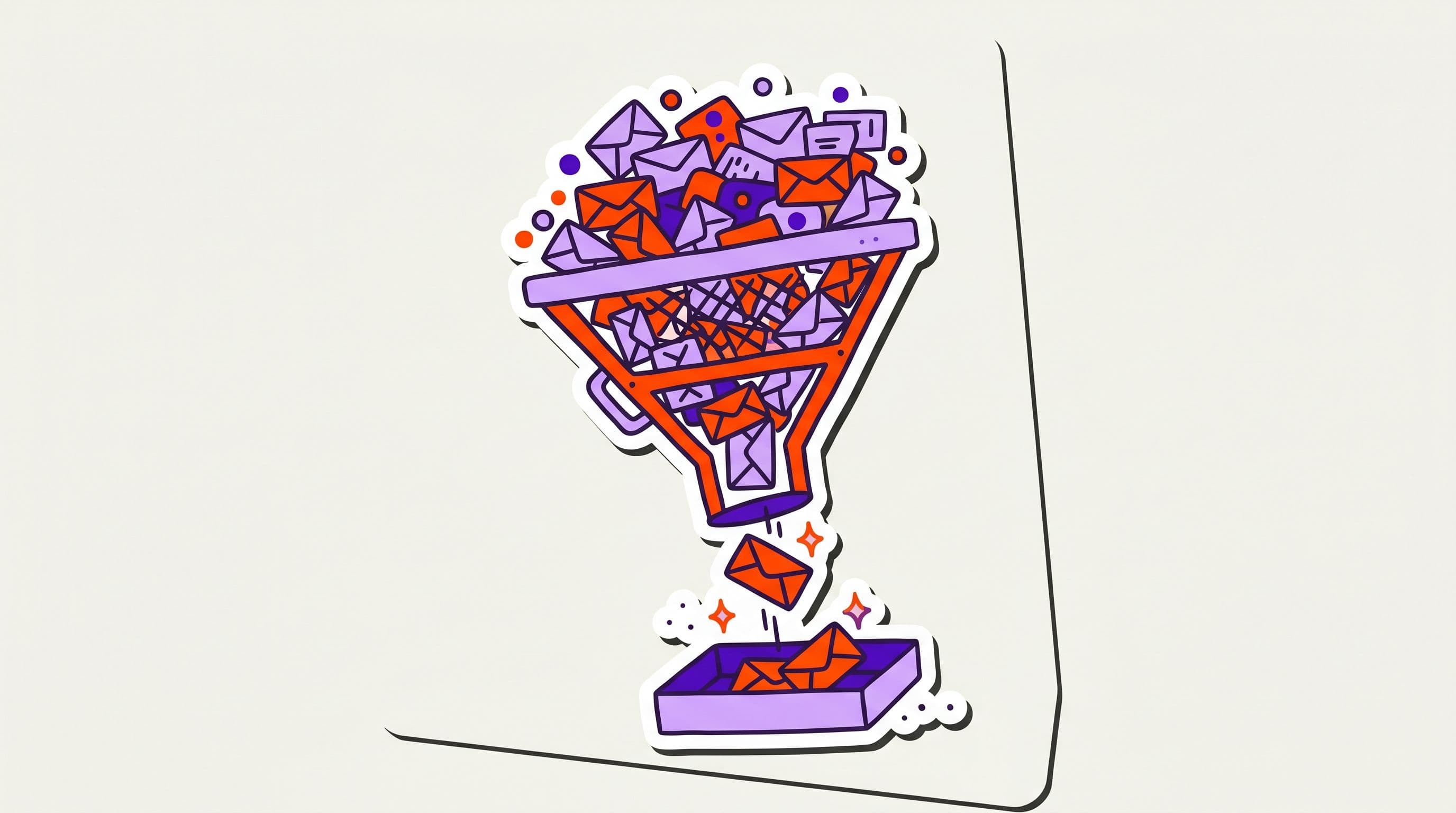
A cold email list shrinks before you ever hit send. Out of the raw matches you pull from a database, only about 30% have a findable email, roughly 70% of those survive verification, and around 60% of those pass real qualification. That is close to one usable contact for every eight you start with. Which is exactly why a good list gets built 5 to 10 times bigger than the campaign that ships from it.
Most people treat list building as a download. You set your filters, hit export, and you have a list. Ten minutes of work. That belief is quietly responsible for a lot of broken outbound, because a database match is not a lead. It is a name and a company. Everything that makes it worth emailing happens after the export, and most of it does not survive.
Why does a cold email list shrink before you send?
Between a row in a database and a real person reading your email, there are three gates. Each one removes a chunk of your list, and the chunks compound.
-
Finding the email. A name and a company is not an address. You have to find a current, deliverable email for that specific person. A large share of profiles simply do not resolve to one.
-
Verifying it. The emails you do find are not all real. Some bounce. Many are catch-all addresses that accept everything and deliver nothing. Sending to them does not just fail quietly. Bounces damage the reputation of every other email you send that day.
-
Qualifying the person. A matching job title is not the same as a good fit. Plenty of people who pass your filters should never get the email. If you skip this gate, you pay for it in reply rates and spam complaints later.
None of these are optional. Skip one and it shows up downstream as bounces, low replies, or a domain that lands in spam. The only real question is whether you do the filtering before you send or let your prospects (and Gmail) do it for you.
How many leads actually survive list building?
Put rough numbers on each gate and the funnel becomes obvious. Around 30% of raw matches have a findable email. Around 70% of those pass verification. Around 60% of those survive genuine qualification.
Multiply it out: 0.30 x 0.70 x 0.60 is about 0.126. Call it one usable, qualified contact for every eight raw matches you start with. The exact percentages move by industry and by how strict your qualification is, but the shape does not change. The list always ends up a fraction of where it began.
If you start with this many raw matches
You can realistically email about
1,000
125
5,000
625
8,000
1,000
10,000
1,250
So if you want to run a 1,000-contact campaign, a 1,000-match list will not get you there. You need to start at roughly 8,000 and let the funnel do its work.
Why "perfect fit" lists still send soft
Here is the trap almost everyone falls into. You build a list to the exact size you want, because that feels efficient. Then half of it evaporates at send time: emails that cannot be found, addresses that bounce, people who were never a real fit. The campaign that actually goes out is a fraction of the list you built, and it is the wrong fraction, because nothing pressure-tested who stayed in.
Then the post-mortem blames the wrong thing. The copy. The subject line. The "deliverability." Sometimes those are real problems. But very often the list was a quarter of its claimed size before the first email left, and no subject line fixes that.
The fix is not a better filter. It is building wider on purpose and letting each gate cut the list down to what is real. You can read more about how we think about this on our why Ken page.
What real qualification looks like (it is not a job title)
The weakest gate in most stacks is qualification, because most tools can only filter on what fits in a dropdown: title, seniority, company size, industry. Useful, but shallow. "VP of Sales at a 200-person company" is not an ideal customer profile. It is a starting point that includes plenty of people you should never email.
Real qualification reads the things a dropdown cannot. Is this actually a B2B SaaS company priced above $3k a month? Does this person own the problem you solve, or just share a title with someone who does? What is the company actually doing right now, based on its site and the person's recent activity? Those are subjective calls, and they are where most of the bad fits get cut. That AI qualification on subjective criteria is the core of our list building and qualification features.
The counterintuitive part: the way to qualify well is to start broad, not narrow. Pre-filtering with keywords feels precise, but it silently drops good prospects who happen to describe themselves differently. It is better to pull a wide net and then qualify hard on the back end, where you can actually read context, than to trust a keyword to be right. Breadth first, judgment second. It is the same playbook we run for sales teams who need pipeline that actually converts.
How we build a list that survives the funnel
This is where owning the pipeline matters. The reason almost nobody over-builds 5 to 10x is cost. If you are paying per lead to scrape a third-party tool, deliberately pulling eight times what you need is financially insane. So people build narrow and accept the attrition.
We built our own database (300M+ contacts from 20+ sources) specifically so over-building is cheap. We target 5 to 10 times the number of contacts a campaign actually needs, then run that raw list through the funnel: enrichment to find real emails, triple verification including catch-alls, and AI qualification that scores each person against the client's profile on criteria no off-the-shelf filter can touch. What lands at the bottom is small. It is also real.
That is not a clever growth hack. It is mostly a refusal to email people who were never a fit. It is also the unglamorous reason the numbers hold up: across all clients our campaigns average a 3% reply rate against an industry norm near 0.8%, and about 7 booked meetings per 10,000 contacts against an industry average of 1. Your results will differ, but the mechanism is not a secret. We just throw out the seven leads that were never going to reply before we send the one that will.
Frequently asked questions
How many leads do I need for a cold email campaign?
More than you think you do. Because of attrition during email-finding, verification, and qualification, only about one in eight raw matches becomes a contact worth emailing. To run a 1,000-contact campaign you generally want to start from a list of roughly 8,000 matches.
Why do so many cold emails bounce?
Usually because the list was never verified properly. Emails go stale, people change jobs, and catch-all domains accept addresses that do not actually exist. Verifying every address (catch-alls included) before sending is the only way to keep bounces low, and low bounces are what protect your sender reputation.
Is a bigger list always better?
No. A bigger raw list is better as a starting point, but only if you then qualify it down hard. The goal is not volume, it is a small list of real, well-fit people. Over-build to survive attrition, then cut aggressively. Sending to a big unqualified list is how you end up in spam.
Can AI qualify leads better than filters?
For subjective criteria, yes. Standard filters can only match structured fields like title and company size. AI can read a website and a profile and make a judgment call, like whether a company actually fits a niche definition or whether a person owns the problem you solve. That is the difference between a list that matches a dropdown and a list that matches your customer.
Should I build this myself or use a service?
You can absolutely build it yourself if you are willing to own the data, the enrichment, the verification, and the sending infrastructure. Most founders and lean teams would rather not. If that is you, the founder use case and our pricing walk through how the done-for-you version works.
The takeaway
A good cold email list is not the one you built. It is what is left after the list you built gets put through the funnel. The teams that win at outbound are not the ones with the biggest lists or the cleverest copy. They are the ones who do the unglamorous work of over-building and then throwing most of it away.
If you want to see what that looks like on your market specifically, you can book a founder call and we will show you the data behind it. Or keep reading on the blog.