
Cold Email Reply Rates by Company Size: What Our Data Shows
Small companies reply more. In our data, every 10x jump in headcount cut human replies by about 40%, while auto-replies held steady.
Cristian Frunze · Oct 29, 2026 · 13 min read
- cold email reply rate by company size
- do small companies reply to cold email
- enterprise cold email
- cold email targeting
- cold email benchmarks
- out-of-office replies
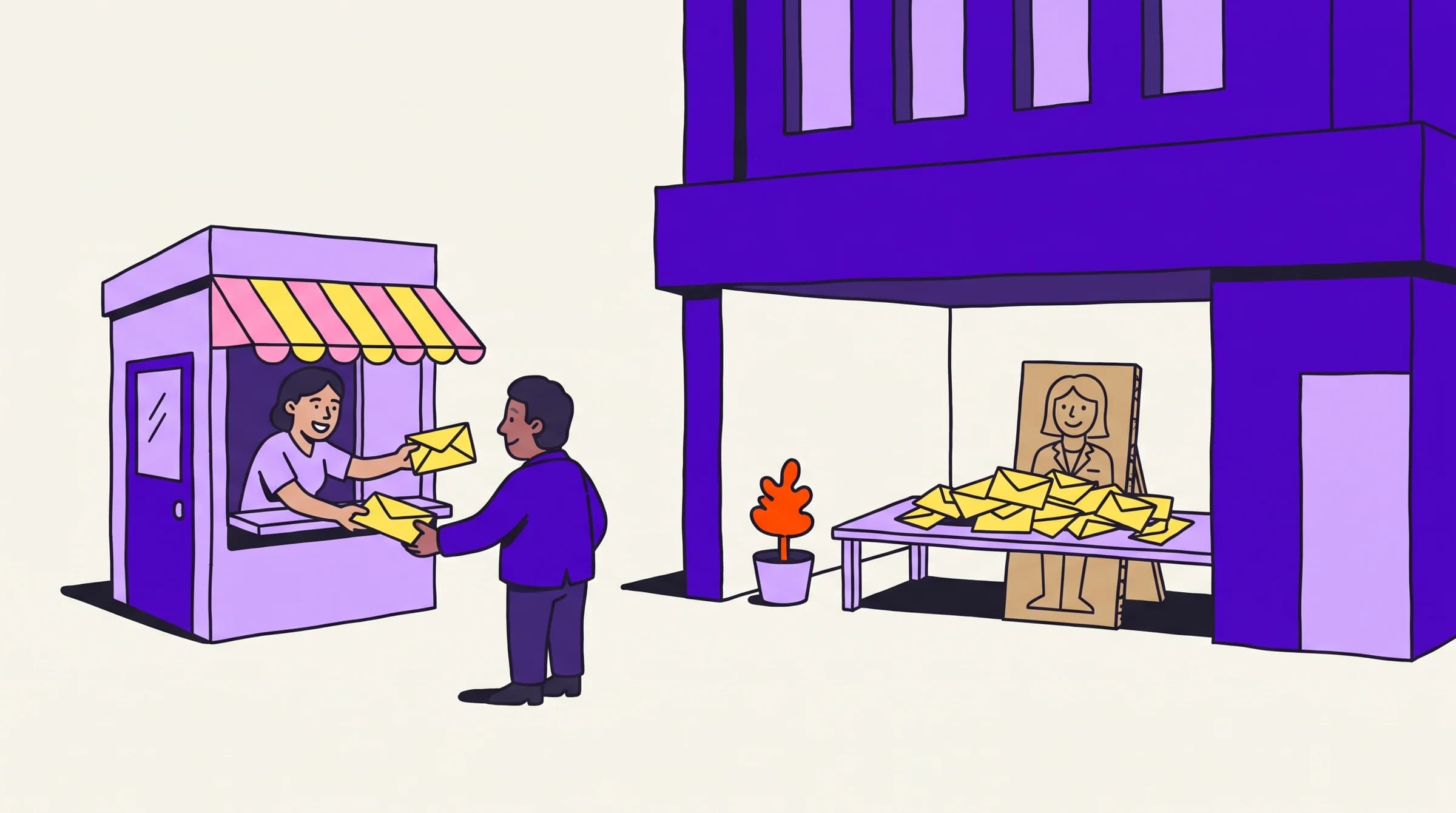
We sorted a summer's worth of cold email contacts by company size and counted who wrote back. The out-of-office robots answered as often at 3,000-person companies as at 30-person ones. The people didn't.
Small companies reply to cold email far more than big ones. In our data, every time a company gets 10 times bigger, the chance that a real person writes back drops by about 40%. Inside the same campaign, a contact at a 1-10 person company sends about 5 times as many human replies as a contact at a 1,000+ person company.
Most published studies agree on the direction. What they miss is the robots. Auto-replies come back from big companies just as often as from small ones, so the email gets there. Then nobody answers it.
How much does company size change cold email reply rates?
Company size moves human replies more than anything else we checked about the person on the other end, including job title, country, industry and mail provider. We looked at people first emailed between June 1 and August 3, 2026, across 16 client workspaces and 51 campaigns, and every contact had at least three weeks to reply.
To keep it fair, we compared each contact only with other contacts in the same campaign. Same offer, same senders, same weeks. A score of 1.0 means "replied exactly as often as the campaign average."
| Employees at the company | Share of contacts | Human reply index, 1-10 = 100 | Same-campaign score | Share of replies that were automated |
|---|---|---|---|---|
| 1-10 | 26% | 100 | 1.34 | 66% |
| 11-50 | 30% | 63 | 0.97 | 81% |
| 51-200 | 19% | 51 | 0.89 | 86% |
| 201-1,000 | 12% | 28 | 0.64 | 89% |
| 1,000+ | 11% | under 20 | 0.26 | 96% |
Source: Ken sending data, contacts first emailed Jun 1-Aug 3, 2026, 16 workspaces. Shares don't add to 100% because a few contacts had no headcount. The 1,000+ row rests on few human replies, so treat it as a rough reading.
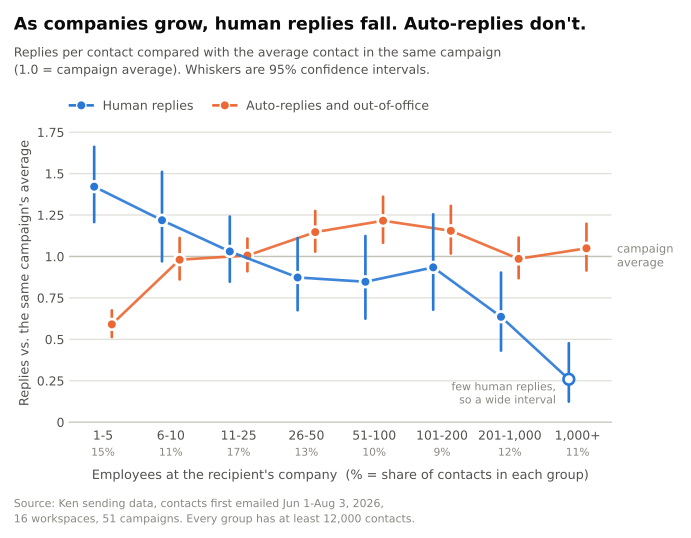
Source: Ken sending data, contacts first emailed Jun 1-Aug 3, 2026, 16 workspaces and 51 campaigns. Every size group has at least 12,000 contacts. Whiskers show 95% confidence intervals.
Here's why I trust the falling human-reply curve, and the one wrinkle in it.
- The slope is steady. A model fit across all 51 campaigns says each 10x jump in headcount multiplies the human reply rate by 0.58. The 95% confidence interval, the range the true number very likely sits in, runs from 0.52 to 0.66. Drop any one workspace and it stays between 0.52 and 0.62.
- It shows up everywhere. Contacts at companies with 50 or fewer people out-replied contacts at bigger companies in all 21 campaigns with at least 500 people on each side. Same in all 9 workspaces with at least 1,000.
- Founders don't explain it. Founders cluster at tiny companies, so maybe we were really measuring job titles. We compared people with the same kind of title inside the same campaign, and the gap barely moved: 1.27 at 1-10 employees, 0.29 at 1,000+.
- Microsoft doesn't explain it. Big companies use Microsoft 365 more. Of the contacts whose mail host we could see, 66% at 1,000+ companies were on Microsoft, against 41% at 1-10. Matching on mail provider too left the gap at 1.25 against 0.31.
- The curve has a shelf. The drop is steepest from 1-5 people to about 25. It flattens between roughly 25 and 200, then falls again. The intervals overlap enough that I wouldn't plan around the exact break points.
Each time a company gets 10 times bigger, the chance of a human reply to a cold email drops by about 40%. That's the number to remember.
Why do studies disagree on how much more small companies reply?
Every study we found agrees on the direction. They disagree on the size of the gap, anywhere from 1.5x to 3.4x. The main reason is what each one counts as a reply.
| Source, checked Oct 2026 | Sample | What counts as a reply | Smallest companies | Largest companies | Gap |
|---|---|---|---|---|---|
| Belkins 2026 study | 7.53M emails sent in 2025 | Human replies per email sent, auto-replies excluded | 0-10: 0.72% | 10,000+: 0.22% | 3.3x |
| Sales.co 2026 benchmark | 2M+ emails, 2024 to early 2026 | All replies per contact, auto-replies included | 1-10: 2.40% | 10,001+: 1.60% | 1.5x |
| Sales.co, positive replies only, our math | Same | Reply rate x share of replies that were positive | 1-10: 0.44% | 10,001+: 0.055% | 8.0x |
| Coldmailopenrate | "5,000,000+" emails, 2025-2026 | Not stated | 1-50: 3.1% | 5,000+: 0.9% | 3.4x |
| Gangly | Not stated | Not stated, medians | 1-50: 5.2% | 5,000+: 2.1% | 2.5x |
| Ken, this article | Contacts first emailed Jun-Aug 2026, 16 workspaces | Human replies per contact, raw | 1-10 | 201+ | 5.3x |
Sales.co's headline says contacts at 1-10 person companies reply "75% more often than those at 5,000+ employee enterprises." The 75% comes from their 5,001-10,000 group, which had the lowest rate in their chart. Against 10,001+ the gap is 1.5x.
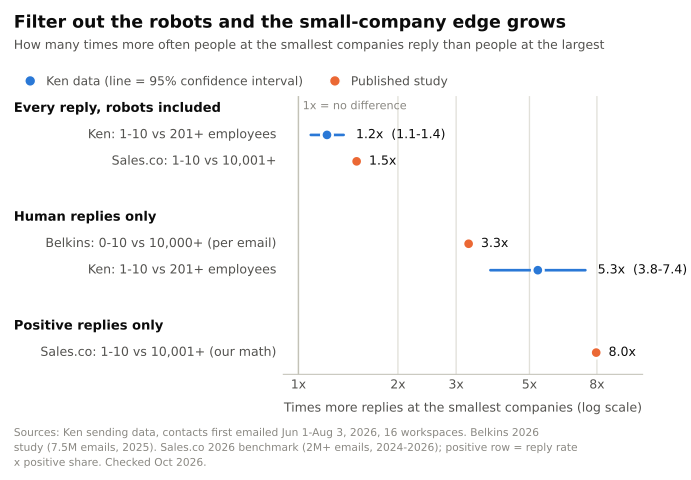
Sources: Ken sending data, contacts first emailed Jun 1-Aug 3, 2026, 16 workspaces. Belkins 2026 study, 7.5M emails sent in 2025. Sales.co 2026 benchmark, 2M+ emails. Checked October 2026.
Our own data shows the whole effect in one place. Between 1-10 and 201+ employee companies, the gap in any reply, robots included, is 1.2x. The gap in human replies is 5.3x. Same contacts, same emails. The only thing that changed is whether out-of-office messages counted. Those are raw ratios, like the benchmarks above. Compared only with others in the same campaign, contacts at 1-10 person companies still drew about 2.9x the human replies of contacts at 201+.
Count the robots and company size looks minor. Count only humans and it's one of the biggest levers in your list. Before you trust any benchmark, check what it divides by. Our guide to what a good cold email reply rate is walks through why that matters.
Are spam filters the reason big companies reply less?
Spam filters probably explain a small part of the gap. Our data says most of it is people not answering. Some top-ranking pages blame enterprise filters anyway. Gangly says they "silently reject or quarantine 30-40% of cold email from unknown senders" and doesn't cite a source.
Big companies do filter more. Of the contacts whose mail setup we could see, 10% at 1-10 person companies sat behind a security gateway, a filter like Proofpoint or Mimecast that checks mail before the inbox sees it. At 1,000+ it was 47%.
But auto-replies point the other way. An auto-reply only fires once the email reaches the mailbox. Google says it plainly in Gmail Help, checked October 2026: "Emails sent to your spam folder or addressed to a mailing list you subscribe to don't get your reply." A message held in a gateway's quarantine never reaches the mailbox, so it can't trigger one either.
So we ran the cleanest test our data allows. We took only Google-hosted inboxes with no gateway in front, where spam would show up as missing auto-replies.
| Employees | Auto-replies vs campaign average | Human replies vs campaign average |
|---|---|---|
| 1-10 | 0.77 | 1.27 |
| 11-50 | 1.06 | 0.96 |
| 51-200 | 0.97 | 0.86 |
| 201-1,000 | 1.29 | below average, few replies |
| 1,000+ | 1.32 | below average, few replies |
Source: Ken sending data, contacts first emailed Jun 1-Aug 3, 2026, on Google-hosted inboxes with no security gateway. 1.0 = the average of the same campaign.
Auto-replies went up with company size, and the 95% intervals for both 201+ groups sit above 1.0. Human replies went down. If Gmail were burying big-company cold email in spam, the vacation replies would have dropped too. They didn't.
Big companies don't ignore cold email at the server. They ignore it at the desk.
Two honest limits. Auto-replies only test people who had one switched on, and if big-company staff set out-of-office more often, that could hide some filtering. Habits clearly differ by size. At companies of 1-5 people, auto-replies ran at about 0.6 of the campaign average across all inboxes, I'd guess because a five-person team rarely bothers with one. And Microsoft doesn't document the same spam rule for its automatic replies, so the test is cleanest on Google.
If it's mostly people, why don't they answer? The positive replies give a clue. In our data, human replies from companies with 50 or fewer people were about 3 times as likely to be positive as human replies from bigger companies. That sample is small, but Sales.co found the same pattern: 18.2% of all replies were positive at 1-10 employees, against 3.43% at 10,001+. Belkins puts it down to who decides. At small companies "there's typically one or two decision-makers to handle any given problem," with "no procurement process, no committee." At big ones the right person is harder to find, and "individuals are more likely to filter or ignore cold outreach as a matter of habit."
Should you stop emailing big companies?
No. But know the price. Using Sales.co's published numbers, here's roughly how many contacts it takes to get one positive reply at each company size. The arithmetic is ours.
| Employees | Reply rate, Sales.co | Share of replies positive, Sales.co | Contacts per positive reply |
|---|---|---|---|
| 1-10 | 2.40% | 18.20% | about 230 |
| 11-50 | 2.10% | 10.78% | about 440 |
| 51-200 | 2.02% | 5.75% | about 860 |
| 201-500 | 2.01% | 4.51% | about 1,100 |
| 501-1,000 | 1.90% | 3.80% | about 1,400 |
| 1,001-5,000 | 1.75% | 3.40% | about 1,700 |
| 10,001+ | 1.60% | 3.43% | about 1,800 |
Sales.co didn't publish a positive share for 5,001-10,000.
That's an 8x spread. So a deal at a 10,000-person company has to be worth about 8 times a deal at a 10-person company just to earn the same per contact you email. That assumes positive replies turn into deals at the same rate, and it's before the longer sales cycle.
| If your big-company deal is worth... | Return per contact, compared with a 1-10 list |
|---|---|
| 2x a small deal | about a quarter |
| 5x | about 60% |
| 8x | about even |
| 15x | about 1.9x |
| 30x | about 3.8x |
Two more facts shape the targeting call. Both come from the U.S. Census Bureau's 2022 business statistics, checked October 2026.
- Big companies are rare. Firms with 1,000+ employees were 10,641 of 6.4 million U.S. employer firms, about 0.17%. With a pool that small, you can't make up a 5x reply gap with volume.
- But they hold the people. Those same firms employed about 49% of U.S. workers. So a title-only search in any people database leans toward big companies, because that's where the people are. Set a headcount filter on purpose when you build your lead list around your ICP.
How should you write cold email for small vs big companies?
Here's what I'd do with these numbers.
Small companies, 1-50 people. You're writing to the person who decides and pays. Name one problem, back it with one specific number, and ask an easy question. Don't cut the follow-ups, though. At small and big companies alike, more than half of the human replies in our data arrived after at least one follow-up had gone out.
Big companies, 200+ people.
- Write to be forwarded. Assume the reader isn't the buyer. Give them two lines they could pass to a colleague: who it's for and what it fixes.
- Ask a routing question. "Is this something your team owns, or is there someone better to talk to?" is easier to answer than "Got 15 minutes?"
- Email a few people per account. In our data, emailing a second or third person at the same company didn't make each person less likely to reply, once we matched on campaign, company size and seniority. With only about 10,600 U.S. companies of 1,000+ people to go around, each extra person is another real chance.
- Read the robots. At 1,000+ employees, 96% of the replies we got were automated. Many name a return date or a colleague. Here's how we handle out-of-office replies without hurting deliverability.
- Judge the segment on human replies only. Auto-replies make a dead enterprise segment look alive.
- Give the email a reason to arrive now. A new leader, a funding round or a hiring push gives a big-company reader a reason to care this month. That's the idea behind signal-based outbound.
How we measured this
- Data. Ken's sending database, pulled October 2026. Contacts first emailed June 1 to August 3, 2026, with at least 21 days for replies to arrive, across 16 workspaces and 51 campaigns. Every Ken figure here is relative, an index, a ratio or a share.
- Replies. A human reply is any reply not flagged as an auto-reply or out-of-office. "Any reply" counts both.
- Same-campaign score. Human replies we saw, divided by what each contact would get at its own campaign's average rate. The 10x slope comes from a Poisson model, a standard model for counts, with a separate baseline for each campaign.
- Company size. Employee counts come from company data profiles. Some are stale, and parent companies can blur with subsidiaries, so a company can land one bracket off.
- Limits. 56% of these contacts worked at companies with 50 or fewer people, so many campaigns were built for small businesses. Many big-company contacts were probably stretch targets, so part of the slope measures fit, not size alone. A campaign can also send different copy to different segments. It was a summer cohort, when out-of-office replies run high. And one workspace made up about 39% of the contacts, which is why we checked every workspace on its own.
Frequently asked questions
Is company size or job title a bigger factor in cold email replies?
Company size, in the data we've seen. Belkins found a 3.3x gap between the smallest and largest companies and a 1.8x gap between founders and VPs. In our data, comparing people at the same company size in the same campaign wiped out most of the founder advantage, while comparing people with the same title barely dented the size gap.
What reply rate should I expect from enterprise accounts?
Expect something low and noisy. Belkins measured 0.22% human replies per email at 10,000+ employee companies in 2025. Sales.co measured 1.60% of contacts replying at 10,001+, with auto-replies counted. Only compare your numbers with a benchmark that counts replies the same way and divides by the same thing, emails or contacts.
Do out-of-office replies mean my cold email reached the inbox?
At Gmail, an auto-reply means that message wasn't filed as spam, because Google doesn't send vacation replies to spam. It doesn't mean a person read it. Microsoft doesn't spell out the same rule, so treat Outlook auto-replies as weaker evidence.
Where does the reply rate drop the most?
In our data, between 1-5 and about 25 employees, and again above 200. Positive replies drop off sooner. The share of human replies that were positive fell sharply above 50 employees.
The short version
Small companies answer cold email. Big companies receive it, auto-reply to it, and mostly don't answer. Go small when deal sizes are close. Go big when a deal there is worth several times more, and judge every segment on human replies. Ken runs cold email and LinkedIn outreach for B2B companies, done for you, on infrastructure we own, and your first campaign is free.