
Should You Put a Calendly Link in Your First Cold Email?
No. Ask for interest in email one and send the calendar link after they reply. What our first-email data and the outside research say about links.
Cristian Frunze · Oct 26, 2026 · 12 min read
- calendly link in cold email
- cold email call to action
- links in cold email
- booking meetings from cold email
- cold email follow-ups
- cold email deliverability
About 1 in 30,000. That's how many of the first emails sent through Ken between February and August 2026 carried something that looked like a booking link.
No, don't put a Calendly link in your first cold email. End it with one short question about interest, and send the link, or two specific times, once the person writes back.
The usual reason is spam. We checked that against our own sending data, and it's messier than the advice. Emails with a link got fewer than half the human replies of emails without one. But that gap came from three campaigns that changed their email on one weekend, and fairer comparisons put the real cost anywhere from nothing to half your replies.
The ask is a different story. The two big studies that looked at it, Gong's and Hunter's, point the same way.
A calendar link in a first cold email stacks two risks: a link that may cost you replies, and an ask for 30 minutes from a stranger who hasn't said they care.
Why does a Calendly link hurt a first cold email?
A Calendly link asks for the biggest thing you want, a meeting, at the moment the reader trusts you least. It also hands them the work. They have to open a page, pick a slot, type their name and block their own calendar for someone they've never heard of.
Even Calendly agrees. A March 2022 post on Calendly's own blog says that when a "sales bro" cold-messages you on LinkedIn and closes with "here's my Calendly" before building any rapport, "that's rude (not to mention ineffective)."
The research on asks points the same way:
- Gong scored the calls to action in 304,174 sales emails by whether a meeting got booked within 10 days. On cold emails, an interest question like "Are you interested in learning more about X?" did best. Asking for a specific time, like "Are you available to meet on Tuesday at 4pm?", had a 15% success rate on cold emails and 37% once a deal was underway. The study is from 2020.
- Hunter's latest State of Cold Email report covers 31 million emails sent in 2025 plus surveys of decision makers. It says open-ended asks like "Open to learning more?" and "Can I send more info?" beat hard asks, and that decision makers prefer them to being asked for a meeting up front. That part comes from the survey, not from reply counts.
There's a trust problem too. In December 2025, Push Security found fake Calendly invites impersonating more than 75 brands, built to steal Google Workspace and Facebook Business logins, BleepingComputer reported. A careful buyer hesitates before clicking a booking link from a stranger, and they're right to.
People are split on whether scheduling links are rude. Calendly's blog reports an informal 2020 poll that came out 50/50. Starting a relationship on a coin flip about your manners isn't a great plan.
Do links in a first cold email cost you replies?
Links in a first cold email probably cost some replies, but nobody has measured how many cleanly, and our own data shows why that's hard.
We checked the first emails that 16 companies sent through Ken across 52 campaigns, between February 25 and August 3, 2026. We counted human replies only, not auto-replies or out-of-office messages.
The first cut looked like a slam dunk. Emails with no link got 2.3 times the human replies of emails with a link. The gap held inside the same company and inside the same campaign.
Then we looked at how that gap happened. None of the campaigns that sent both kinds ran a split test. The three biggest switched from no link to a link on one weekend in late June. The new version was nearly the same email, with the same single question, about seven more words and one tracked link. So "inside the same campaign" really meant "before versus after." A before-and-after number mixes the change you made with everything else that moved that week.
So we ran two fairer comparisons:
- Same campaign, same week. Link emails got 0.73x the human replies of link-free ones. The 95% range runs from 0.48 to 1.11, and that range includes "no difference."
- Against campaigns that changed nothing. Over the same dates, 11 campaigns that never touched their first email kept about 90% of their human replies. The three switchers kept 42%. Side by side, the link looks like it cost about half the replies, 0.46x with a 95% range of 0.26 to 0.81. But in the 10 days before the switch, with no link on either side, the switchers were already losing replies faster than the other campaigns, auto-replies most of all. So 0.46x overstates the cost.
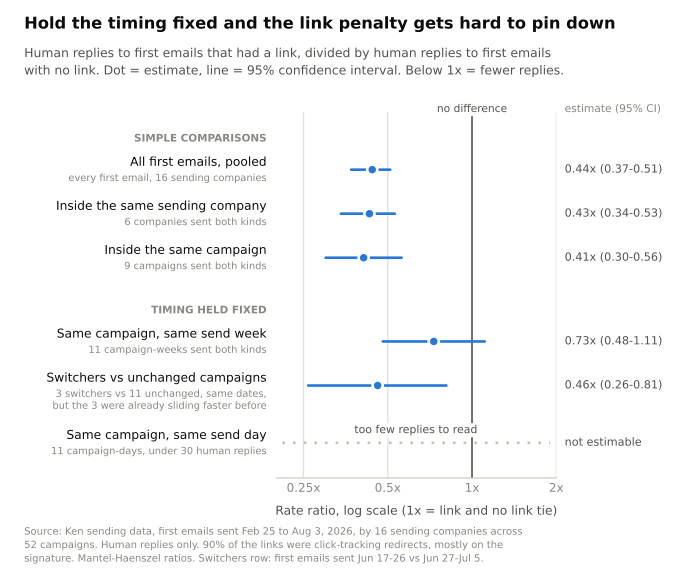
Source: Ken sending data, first emails sent Feb 25 to Aug 3, 2026, by 16 sending companies across 52 campaigns. Human replies only. Lines show 95% confidence intervals.
My read is that a tracked link in a first email probably costs some replies, somewhere between almost none and half. Our data can't narrow that down, and nobody has published anything that does. When someone quotes you one confident number on links, ask how they got it.
One detail matters a lot. 90% of these links were click-tracking redirects, mostly on the company name in the signature. So the test is about a tracked signature link. A calendar link carries the same risk and adds the meeting ask on top.
There's also one clue that a link might cost inbox placement. Gmail doesn't send vacation replies to mail that lands in spam. After the switch, out-of-office replies fell to about half, 0.51x within the same campaign and week. But the switchers' auto-replies had already dropped by about 40% in the week before the link went in, while other campaigns held steady. And on days when both versions went out, auto-replies pointed the other way. It's a lead worth testing, not a finding.
What does the outside evidence on links say?
Most "no links in email one" advice is sensible. Almost none of it is measured:
| Source (checked October 2026) | Claim | Sample | Fair comparison? |
|---|---|---|---|
| Overloop | A URL in email 1 cut replies from 9.4% to 5.1% | Link-building pitches to editors, group sizes not given | Called an A/B test, no details |
| Clay community post | Calendar links "tank reply rates to under 1%" | 200,000+ emails | No comparison group described |
| Hunter | Email tracking on: 4.4% replies, off: 7.4% | 31M emails, 2025 | No, different sequences |
| lemlist help center | "Limit links to 1 maximum per email, ideally 0 in your initial cold outreach" | Advice | No data |
| Gong Labs | Interest asks beat meeting asks on cold email | 304,174 emails | Observational, no split test |
| Ken (this article) | 0.44x pooled, 0.46x to 0.73x with timing held fixed | First emails from 16 companies, Feb to Aug 2026 | Partly, no split test |
Nobody has published a clean split test of a calendar link in a first cold email. The steadier signal is about the ask. Gong's email data and Hunter's survey both found that low-pressure questions beat meeting requests on cold email.
Will a Calendly link send my email to spam?
A Calendly link probably won't send you to spam on its own. Calendly is a well-known domain, and Google's sender guidelines don't ban links. As of October 2026, they only ask that "web links in the message body should be visible and easy to understand."
Two things make a link riskier than it looks:
- Click tracking rewrites it. With click tracking on, your sending tool swaps the Calendly address for its own redirect so it can count clicks. That's what 90% of the linked first emails in our data carried. As of October 2026, Instantly's help center says its default tracking link is "shared among Instantly customers unless you set up a custom tracking domain." So the first thing a filter sees isn't Calendly. It's a redirect, and on a shared tracking domain, one that strangers use too.
- Security tools scan it. Microsoft's Defender for Office 365 docs, checked October 2026, say Safe Links scans URLs before delivery, and the recommended setting holds the message until the scan finishes. lemlist's help center warns that "bots click on every link in your email before the recipient even sees it," so click counts on cold email mislead you too.
If you keep any link, turn click tracking off. We explain the same thinking for opens in why we turned off open tracking on cold email, and the cold email deliverability guide covers the rest.
What should the first email ask for instead?
The first email should ask for something a busy person can answer in one word. A reply is the goal of email one, not a booking.
| Ask | Example | Why it works |
|---|---|---|
| Interest question | "Worth a look?" | Yes or no. Gong's best-performing type of cold ask |
| Permission to send something | "Want me to send the 2-minute breakdown?" | Gets a reply first. The link goes in your answer |
| Problem check | "Is churn on your plate this quarter?" | Easy to answer, and even a "no" teaches you something |
| Right-person check | "Are you the right person for this, or is it someone on your team?" | Low stakes, often gets you a referral |
Skip "Do you have 15 minutes on Tuesday?" in email one too. It's still a meeting ask, just without the link.
My rule is simple. No booking link until the other person has written back.
Does the first email have to book the meeting?
No. The first email starts the conversation. In our data, 59% of people who replied as humans did so after a follow-up. Per email sent, our fourth email earned human replies at 0.99x the rate of the first. A tie.
Sources disagree on the exact split, and part of the reason is whether they count auto-replies. When we add auto-replies, the first email's share jumps from 41% to 52%, because out-of-office messages fire the moment the first email lands.
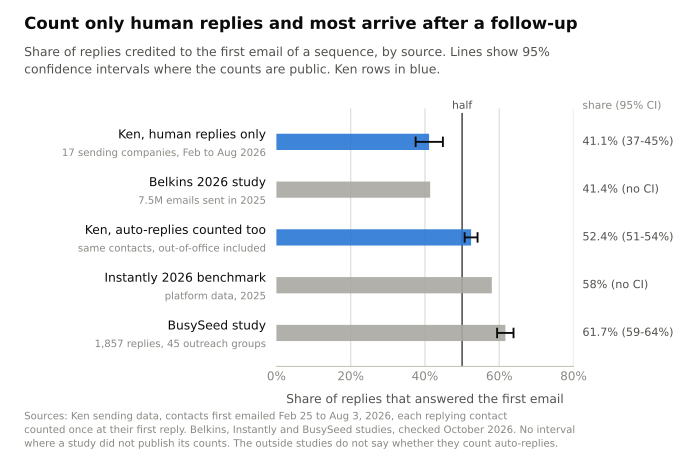
Source: Ken sending data, contacts first emailed Feb 25 to Aug 3, 2026, 17 sending companies; Belkins (7.5M emails, 2025), Instantly (platform data, 2025) and BusySeed (n = 1,857 replies), checked October 2026. Lines show 95% confidence intervals where counts are public.
Belkins found the same 41% for the first email across 7.5 million emails. On meetings, it reports that the "appointment rate also stabilizes at 0.2% from step 3 onward, which is twice the rate of steps 1 and 2." Meetings come later in the sequence. That's where a direct ask belongs.
When does a calendar link make sense?
A calendar link makes sense once the person has shown interest. Gong's data shows the flip. Once a deal is underway, a specific ask wins: 37% for a specific time, 32% for an open-ended meeting ask, 25% for an interest question. Be soft with strangers and specific with people who've raised a hand.
| Situation | Calendar link? | What to send |
|---|---|---|
| First cold email | No | One interest question |
| Follow-ups 2 and 3, no reply | Not yet | A new angle or proof point, still ending in a question |
| A later follow-up, step 4 or so | Optional | Two specific times, with the link as a backup |
| They replied "sure, tell me more" | Yes | Two times plus the link, the same day |
| Inbound lead, referral or event contact | Yes | The link and a one-line agenda |
| They asked for your calendar | Yes | Just the link |
Calendly's own blog suggests the polite version: "Feel free to suggest some times that work for you, or if it's easier, here's my Calendly link!" Times first, link as the shortcut. Our guide on handling cold email replies covers what to write after a yes.
One more thing from our data. Between November 2025 and September 2026, about 1 in 28 replies to our campaigns that weren't automated carried the prospect's own scheduling link, and almost two thirds of those were Calendly. Some were invitations, some sat in a signature. Buyers use these tools all day. They just don't want one from someone who hasn't earned it yet. And when a prospect sends you their link, use it.
What about a calendar link in my email signature?
In a cold sequence, leave the calendar link out of your signature. It's still a link, click tracking still rewrites it, and it asks for the meeting in every single email. Most of the links in the first emails we studied were this kind of signature link, and both of our fairer comparisons still put them below 1x. Keep the cold signature to your name, title and company in plain text, and add the booking link to the signature you use for replies.
Frequently asked questions
Is it rude to send a Calendly link?
Not after someone has agreed to talk. It reads as rude when it shows up uninvited. Offer two times first and the link as a backup, and almost nobody minds.
Should I offer two specific times instead of a link?
After a reply, offer both. In a first cold email, neither. A specific time is still a meeting ask, and Gong found interest questions beat time asks on cold email.
Does the same rule apply to LinkedIn messages?
Yes. The example Calendly's own blog calls rude is a LinkedIn cold message that ends with "here's my Calendly." Connect, start a conversation, then share the link.
Can I put the calendar link in a P.S.?
In a later follow-up, a P.S. like "or grab a time here if that's easier" is a fair middle ground. In email one it's the same ask in smaller font, so skip it.
How do I test this on my own list?
Send the same copy with and without the link on the same days, split your list at random, and count human replies, not clicks. Our data shows why the same days matter. A before-and-after switch produced a confident 2.3x gap that fairer comparisons couldn't pin down. Our guide to cold email A/B testing covers how big the test needs to be.
Get the first campaign built for you
Ken runs cold email and LinkedIn outreach for B2B companies, done for you, on infrastructure we own. Human copywriters build the frameworks, AI fills them with real prospect data, and a human approves every campaign before the first send. Your first campaign is free: ken.so/free-campaign.