
I Sent 5,000 Cold Emails and Got Zero Replies. What Went Wrong?
Zero replies from 5,000 cold emails is almost never bad luck. Even the lowest benchmark predicts 11. How to find what broke, in the order that matters.
Cristian Frunze · Oct 27, 2026 · 12 min read
- cold email zero replies
- cold email no replies
- cold email deliverability
- out-of-office replies
- cold email reply rate
- email bounce codes
Five thousand emails out. Nothing back. Not a "no", not an unsubscribe, not even an out-of-office.
Zero replies from 5,000 cold emails is almost never bad luck. If people had actually seen those emails, even the gloomiest published reply rate I could find predicts about 11 replies, and the chance of getting none is about 1 in 60,000. Zero means your emails didn't reach inboxes, your replies are going somewhere you aren't looking, or nobody on the list had a reason to answer.
Check in the order that matters. Delivery first, then the list, then the offer, and the copy last. Most people start by rewriting the subject line, which is backwards.
Every guide says "check your deliverability." Few tell you how to check it for free, within the hour. Gmail and Microsoft 365 don't send out-of-office replies to email they filed as spam. So the auto-replies you get, or don't get, show where your mail went.
If 5,000 people had really seen your email, silence would be a statistical miracle. Zero is a measurement, and it usually measures your spam folder.
Could zero replies from 5,000 emails just be bad luck?
No. Here's the math.
Say your 5,000 emails were a three-step sequence to about 1,670 people. The most cautious recent benchmark I know is Belkins' 2026 study, checked October 2026. It covers 7.5 million cold emails sent in 2025 and found 0.45% human replies per email sent, with auto-replies and bounces taken out. At that rate, 5,000 seen emails should bring about 22 replies.
The chance of zero is 0.9955 multiplied by itself 5,000 times. That comes to about 1 in 6 billion. The Powerball jackpot is 1 in 292 million, so a zero here is about 20 times less likely than winning it with one ticket.
Take the worst group in the same study, emails to companies with 10,000+ employees, at 0.22% per email. You'd still expect 11 replies. The chance of zero is about 1 in 60,000.
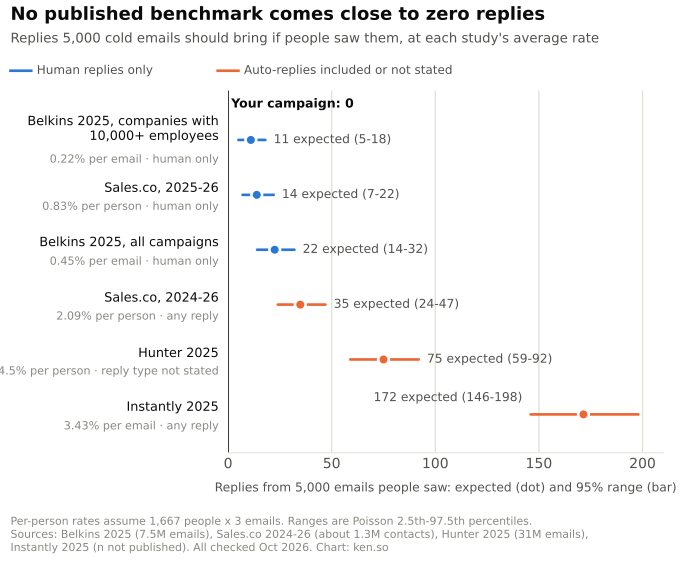
Source: Belkins 2025, 7.5M emails; Sales.co 2024-2026, about 1.3M contacts; Hunter 2025, 31M emails; Instantly 2025 benchmark report, sample size not published. All checked October 2026. Per-person rates assume 1,667 people getting 3 emails each. Bars show the 95% range from chance.
Benchmarks disagree because they count different things, which our guide to cold email reply rates untangles. But the disagreement runs from 11 replies to 172. None of it is near zero.
How many emails before zero replies means something?
Fewer than you'd think. Statisticians have a shortcut for zero results called the rule of three. If something happened 0 times in n tries, you can be 95% sure its true rate is below about 3 divided by n. The rule comes from Hanley and Lippman-Hand in JAMA, 1983.
Zero out of 5,000 means your real reply rate is below 0.06%, or 1 reply per 1,670 emails. That's 7.5 times below Belkins' average.
| Emails people saw | Chance of zero at 0.45% per email, Belkins average | Chance of zero at 0.22%, Belkins' 10,000+ employee group | Highest true rate that fits a zero | What zero tells you |
|---|---|---|---|---|
| 300 | 26% | 52% | 1.0% | Nothing yet |
| 660 | 5% | 23% | 0.45% | Suspicious |
| 1,000 | 1.1% | 11% | 0.30% | Something's off |
| 2,500 | 1 in 79,000 | 0.4% | 0.12% | Not luck |
| 5,000 | 1 in 6 billion | 1 in 60,000 | 0.06% | Not luck |
The key word is "saw." Only emails that land in front of a person count. If you sent 5,000 and only 650 reached an inbox, you're on the 660 row, where zero is still a 1-in-20 fluke.
That turns the math around. For zero replies from 5,000 emails to be even a 1-in-20 fluke at an average reply rate, about 87% of the emails have to vanish. Validity's 2026 deliverability benchmark found the average marketing email reached the inbox 87.2% of the time in 2025. A zero-reply campaign is that number flipped.
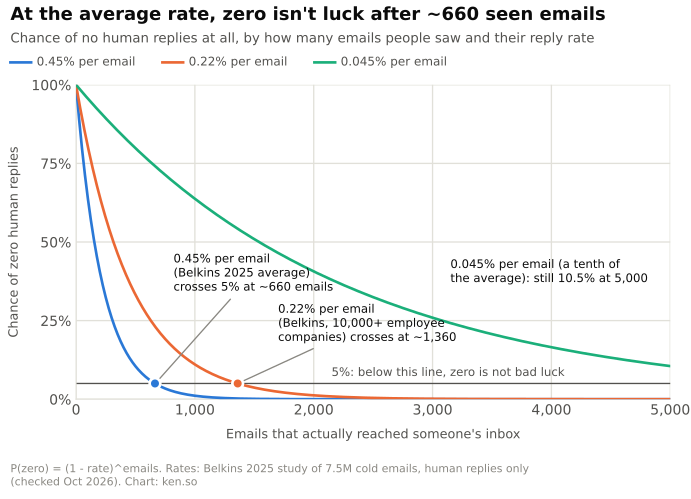
Source: Ken calculation. Chance of zero = (1 - reply rate) to the power of emails seen, using Belkins' 2025 human reply rates from 7.5M cold emails, checked October 2026.
One honest caveat. This math assumes your campaign is roughly average. A campaign aimed at people with no reason to care can run at a tenth of the average, the green line. Then zero from 5,000 happens about 1 time in 10, and the silence is real feedback about the list or the offer. The checks below tell the two cases apart.
What should you check first?
The plumbing. It takes five minutes and it's embarrassing to skip.
- Did the emails go out? Count what's in the Sent folder or your tool's send log, not what was scheduled. A disconnected inbox or a paused campaign sends nothing.
- Can a reply reach you? Reply to one of your own emails from a personal Gmail and see where it lands.
- Where do your two reply addresses point? When people hit reply, the email goes to your Reply-To address, or to the From address if there isn't one, per RFC 5322. Automatic replies are supposed to go to the hidden Return-Path, also called the bounce address, per RFC 3834. If either one feeds a mailbox nobody reads, you'll see zero while replies pile up.
- Did your tool file them away? Many sending tools sort out-of-office messages into their own folder. Look there before you count.
How do you know if your cold emails reached the inbox?
Not from open rates. Apple's Mail Privacy Protection "prevents senders from seeing if you've opened the email message they sent you," and on a Mac it loads remote content in the background when a message arrives. Opens show up for emails nobody read, which is one reason we turned open tracking off.
Use the out-of-office test instead. Google says Gmail's automatic reply isn't sent for "emails sent to your spam folder." Microsoft says that when Exchange Online, the mail system behind Outlook in Microsoft 365, marks a message as spam and sends it to Junk, "an automatic reply isn't generated at all." Both checked October 2026. So every vacation reply proves that one email landed somewhere other than spam. Orestas Nariunas of a-sales.co gives the same advice in Hunter's State of Cold Email. "If you want to know whether you're actually inboxing, watch your out-of-office replies."
The test is also fast. In our sending data, the median auto-reply arrived about 25 seconds after the email that triggered it, and 98.5% arrived within an hour. You'll have an answer the same afternoon.
How many should you expect? In Sales.co's study, 2.09% of contacts replied and 45.1% of those replies were automatic. That's about 1 auto-reply per 100 people, or around 16 from 1,670 people. In our own data, people who sent only an auto-reply outnumbered people who wrote back 2.3 to 1 before June 2026, and 4 to 1 over the summer, probably because more people were on vacation.
Auto-replies come back whether or not your pitch is any good, which makes them the best free delivery test you have. Zero of them on 5,000 emails means your mail almost certainly didn't land.
Then read your bounces instead of just counting them. A 5.1.1 code means the mailbox doesn't exist, which is a list problem. A 5.7 code means the server refused you on policy or security grounds, per RFC 3463. Gmail's version reads "This message is likely unsolicited email." In our data, 59% of hard bounces from February to October 2026 were spam, reputation or policy blocks. Only about 21% were bad addresses. A "hard bounce" is often your reputation talking.
Last, run a seed test. Send the real email to test inboxes on Gmail, Outlook.com and a Microsoft 365 business account, and see where it lands. Google Postmaster Tools helps at volume, but Google says data "might be missing" when daily volume is too low. Our deliverability guide covers the fixes.
What does each kind of silence tell you?
Line up what came back, and the pattern usually names the problem.
| What came back from 5,000 emails | What it usually means | Check first |
|---|---|---|
| Nothing at all. No bounces, no auto-replies, no people | The emails didn't go out, or replies go somewhere you don't look | Send logs, Reply-To, Return-Path |
| Many bounces, mostly 5.7 codes that say "blocked," "policy" or "reputation" | Servers are refusing you | Domain and IP reputation, authentication, volume per inbox |
| Few bounces and zero out-of-office replies | Accepted, then filed as spam | Seed test, warmup, links and tracking, volume |
| A clean first day, then 5.7 bounces as follow-ups go out | Servers took your first email, then turned on you | Volume per inbox, domain reputation |
| Bounces over 2%, mostly 5.1.1 "does not exist" | Bad or stale data | Verify the list, drop old and risky addresses |
| A steady trickle of auto-replies, zero people | The mail lands. People don't care | List, then offer, then copy |
| People reply, but only "remove me" or "not relevant" | Wrong people or wrong pitch | Targeting and offer |
The 2% bounce line comes from Instantly's 2026 benchmark report, which says to keep bounces "below 2% (ideally much lower)."
How long should you wait before calling it?
Robots answer fast and people don't, so the right wait depends on what you're checking.
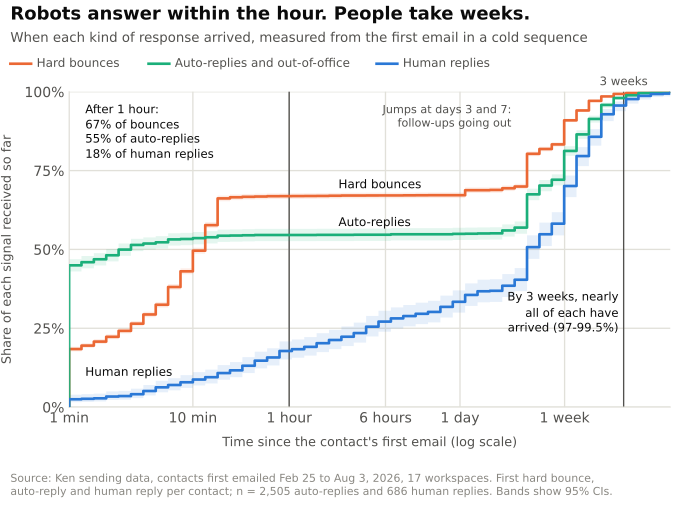
Source: Ken sending data, contacts first emailed February 25 to August 3, 2026, 17 workspaces. First hard bounce, auto-reply and human reply per contact, n = 2,505 auto-replies and 686 human replies. Bands show 95% confidence intervals.
In our data, 67% of hard bounces and 55% of auto-replies had arrived within an hour of a contact's first email. Only 18% of human replies had. The median human reply came 3.3 days after the first email, and 97% were in by three weeks. The shape held when we dropped the biggest workspace.
People aren't slow, though. They answer follow-ups. Measured from the email they actually replied to, the median human reply came 1 hour 46 minutes later, and 95% came within three days. Most people skip the opener and answer when a follow-up bumps the thread back to the top of their inbox. That's why the human curve jumps at days 3 and 7.
A 72-hour check works for one email. For a sequence it's too early. Three days after the first email, only 44% of human replies had arrived. Tiny tests mislead too. Fifty people getting three emails each come back empty about half the time, even at Belkins' average rate.
Delivery can also break partway through. Of the first hard bounces in our data, a third arrived after day one, as follow-ups went out. Those late bounces were blocks 81% of the time and bad addresses only 9%. On day one the split was 56% and 20%. A server that takes your first email and refuses the second isn't judging your list. It has decided it doesn't want your mail. Without our largest workspace the gap shrank but held, 75% blocks against 57%.
So judge delivery on day one. If 24 hours after your first batch you have no bounces and no auto-replies at all, don't wait three weeks for a miracle. Read the bounces again after each follow-up. Judge the list and the offer at week three.
If the emails landed, is it the list, the offer or the copy?
If auto-replies came back at a normal clip and people didn't, your mail is fine and your message isn't. Work down in this order, because each one caps the next.
The list. I'd look here first, because no copy fixes the wrong person. Does the person you emailed own the problem you solve? Company size alone moves reply rates a lot. In Belkins' data, companies with 0-10 employees replied at 0.72% per email and companies with 10,000+ at 0.22%. Our data slopes the same way. Inside the same campaigns, contacts at 201-1,000 person companies sent auto-replies right at the rate their campaign predicted, but human replies at only about two thirds of it. The mail arrived. The person who cared wasn't there. That's 31 human replies from contacts first emailed June to August 2026, so treat it as a lean, not a law. Here's how to build a list around a tight ICP, your ideal customer profile.
The offer. What does the reader get for replying? "Can we book 30 minutes for a demo?" asks a stranger for a lot. In a 2020 study of 304,174 emails, Gong Labs found that asking about interest, like "Are you interested in learning more about X?", was the best-performing call to action in cold email. Gong measured it by meetings booked within 10 days. Make the first yes small.
The copy. Copy comes last because it rarely turns a true zero into anything. Read 10 emails as they were actually sent, not the template. Look for broken merge fields like "Hi {{first_name}}", personalization that reads the same for every company, and a block of text nobody finishes on a phone.
What should you do before sending the next 5,000?
Don't send them yet. Fix what the checks found, then restart with a test batch of at least 1,000 emails you're confident will land. At Belkins' average, zero then has about a 1% chance, so one batch tells you whether the fix worked without burning your whole market. Give it the same three weeks.
If you'd rather hand the whole thing off, Ken runs cold email and LinkedIn outreach for B2B companies, done for you, on infrastructure we own. Human copywriters build the frameworks, an AI check reviews every email, and a human approves the campaign before the first send.
Frequently asked questions
Is zero replies after 1,000 cold emails normal?
Not if they landed. At Belkins' 2025 average of 0.45% human replies per email, 1,000 seen emails give zero only about 1% of the time. Run the out-of-office test before you touch the copy.
Does an out-of-office reply mean my email reached the Primary tab?
No. It means the email landed outside spam. Gmail's help page names only the spam folder and mailing lists as exceptions, so mail filed under Promotions can still trigger a vacation reply.
Does zero replies mean my domain is on a blocklist?
Not necessarily. Servers that check blocklists often reject the email outright, and the bounce text usually names the list, like Spamhaus. Silence with few bounces points to spam-folder filtering instead.
Should I keep following up if the first emails got zero replies?
Not until you know your mail lands, because follow-ups to the spam folder just add more of the same. Once delivery is fixed, follow-ups matter. In Belkins' 2025 data, 58.6% of replies came after the first email, and in ours, 59% of first human replies did.
Can a bad subject line cause zero replies?
It can lower replies, but it can't explain a true zero. A subject line only matters once the email is in the inbox, and landed emails trigger out-of-office replies whatever the subject says.
The short version
Zero replies from 5,000 cold emails is a signal, not bad luck. Make sure replies can reach you, use auto-replies and bounce codes to see whether mail landed, give people three weeks, and only then question the list, the offer and the copy. If you want a second set of eyes on all of it, your first campaign with us is free.