
How Long Do Prospects Take to Reply to Cold Email?
Half of human replies to cold email land within 2 hours of the email that prompts them, 95% within 3 days. A full sequence needs about 2 weeks. Data from 686 replies.
Cristian Frunze · Nov 03, 2026 · 13 min read
- how long does it take to get a reply to a cold email
- cold email reply time
- cold email follow-up timing
- best time to send cold email
- when to judge a cold email campaign
- cold email response time data
We timed 686 replies from real people to our cold emails. Measured from the email they answered, the typical one took 1 hour 46 minutes. Measured from the first email in the sequence, the same replies took 3.3 days.
Half the people who reply to a cold email do it within two hours of the email that prompts them, and 95% reply within three days of it. But most replies answer a follow-up, not the first email, so a full sequence needs about two weeks to collect 90% of its replies.
That gap decides how long to wait between follow-ups and when you can judge a campaign. The replies came from cold emails we sent between February and August 2026, with out-of-office robots counted separately. Kenso runs cold email and LinkedIn outreach for B2B companies, done for you, on infrastructure we own, so we see when every reply lands.
What we found:
- 42% of human replies arrived within an hour of the email they answered, and 95% within three days.
- Counted from the first email, only 44% were in by day 3 and 93% by day 14.
- A no comes back faster than a yes. A yes was 5.6 times as likely to land more than three days after the email.
- Weekday emails got a median reply in about an hour. Weekend emails waited about 7 hours.
- Thursday and 7-9am sends drew the most human replies. Between 9am and 5pm, the hour made no difference.
An email's reply window is three days. A sequence's reply window is two to three weeks.
How fast do people reply to a cold email?
Fast. Counted from the email they actually answered, the median human reply came 1 hour 46 minutes later. The median is the middle one if you line every reply up by speed. A quarter came within 17 minutes, 42% within the hour and 95% within three days.
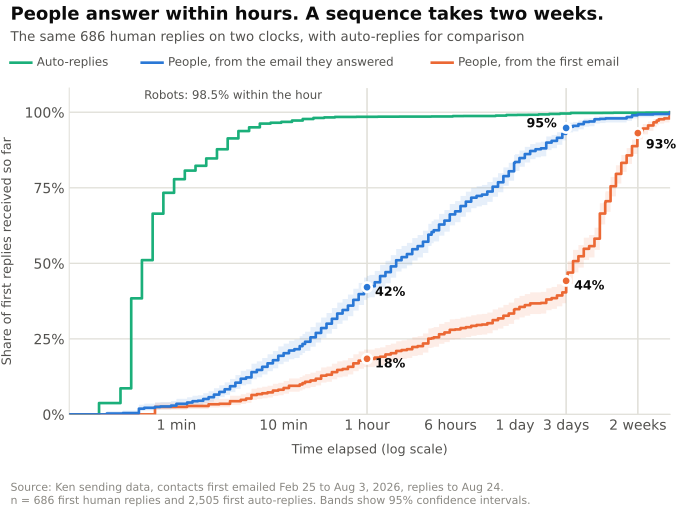 Source: Kenso sending data, contacts first emailed Feb 25 to Aug 3, 2026, replies to Aug 24. n = 686 first human replies and 2,505 first auto-replies. Bands show 95% confidence intervals, the range the true value most likely sits in.
The orange line is the same 686 replies, timed from the first email of the sequence. It crawls for three days, then climbs in steps as each follow-up goes out, around day 3 and again around day 7. 59% of the people who replied did it after a follow-up. They saw the first email, did nothing, and answered when the next one pushed the thread back to the top of their inbox.
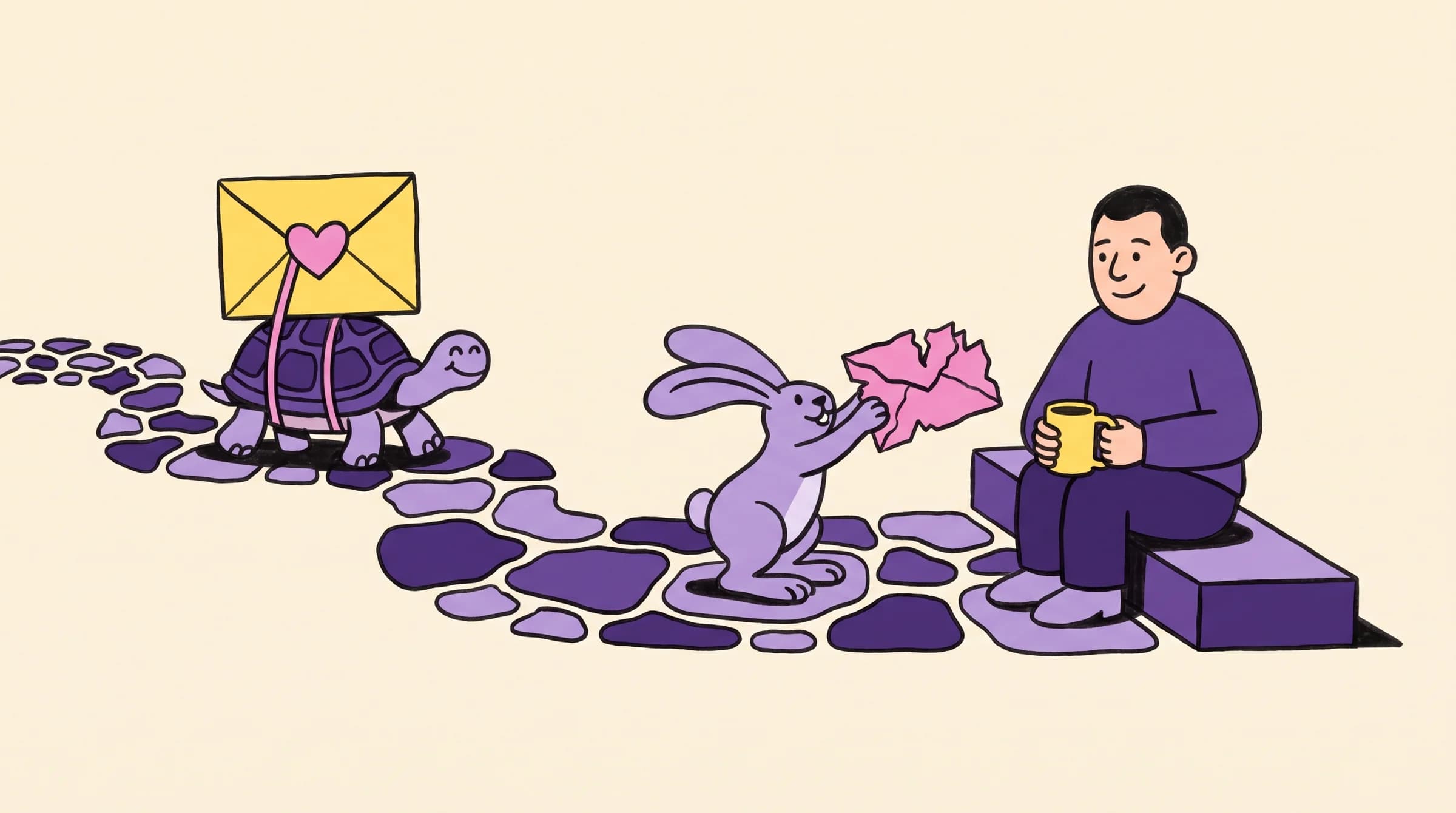
People answer fast. Campaigns pay out slowly. Both are true.
Our numbers line up with research on ordinary email. A study of 16 billion Yahoo emails found half of all replies came within 47 minutes and over 90% within a day. A Microsoft Research study of one company's email from 2000 and 2001 found people took twice as long to answer someone outside the company, a median of 135 minutes against 66 for colleagues. Cold email is about as outside as email gets. Our median, 106 minutes, sits between the two.
Robots are faster still. The median out-of-office reply came 25 seconds after the email, and 98.5% came within the hour.
Why do published cold email reply times disagree?
Because they count different things.
| Source (checked October 2026) | What was timed | Within 1 hour | Within 24 hours | Within 3 days |
|---|---|---|---|---|
| Smartlead, 850M+ emails, H1 2026 | All replies, from the email answered. Doesn't say if auto-replies count | 64% | 88.5% | 93.9% |
| CIENCE, 6M rows, 2021 | Replies to cold email | 19% | 87% | Not given, 99.5% by day 7 |
| Noon, 172 replies to recruiters' cold emails, summer 2026 | From the first email | Not given | 39% | Not given, 79% by day 7 |
| Kenso, 686 human replies, Feb-Aug 2026 | People only, from the email answered | 42% | 84% | 95% |
| Kenso, the same replies | People only, from the first email | 18% | 35% | 44% |
Two things move these numbers more than anything about your prospects.
The clock. "From the email they answered" and "from the first email" can be days apart. Noon timed from the first email and got a median of 2.1 days, close to our 3.3.
The robots. Sales.co looked at 2M+ cold emails and found 45.1% of replies were auto-replies. Mix our human and robot curves at that share and you get 68% within an hour and 91% within a day. Smartlead reports 64% and 88.5%. The fit isn't perfect. At three days the mix says 97% and Smartlead says 94%. Smartlead's page doesn't say what it counts, so I can't prove this. It's the simplest explanation I can find.
The math is simple enough to check yourself. Out-of-office messages arrive within the hour almost every time, and people do about four times in ten. So once robots make up more than about 30% of the replies in a dataset, they outnumber people in its "within an hour" bucket.
When a reply-time stat counts out-of-office messages, its "within an hour" share is mostly robots. Count only people and about four in ten replies arrive within the hour.
Is a fast reply good news?
Not necessarily. Fast replies lean no. The median no, meaning not interested, wrong person or remove me, arrived 1 hour 15 minutes after the email. The median yes took 3 hours 28 minutes.
When we compared replies inside the same client's campaigns, a reply that took six hours or more was 1.65 times as likely to be a yes as a faster one. Pooled across clients, replies that took over a day were 1.9 times as likely to be a yes as replies that came within 15 minutes.
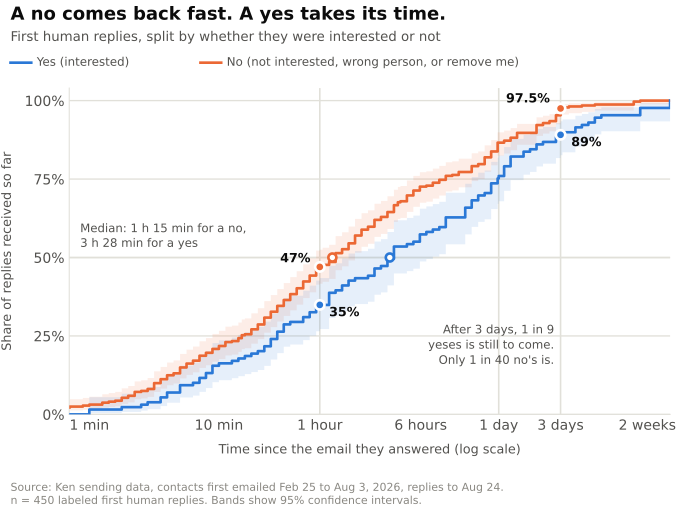 Source: Kenso sending data, contacts first emailed Feb 25 to Aug 3, 2026, replies to Aug 24. n = 450 first human replies with a yes or no label from Kenso's reply classifier. Bands show 95% confidence intervals.
The tail matters more than the median. Three days after the email, 97.5% of the no's had arrived but only 89% of the yeses. Inside the same client's campaigns, a yes was 5.6 times as likely as a no to arrive more than three days late. Late replies are rare, so the likely range is wide, 2.1x to 15x. The gap held without our largest workspace too.
Saying no is quick. "Not interested." "Take me off your list." You can type it on your phone between meetings. A yes usually needs a look at the calendar or a word with a cofounder first. A no takes one line. A yes takes a calendar.
What that means in practice:
- Don't read a campaign's mood from the first hour. The first replies to any email skew toward no. That's timing, not a verdict.
- Leave the last email alone for a week. One in nine yeses shows up more than three days after the email it answers, so don't mark anyone as a non-responder before then.
- Answer the yes the same day. We cover the rest in how to handle cold email replies.
Does the time you send change how fast prospects reply?
A lot. Here's how long people took to answer, by when the email landed in their own time zone:
| Email landed (recipient's local time) | Human replies | Median wait | Within 1 hour | Within 24 hours |
|---|---|---|---|---|
| Weekday morning, 7am-noon | 200 | 1.0 hour | 51% | 87% |
| Monday-Thursday afternoon, noon-5pm | 228 | 1.1 hours | 50% | 90% |
| Friday afternoon, noon-5pm | 61 | 2.4 hours | 38% | 79% |
| Weekday evening or night, 5pm-7am | 59 | 5.6 hours | 34% | 86% |
| Saturday or Sunday | 138 | 7.2 hours | 23% | 70% |
Source: Kenso sending data, Feb-Aug 2026, n = 686 first human replies. Small rows are rough. The evening median could be anywhere from about 1.5 to 13 hours.
The Microsoft study found the same shape in company email. Morning and afternoon emails got answered in under an hour. Evening and night emails waited over seven hours, and weekend emails took 13 to 30 times longer than weekday ones.
So count business days, not calendar days. Emails that landed Friday to Sunday got 73% of their human replies within a day, against 90% for Monday to Thursday. Weekend replies do happen. 64% of the replies to weekend emails came on the weekend itself. They're just slower, and fewer people write them.
What day and time get the most cold email replies?
Early morning, and probably Thursday. We compared the human reply rate per email for each send day and two-hour slot against all the others. Each comparison stayed inside the same client, sequence step and time zone, so one client that happens to send on Thursdays can't fake a Thursday effect.
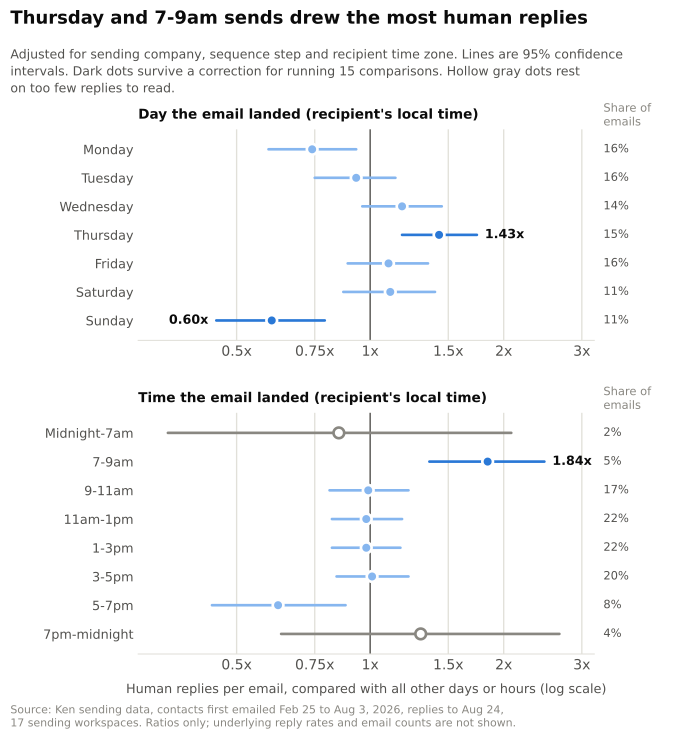 Source: Kenso sending data, contacts first emailed Feb 25 to Aug 3, 2026, replies to Aug 24, every email sent to them across 17 sending workspaces. Lines show 95% confidence intervals. Only ratios are shown.
We tested 15 days and time slots at once. With that many tries a few look good by luck, so we used a stricter bar. Three results cleared it: Thursday at 1.43x the human replies of other days, Sunday at 0.60x and 7-9am at 1.84x. The Sunday number stings, because 11% of our own emails landed on a Sunday in the recipient's time zone. From 9am to 5pm, every two-hour slot sat between 0.98x and 1.01x, so 10am versus 2pm doesn't matter.
The 7am slot is the sturdiest. It held at 1.65x without our largest workspace. Thursday shrank to 1.28x without it and could be no real effect.
Monday at 0.74x and 5-7pm at 0.62x look weak too but didn't clear the bar, so treat them as hints. Friday drew no extra human replies, yet 1.48x the replies of other days once robots count. Instantly also sees the most auto-replies on Friday, when people heading into the weekend switch on their out-of-office.
Why would 7am beat 10am? My guess is the morning sweep. Microsoft's Work Trend Index found 40% of people online at 6am are reviewing email to plan their day, and the average worker gets 117 emails a day, most skimmed in under a minute. An email already waiting at that first sweep gets read before the day fills up. Our data can't prove that part.
Other studies mostly agree:
| Source (checked October 2026) | Data | Best day | Best time |
|---|---|---|---|
| Belkins | 7.5M emails, 2025 | Wednesday and Thursday | 8am-noon |
| Smartlead | 850M+ emails, H1 2026 | Not given | 6-10am, recipient's time |
| Amplemarket | 200K+ leads | Wednesday to Friday | Replies peak 7:30-8:30am |
| Instantly | 2026 benchmark report | Wednesday | Not given |
| CIENCE | 6M rows, 2021 | Wednesday | 8am |
| Sales.co | 2M+ emails, 2024-2026 | Monday for replies, Thursday for positive replies | Not given |
| Kenso | 17 workspaces, Feb-Aug 2026 | Thursday | 7-9am |
The day barely matters in big datasets. Belkins' weekdays span only 0.44% to 0.48% replies per email. The hour matters more. I'd land the email between 7 and 9am in the recipient's time zone, midweek, never on Sunday. Then I'd stop fiddling with send times and go fix the list and the offer.
How does reply timing set the gap between follow-ups?
It points to about three business days. 95% of human replies to an email arrive within 72 hours, so by then each email has done most of its work, and a longer gap mostly adds waiting. Smartlead lands on the same number and says a longer gap "gains at most the last 6.1%" of replies. Our own sequences sent email 2 a median 3.1 days after email 1, email 3 at 6.8 days and email 4 at 9.7 days.
The last email is the exception. Give it a full week before you call the sequence. That's where the slow yeses live.
When can you judge a cold email campaign?
Not before the last email has had a week to work. Here's how much of a campaign's human replies had arrived by each day:
| Days after the first email | Human replies in so far | What you can fairly judge |
|---|---|---|
| 1 | 35% | Delivery. Out-of-office replies show up within minutes, so if none arrive at all, check that your mail is landing |
| 3 | 44% | Almost nothing. You've seen the opener's replies and little else |
| 7 | 71% | An early read, if the list is large |
| 14 | 93% | Most of a four-email sequence |
| 17 | 96% | The full four-email sequence, a week after its last email |
Source: Kenso sending data, Feb-Aug 2026, n = 686 first human replies. Shares are of the human replies we had by August 24, at least 21 days after every first email. They are not reply rates.
Judge a campaign one week after its last email goes out. For a four-email sequence spread over ten days, that's about day 17.
Volume matters as much as time. With a few hundred contacts, a good campaign and a bad one differ by a handful of replies, which is noise. Our guide to cold email A/B testing covers how many people you need.
How we measured this
- Data. Contacts first emailed February 25 to August 3, 2026, with replies tracked to August 24, so everyone had at least 21 days to answer. 17 client workspaces sent the emails, and 16 of them got human replies.
- People vs robots. Our sending platform and reply classifier flag auto-replies. We also searched every human reply for auto-responder wording. 7.7% matched, and dropping them moved the within-an-hour share from 42.1% to 43.0%.
- Which email a reply answers. The last one we sent that person before the reply.
- Yes and no. Labels from Kenso's reply classifier on 450 of the 686 replies.
- Same-client comparisons. Mantel-Haenszel ratios, a standard method that compares within each workspace first so one big sender can't skew the result.
- Local time. From the recipient's own location for 60% of emails, otherwise the campaign's time zone.
- The big caveat. One workspace holds 44% of human replies. Without it the median wait is 3.2 hours instead of 1.8, but 94% of replies still arrive within three days and the yes-versus-no gap holds.
- Other limits. Most contacts were first emailed in summer, which is out-of-office season. Send times weren't random, so a campaign that sends at 7am may differ in other ways too.
Frequently asked questions
Is a reply that comes weeks later still worth answering?
Yes. In our data, slow replies leaned toward yes, not no. Among contacts we could follow for months, a few answered more than six weeks after the first email.
Should out-of-office replies count as replies?
No. They arrive in about 25 seconds, most of them on the first email, and say nothing about whether your message worked. Count them separately and use them to reschedule. We wrote up why out-of-office replies need their own handling.
Whose time zone should I use for send times?
The recipient's. 7am only helps if it's 7am where they are.
Why did nobody answer my first email but people answered the third?
The follow-up pushed the thread back to the top of their inbox. In our data, 59% of the people who replied did it after a follow-up, and so did half of the people who said yes. A one-email campaign never hears from them.
They opened it but didn't reply. Should I follow up sooner?
No. Opens are unreliable. Apple Mail's privacy protection downloads the tracking image in the background whether or not anyone reads the email. Stick to three business days. Here's why we turned open tracking off.
The short version
People answer cold email within a few hours of the email that gets them. Sequences pay out slowly, because most replies answer a follow-up. Space follow-ups three business days apart, land them at 7-9am in the recipient's time zone, and give the last email a week before you judge anything. If you'd rather have someone else run the clock, your first campaign with Kenso is free.