

Do CEOs Reply to Cold Email More Than VPs? Reply Rates by Job Title
Founders and C-level sent 2.1x the human replies of VPs, directors and managers in our data. Count auto-replies too and the ranking flips.
Cristian Frunze · Oct 30, 2026 · 12 min read
- which job titles reply most to cold email
- cold email reply rate by job title
- do CEOs reply to cold email
- cold email seniority
- who to target with cold email
- out of office replies
- cold email data

Sort a cold email inbox by job title and VPs, directors and managers look like your best audience, because they fill it. Then you open the messages. Most of them say some version of "I'm out of the office until the 14th."
Founders, owners and C-level executives reply most to cold email, and VPs, directors and managers reply least. In our data, founders and C-level contacts sent about 2.1 times as many human replies per person as VPs, directors and managers. Part of that is company size, since founders cluster at small companies. But even inside the same campaign, at the same company size, the middle of the org chart stayed the quietest group.
We measured this on contacts in 51 campaigns from 16 sending workspaces. First emails went out between June 1 and August 3, 2026, and we tracked replies to August 24. Ken runs cold email and LinkedIn outreach for B2B companies, done for you, on infrastructure we own, so every reply lands somewhere we can label it as an auto-reply, a human reply or a positive reply.
Those labels change the answer. Middle managers' inboxes answer cold email more often than founders' inboxes do. The people behind them answer less.
Which job titles reply most to cold email?
On the raw numbers, founders, owners and C-level contacts reply most, individual contributors come next, and VPs, directors and managers come last. Compare like with like and individual contributors catch up with the executives, while the middle stays last. The table compares each group with what similar contacts got, where 1.0x is average. Only replies a person typed count here. Auto-replies and out-of-office notes don't.
| Job title group | Share of contacts | All contacts together | Same campaign | Same campaign and company size |
|---|---|---|---|---|
| Founders, owners, partners | 21% | 1.25x | 1.13x | 0.99x |
| CEOs, CFOs, presidents and other C-level | 18% | 1.01x | 1.21x | 1.15x |
| VPs, directors, managers | 33% | 0.54x | 0.70x | 0.80x |
| Other individual contributors | 16% | 0.82x | 1.10x | 1.21x |
| Agents, brokers, advisors, mostly from one client | 12% | 2.04x | 1.01x | 1.01x |
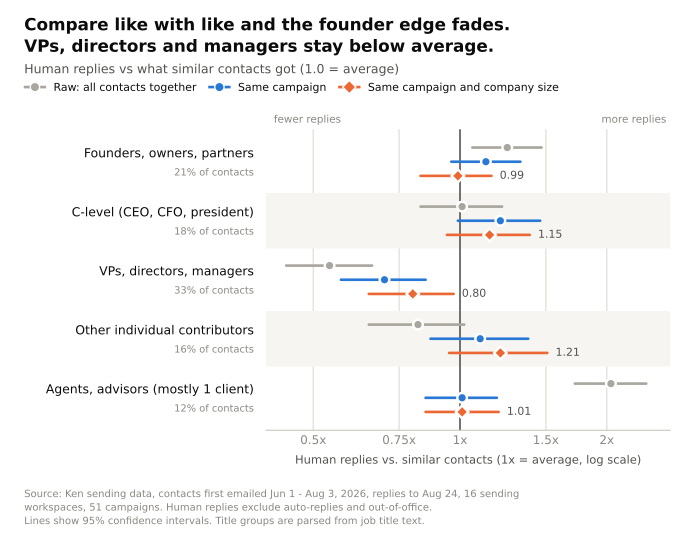 Source: Ken sending data, contacts first emailed Jun 1 to Aug 3, 2026, replies to Aug 24, across 16 sending workspaces and 51 campaigns. Lines show 95% confidence intervals.
Read the table from left to right. The first column is what most benchmark posts publish, with everyone lumped together. It mixes up who you emailed with how good the campaign was.
The agents and advisors row shows why that matters. In the first column they look like the best-replying titles anywhere, at 2x average. But 98% of them came from one client whose campaigns did well with everyone they emailed. Inside their own campaigns they replied exactly as often as everyone else, 1.01x.
VPs, directors and managers are the only row that stays below 1.0 in every column. Even against contacts in the same campaign at the same company size they came in at 0.80x. The 95% confidence range, the span the true number very likely sits in, runs from 0.65x to 0.97x. Founders and C-level contacts out-replied them in 12 of the 14 campaigns where both groups had at least 500 contacts.
Is the founder edge real, or is it company size?
The founder edge is mostly a company-size effect. 42% of the founders, owners and C-level contacts in our data worked at companies with 1 to 10 employees, against 10% of the VPs, directors and managers. Small companies reply more no matter who you email, so founders get credit for how small their companies are.
Compare each founder only with contacts at the same company size in the same campaign and the edge disappears. Founders, owners and partners land at 0.99x, right at average. C-level contacts keep a small edge at 1.15x, but the range runs from 0.94x to 1.39x and includes 1.0, so I wouldn't bet on it.
Two other large datasets show the same size effect. Belkins' study of 7.5 million emails sent in 2025 found that contacts at companies with 0 to 10 employees replied at 0.72% per email, against 0.22% at companies with 10,000 or more. Sales.co's 2026 report found that people at 1 to 10 person companies replied 75% more often than people at companies with 5,001 to 10,000 employees, their lowest group. I checked both in October 2026.
So a founder of a five-person company replies more because they run a five-person company, not because "founder" is a magic title. The gap between the top and the middle still survives the size adjustment. It shrinks from 2.1x raw to about 1.35x, with a range of 1.02x to 1.8x. Smaller, but real.
The founder advantage was widest at companies with 1 to 10 employees. By 201 to 1,000 employees the two groups were about level, though the counts get small once you split by size.
I think the reason is plain. At a small company the founder is both the buyer and the inbox, and there's nobody else to forward your email to.
The surprise was individual contributors, the engineers, account executives and analysts. Compared like with like, they replied about as often as executives, at 1.21x. They also beat VPs, directors and managers in 10 of the 11 campaigns where both groups had 500+ contacts. The 11th was a tie.
Do VPs and directors ignore cold email, or do their inboxes?
VPs and directors do both, and the inbox part is bigger than most people think. Count every reply, robots included, and VPs, directors and managers replied 1.59x as often as founders and C-level contacts in the same campaigns. Count only replies a person typed and the figure drops to 0.54x.
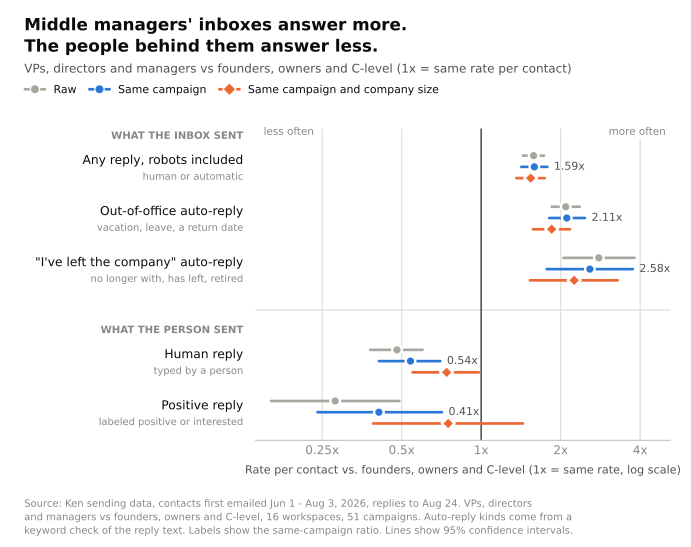 Source: Ken sending data, contacts first emailed Jun 1 to Aug 3, 2026, replies to Aug 24, VPs, directors and managers vs founders, owners and C-level contacts across 16 sending workspaces. Lines show 95% confidence intervals.
We ran a keyword check over the text of every auto-reply and sorted them by kind. Compared with founders and C-level contacts in the same campaigns, VPs, directors and managers sent:
- 2.1x as many out-of-office replies. About three in four auto-replies were out-of-office notes in both groups. The middle just sent more of them.
- 2.6x as many "I've left the company" notices. That was still 2.25x at the same company size. Founders rarely leave their own companies. Managers change jobs, and contact data lags behind them.
- About half as many human replies.
Put another way, for every VP, director or manager who typed a reply, nine more answered only with an auto-reply. For founders and C-level contacts the ratio was about two to one.
Summer vacation doesn't explain the gap on its own. Contacts first emailed in June showed the same nine-to-one ratio as the ones emailed in July.
Two things to take from that. An out-of-office reply means the email landed and the person exists, so follow up after their return date instead of writing them off. We covered that in how to handle out-of-office replies. A "no longer with the company" notice means someone else probably owns the role now. That's a job-change window if the new person fits your ICP.
Why do published studies disagree about who replies?
Published studies disagree because they count different things. Search "do CEOs reply to cold email" and you'll find studies saying executives reply more, less and about the same. Sort them by what each one counts as a reply and much of the contradiction goes away.
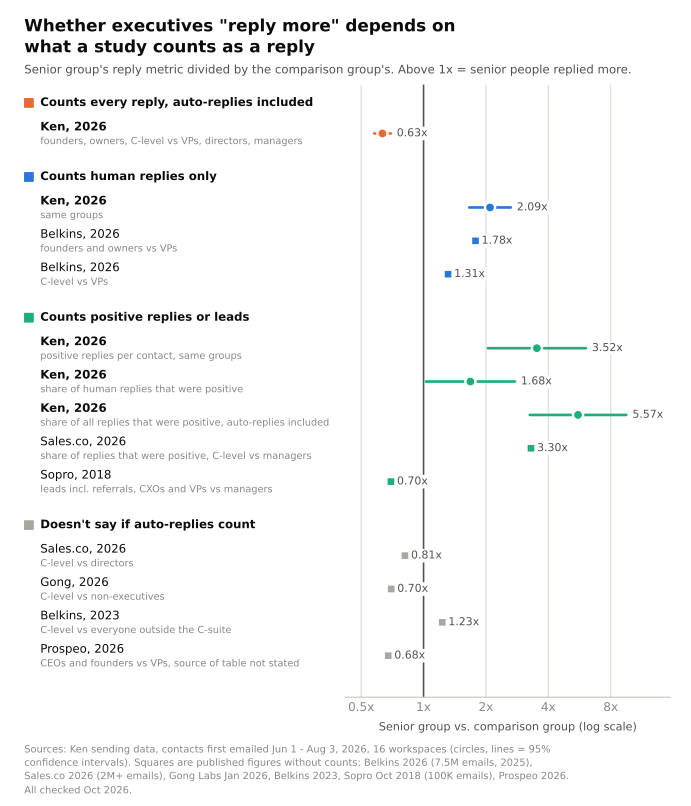 Source: Ken sending data, contacts first emailed Jun 1 to Aug 3, 2026, in the two groups compared, plus the published studies in the table below, checked October 2026. Only Ken's estimates rest on our own counts, so only they carry 95% confidence intervals.
| Source, checked October 2026 | Data | What counts as a reply | Who came out ahead |
|---|---|---|---|
| Belkins, 2026 | 7.5M emails sent in 2025 | Human replies only. Auto-replies and bounces excluded | Founders and owners at 0.57% per email, then C-level at 0.42%, then VPs at 0.32% |
| Sales.co, 2026 | 2M+ emails, 161 campaigns | Headline rate counts any reply, and 45.1% of replies were auto-replies. The job-title cut doesn't say | Directors on replies, 2.46% vs 2.00% for C-level. C-level on the share of replies that were positive, 3.3x managers |
| Gong Labs, 2026 | "1M+ executive sales cycles" | Not stated | Non-executives. C-level contacts were 30.2% less likely to reply |
| Prospeo, 2026 | A title table on a guide page. The source of the table isn't stated | Not stated, beyond counting "not interested" replies | VPs, at 11.3% vs 7.63% for CEOs and founders |
| Belkins, 2023 | Size not stated | Not stated | C-level, 6.4% vs 5.2% for everyone outside the C-suite |
| Sopro, 2018 | 100,000 emails | Leads, including referrals and "ask me later" | Heads of department at 23% above average and managers at 15% above. CXOs, a group that included VPs, came in 20% below |
| Ken, 2026, this article | Contacts first emailed Jun 1 to Aug 3, 2026, 16 workspaces | Split three ways | The middle on any reply, at 1.6x. Founders and C-level on human replies, at 2.1x, and positive replies, at 3.5x |
Here's the pattern. Every study that puts VPs, directors or managers on top either doesn't say whether it removes auto-replies or counts something other than replies. The two datasets that clearly strip auto-replies out, Belkins' and ours, both put founders and owners well above VPs. Belkins ranks VPs last of the three groups it measured.
Sales.co's headline rate counts every reply, and almost half its replies were auto-replies. Its job-title section doesn't say whether it removes them, but its result, directors above C-level, is exactly what our data shows when we count the robots too. Gong's result is the one I can't place from the outside, because it doesn't say what counts as a reply or who the non-executives were.
If a benchmark doesn't say whether it counts auto-replies, its job-title ranking can't be trusted. That goes for ours too, which is why we split every number three ways.
Do founders say yes more often, or just reply more?
Founders and C-level contacts sent about 3.5x as many positive replies per person as VPs, directors and managers. Inside the same campaign it was 2.4x. At the same company size it shrank to 1.3x, with a range that includes 1.0. So the yes gap is mostly a company-size gap too.
The robots bend this number as well. Take the share of replies that were positive. Divide by human replies only, and a founder's or CEO's reply was about 1.7x as likely to be positive as a middle manager's. Divide by every reply, out-of-office notes included, and the same data says 5.6x, because the middle's pile of auto-replies drags its share down.
Sales.co found that C-level replies were 3.3x as likely to be positive as managers' replies. Its method divides positive replies by all replies in a group and doesn't say whether auto-replies come out first. Its 3.3x sits between our two answers. Positive replies are rare, though, so read all of these as a direction, not a precise multiplier.
Founders and C-level contacts also answered faster. 40% of their human replies came within 24 hours of the first email, against 28% for the middle. About half their replies answered the first email, while two in three of the middle's came after a follow-up. Campaigns send different numbers of follow-ups, so read that loosely. Still, when you email the middle, the follow-ups do more of the work.
Which title should you email at each company size?
Pick by company size first and job title second. Here's what I'd do with this data:
- Under about 50 employees, email the founder or CEO. They're the buyer, they answer faster, and nobody filters their inbox.
- From 50 to 200 employees, email the executive who owns the problem, or the person who does the work. Individual contributors replied as often as executives in like-for-like comparisons. They can't sign, but they can tell you who can.
- At bigger companies, don't default to a VP or director just because the title sounds like a buyer. Email them when they clearly own the problem, and plan for more follow-ups.
- Re-check middle managers close to send day. Even at the same company size, they were 2.25x as likely to send back a "no longer with the company" notice.
Pick titles by who can say yes, not by who should care. Our data gets thin above 200 employees, so point 3 is more judgment than measurement. All four start with building the lead list around your ICP, long before anyone writes an email.
What can't this data tell you?
- It's a summer cohort. Out-of-office replies run high from June to August. The pattern held in both June and July, but the size of the gap may differ in other months.
- Same campaign isn't the same email. Campaigns often give each persona its own copy, so a VP and a founder in one campaign may have read different emails.
- The data comes from 16 workspaces. The biggest holds about 39% of contacts, and Ken's own outbound is one of them. Still, the top beat the middle in all 6 workspaces with 1,000+ contacts in both groups.
- We grouped titles by their text. We counted "managing director" as C-level and "head of" as director, so some edge cases land in the wrong group. The seniority field from our enrichment data shows the same pattern.
- A human reply isn't a meeting. Human replies include "no thanks" and "take me off your list." More human replies means more conversations, not more booked calls.
- There are no absolute reply rates here. This compares groups. It isn't a benchmark. For that, see what a good cold email reply rate is.
Frequently asked questions
Do CEOs actually reply to cold emails?
Yes, more than most titles. C-level contacts sent about 1.2x the human replies of similar contacts in the same campaigns. In Hunter's 2026 survey of decision makers, 32% said they'd replied to five or more cold emails in the past year and 33% said they'd replied to none.
Should I email the CEO or the VP at a mid-size company?
Start with whoever owns the problem. If that's unclear, email the executive who owns the budget, or a hands-on individual contributor. VPs, directors and managers trailed both groups in our same-campaign, same-size comparison.
Are out-of-office replies a bad sign?
No. An out-of-office reply means your email was delivered and the address belongs to a real person. Pause and follow up after the return date. A "no longer with the company" reply is different, so find out who replaced them.
Why do some benchmarks say directors or VPs reply more than CEOs?
Usually because they count auto-replies, or don't say whether they do. Directors and managers send far more out-of-office messages, which pushes up their reply rate. Count only replies a person typed and the ranking flips.
Does job title matter more than company size?
Company size explained most of the founder edge in our data. The gap for VPs, directors and managers survived it, at 0.80x average even against contacts at the same company size.
Where to start
Email the person who can say yes, and judge every list by human replies, not inbox noise. If you'd rather have a team pick the titles, write the emails and read every reply for you, your first campaign is free.