
How Web Design Agencies Get Clients with Cold Email
Pair a company change with one flaw they can see on their phone. We checked 248 B2B sites: 1 in 3 showed a redesign signal, 1 in 8 provably failed mobile speed.
Cristian Frunze · Oct 21, 2026 · 12 min read
- web design agency cold email
- how to get web design clients
- website redesign leads
- core web vitals cold email
- cold email for agencies
- buying triggers

Run a company's homepage through Google's PageSpeed Insights on mobile, and there's a good chance it comes back red. The median site in HTTP Archive's August 2026 test of millions of sites scored 48.5 out of 100. So "your site scored 41" tells a founder something true of half the internet.
Web design agencies get clients with cold email by pairing a change at the company, like a rebrand, a raise, a launch or a new head of marketing, with one flaw the founder can check on their own phone. Then they offer a small first step, not a full redesign.
I wanted to know how often the "your site is broken" pitch is true, and whether you can prove it. So on October 8, 2026 we checked the homepages of 168 random US B2B companies with 11 to 200 employees from Ken's company database, plus 80 that raised money in the last 120 days. Then we pulled Google's real-user speed data for each one. Three results changed how I'd write these emails:
- Most B2B sites look fine to a machine. Only 35% of the random sites showed any redesign signal we could measure.
- You can prove a speed problem for about 1 in 8. Google had no mobile speed data at all for 72% of them.
- Funded companies have less visible mess, but not faster sites. They had a stale footer, no HTTPS or no mobile layout a third as often, 5% against 15%. They failed Google's mobile speed test just as often, 11% against 12.5%.
A broken website tells you a company could use you. A change at the company tells you when. You'll rarely find both at once, so run two lists with two different emails.
Which triggers mean a company needs a new website?
Website redesign triggers come in two kinds. Need signals say the site has a problem. Timing signals say something changed at the company, so the site is now behind the business even if it works fine.
| Trigger | Type | Why it matters | Where to spot it |
|---|---|---|---|
| Rebrand: new name, logo or domain | Timing | The site has to follow, often by a set date | LinkedIn, press release, new domain |
| Funding round in the last few months | Timing | Budget, and pressure to look bigger | SEC Form D on EDGAR, press |
| New product or new market | Timing | New pages and a new story, often by a launch date | Launch posts, changelog |
| New head of marketing | Timing | A new owner, open to new vendors | LinkedIn job changes |
| Hiring a web developer or designer | Timing | They already know there's work | Job boards |
| Fails Core Web Vitals | Need | Real visitors wait, and Google uses it in ranking | Top of PageSpeed Insights |
| Footer year 2024 or older, dead blog | Need | Nobody owns the site | Footer, blog, sitemap dates |
| Old WordPress, jQuery or PHP | Need | Security holes and skipped upkeep | Page source, Wappalyzer |
One warning on funding. Having raised money at some point is not a trigger. In our sending data (contacts first emailed February to August 2026, across 17 workspaces), people at companies with any funding round on record replied at 1.01x the rate of people at same-size companies in the same campaigns. Only fresh money might matter, so check the date. A company raising a private round under Regulation D must file a Form D within 15 days of the first sale, which makes EDGAR a quick public place to spot a raise.
New marketing leaders work the same way. A new VP is a window, not a buying signal, and signal-based outbound covers how to stack events like these.
How often do B2B websites actually show a redesign signal?
B2B websites show a measurable redesign signal less often than most agency playbooks assume. Of the 150 random B2B sites that loaded, 52 (35%) had at least one. Two thirds showed none.
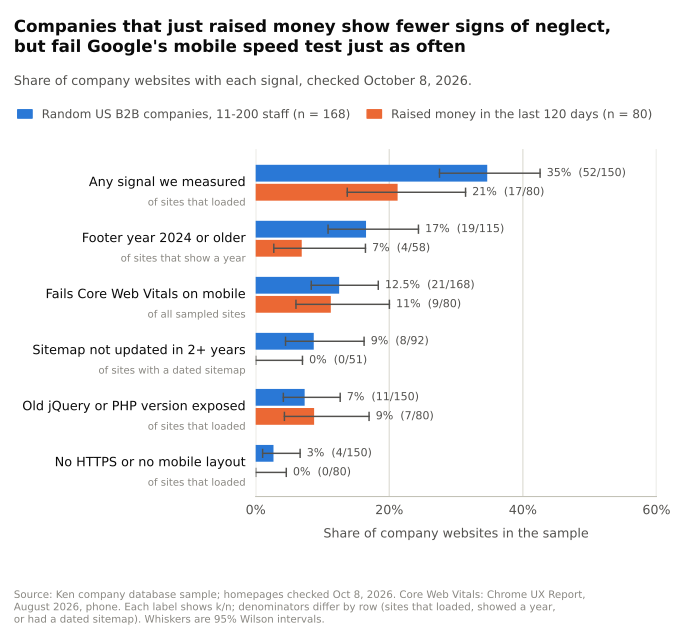
Source: Ken company database sample, 248 homepages checked October 8, 2026 (168 random US B2B companies with 11-200 staff, 80 funded in the last 120 days). Core Web Vitals from the Chrome UX Report, August 2026. Whiskers show 95% Wilson intervals.
- "Your site isn't mobile-friendly" is dead. One site in 150 had no mobile layout. Four had no working HTTPS.
- Stale footers are the most common visible sign. 19 of the 115 sites that show a year (17%) still said 2024 or earlier.
- Funded companies run newer sites. Their median founding year was 2020, against 2000 for the random group, and 31% of their sites ran on Webflow, Framer or Next.js, against 13%.
The gap between the groups, 21% against 35%, is real but modest. A Fisher exact test gives p = 0.04, which means luck alone would produce a gap this big about 4% of the time. And the gap comes from neglect, not speed. Funded companies had fewer stale footers and not one sitemap left untouched for two years, but they failed Google's mobile test at the same rate. A newer stack isn't a faster one. In HTTP Archive's data, only 35% of Next.js sites pass on mobile, against 49% of WordPress sites.
A script can't judge taste, either. A site can pass every check here and still look like 2016. So read 35% as the floor for "provably neglected," not the share of companies that could use a better site.
Split the list. Companies with a provable flaw get an email that leads with the flaw. Companies with a fresh trigger get one that leads with the change: "your site was built for the company you were before the raise."
Is "your site fails Core Web Vitals" a good cold email hook?
Core Web Vitals are Google's three speed checks, measured on real visits. The main content should show up within 2.5 seconds, the page should react to a tap within 200 milliseconds, and the layout shouldn't jump around, per web.dev. A site passes when at least 75% of visits are good on all three.
The Core Web Vitals hook works only when you can prove it, and for most small B2B sites you can't. Google's real-user data, the Chrome UX Report, grades a site only when enough Chrome users visit it, and it doesn't publish the cutoff. In our random sample, 72% of companies had no mobile grade at all.
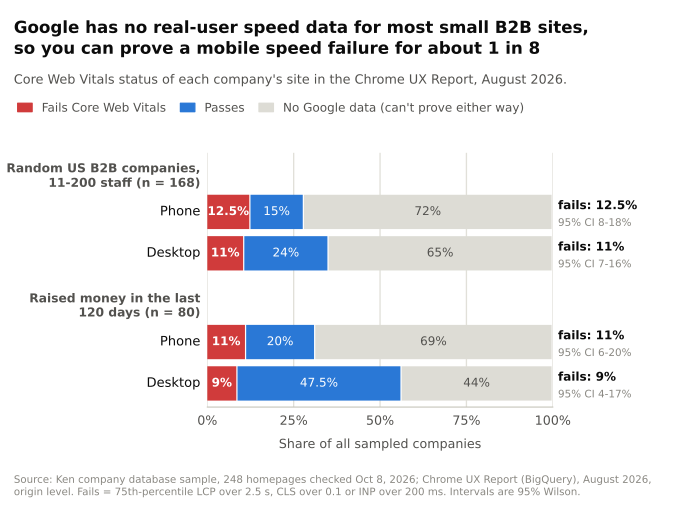
Source: Chrome UX Report (BigQuery), August 2026, for the 248 companies in our October 8, 2026 sample (168 random US B2B companies with 11-200 staff, 80 funded in the last 120 days). Intervals are 95% Wilson.
- When Google does grade a site, failing is common. 21 of the 47 graded sites (45%) failed on mobile. That's close to the web overall, where HTTP Archive's Core Web Vitals report shows 53% of 8.7 million mobile sites passing in August 2026. Home pages, the page you'll point at, pass less often than inner pages, 45% against 56% on mobile in the 2025 Web Almanac.
- Check desktop too. More sites had desktop data than mobile data, 35% against 28%. Counting a failure on either device lifts the share you can prove from 12.5% to 18.5%.
- Bigger companies don't change the math. Google graded 48% of the sites at companies with 51 to 200 staff, against 23% at 11 to 50, but the bigger sites passed more often. The share you could prove fails stayed near 1 in 8 for both. The bigger group is only 31 companies, so treat that as a hint.
The platform a prospect uses tells you a lot.
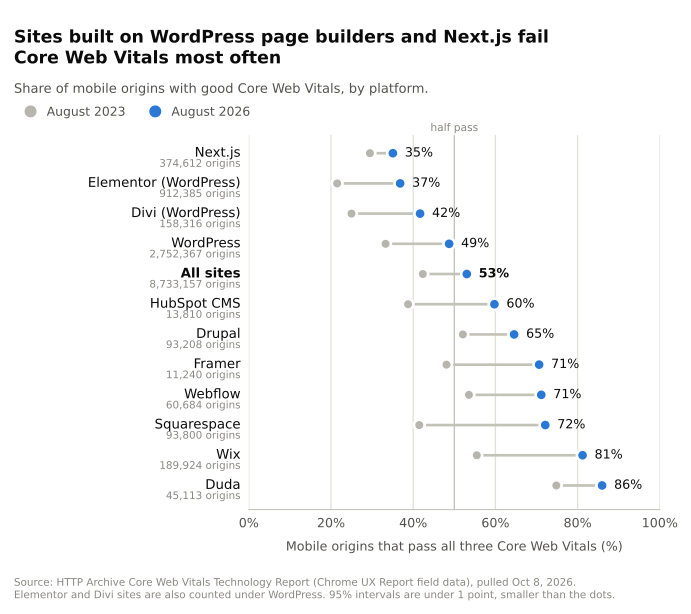
Source: HTTP Archive Core Web Vitals Technology Report (Chrome UX Report field data), August 2023 and August 2026, pulled October 8, 2026. n = 11,240 to 8.7M origins per row, so 95% intervals are under 1 point.
Only 37% of sites built with Elementor and 42% built with Divi, two WordPress page builders, pass on mobile, against 81% on Wix and 86% on Duda. My read is that hosted builders control the whole stack, while a page-builder site carries every plugin its last developer installed. Wappalyzer or BuiltWith shows the platform in seconds, and 31% of our random B2B sites ran Elementor or Divi.
Three rules keep the hook honest:
- Quote the field data, not the score. The 0-100 PageSpeed number is a lab test on a simulated phone, and Lighthouse colors anything under 50 red. About half of all sites score red, yet 53% pass with real users. If PageSpeed Insights shows no real-user data, don't claim they fail Google's test.
- Name the element. In 27 of the 30 failures we found, the main content loaded too slowly. That's a hero image or headline you can point at.
- Sell leads, not rankings. Google uses Core Web Vitals in ranking but "always seeks to show the most relevant content, even if the page experience is sub-par" (checked October 2026). Conversion is the stronger case. In Portent's 2022 study of 14 B2B lead-gen sites, pages that loaded in 1 second converted at 3x the rate of 5-second pages. It's a correlation, but it's the language a founder cares about.
How do you show, not tell, in a web design cold email?
Showing means naming one thing the founder can open on their phone and see. "Your site could use a refresh" is telling. "On an iPhone, your new product shows up four scrolls down, under a logo bar from 2023" is showing.
The structure I'd use:
- One problem, named precisely. Which page, which device, which element.
- Tied to the trigger. Why it matters now.
- Proof offered, not attached. The video or mockup goes out after they say yes.
That third rule may also help you reach the inbox. In our data (first emails sent late February to early August 2026, across 16 workspaces), we compared first emails with and without a link inside the same campaign and send week. Human replies came in at 0.73x, with an interval from 0.48 to 1.11, so that part isn't settled. Auto-replies fell to 0.51x (0.41 to 0.64). Gmail doesn't send vacation replies to mail in spam, so that drop could mean more link emails missed the inbox.
I'd call it a warning sign, not proof. Most of the comparison comes from a few campaigns that switched templates over one weekend in late June. Their auto-replies were already falling the week before the switch, and on days when both versions went out, auto-replies pointed the other way. Most of those links were click-tracked signature links, and tracking adds risk for little gain, the same reason we turned off open tracking.
An example built on those rules:
Subject: the add-on, on mobile
Hi Dana,
Saw you launched the analytics add-on last month. Congrats.
On an iPhone, the homepage still leads with the old tagline, and the add-on doesn't appear until the fourth scroll. Google's real-user data also has your mobile pages loading their main image in about 3.4 seconds, past its 2.5-second line.
I recorded a 2-minute video with three fixes I'd make before your next campaign. Want me to send it?
Sam
No link, no attachment, no "quick call." Just a yes or no to something useful.
What offers work better than a free redesign mockup?
Web design offers that work are small, specific and tied to the reason you emailed. Nobody decides on a full redesign from a cold email, and a free mockup costs you hours for a prospect who hasn't said yes to anything.
| Offer | What you send | Your cost | Best for |
|---|---|---|---|
| Three-fix teardown, on request | A 2-minute video or three marked-up screenshots | Low | Need-led list |
| Trigger-scoped sprint | A launch page for the new product, or the rebrand rollout | Small project | Timing-led list |
| Speed fix with a target | Fix the main templates, then show the pass in Google's real-user data a month later | Medium | Sites that fail on real-user data |
| Homepage concept | A designed mockup of their homepage | High | Your top 10 to 20 dream accounts |
If I ran a web design agency, I'd lead the need-led list with the teardown and the timing-led list with the sprint. Tying part of the fee to a result, like passing Core Web Vitals, also makes the yes easier and shows you trust your own work.
How many companies do you need to screen to find good prospects?
How many companies you screen depends on which signal you require. Using our sample rates, here's what it takes to find 100 prospects among random US B2B companies with 11 to 200 employees.
| Filter | Share of random B2B companies (95% CI) | Companies to screen for 100 prospects |
|---|---|---|
| Any redesign signal we measured | 35% (28-43%) | About 290 (235-365) |
| Fails Core Web Vitals on phone or desktop | 18.5% (13-25%) | About 540 (400-750) |
| Footer year 2024 or older | 13% (8-19%) | About 790 (530-1,200) |
| Provably fails mobile Core Web Vitals | 12.5% (8-18%) | About 800 (545-1,200) |
| Funding round in the last 120 days | 0.1% | About 100,000 |
The last row is the one to sit with. In Ken's company database, 414 of 415,108 privately held US companies with 11 to 200 employees had a funding round recorded in the last 120 days. Funding records miss some rounds, so the true share is higher, but it's still small. One timing trigger can't fill a list. Stack several, like rebrands, launches, new hires and funding, and check for them every week.
Need gives you volume. Timing gives you a reason to write today. You want both lists running.
Frequently asked questions
Is it rude to point out problems with someone's website?
It's rude when it's vague or smug. "Your site looks outdated" insults whoever built it. "The add-on you launched is four scrolls down on mobile" is a useful fact they can check.
What subject line should a web design cold email use?
Use a few lowercase words about their thing, like "the add-on, on mobile." Skip "website redesign" and "quick question." Both read as a pitch before the email is even open.
How many follow-ups should a web design cold email sequence have?
Plan for three or four. In our sending data (February to August 2026, 686 first human replies, 17 workspaces), 59% of first human replies came after a follow-up, not the first email. Give each follow-up one new detail, like a second observation or a short before-and-after.
Do I need a separate domain for cold email?
Yes. Send from separate, warmed domains so a bad week never touches the domain your clients and invoices use. At Ken we never send from a client's primary domain, and new domains warm up for 2 to 4 weeks before the first campaign.
Get your first campaign built free
Ken runs cold email and LinkedIn outreach for B2B companies, done for you, on infrastructure we own. Human copywriters build the framework, AI fills it with real prospect data, a quality check reviews every email, and nothing goes out until you approve it. If you run a web design agency and want a campaign built around real triggers, your first campaign is free.