
AI SDR vs Human SDR: The 90/10 Split Nobody Talks About
AI SDR vs human SDR is the wrong fight. Automate ~90% of outbound machinery; keep a human on the ~10% that is writing someone wants to read.
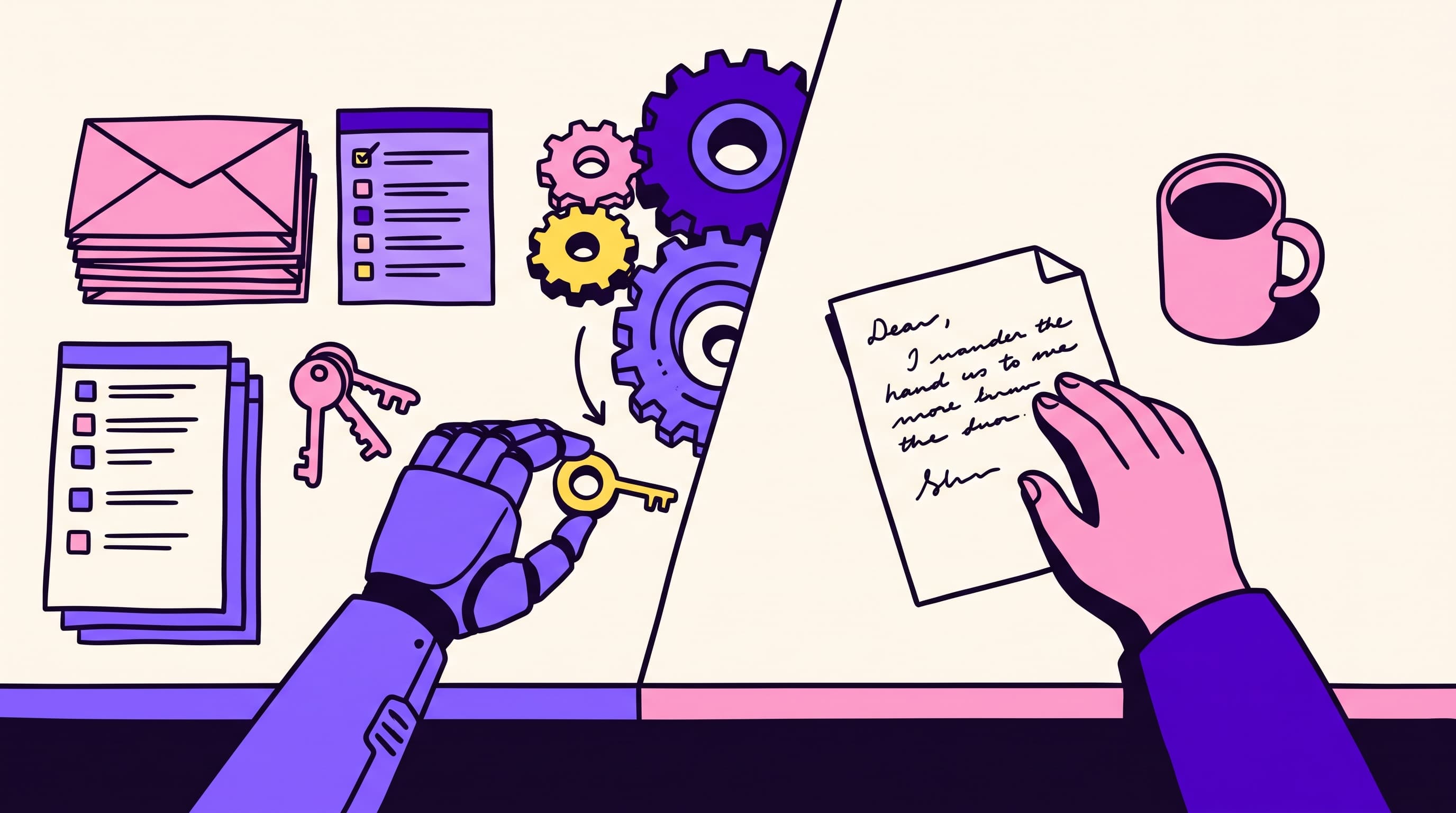
An AI SDR automates outbound machinery — lists, enrichment, sequencing, first drafts — at software cost. A human SDR owns judgment and writing. The real split is not AI versus human: automate roughly 90% of the machinery, and protect the ~10% that is a person writing something another person wants to read.
Every comparison page on this query ends the same way: “hybrid wins.” Then it sells software that is not hybrid. The honest version names which half of the job is machinery and which half is writing — and refuses to pretend an agent that authors and sends unsupervised email is doing the half that decides whether anyone replies.
What is an AI SDR?
An AI SDR is a product category, not a job title with a pulse. In 2026 it usually means software (sometimes marketed as an “agent”) that chains top-of-funnel tasks:
- Building or scoring lead lists from ICP rules and intent signals
- Enriching contacts (title, company, email, tech stack, recent activity)
- Drafting personalized email and LinkedIn copy
- Running multi-step sequences and follow-ups
- Classifying replies and routing interest toward a calendar
Vendor demos that promise end-to-end autonomy still depend on data quality, sending infrastructure, and a human who owns brand risk. Every automated message goes out under your name — hallucinations, stale openers, and domain burn are your problem, not the vendor’s.
Can AI replace an SDR?
No — not the whole job, and not sustainably as an unattended author of cold email.
What AI can replace is repetitive machinery that used to eat junior SDR hours: research grunt work, list hygiene, sequence logistics, first-pass drafting, and CRM busywork. 2026 write-ups keep landing on the same pattern: junior volume roles shrink; reply-specialist roles do not. High annual churn on full-replacement AI SDR tools (often cited at 50–70% across sales-tech analyses) is the market voting with its feet.
What AI still fails at, reliably:
- Knowing which detail is worth opening with (vs. the first fact a scraper found)
- Writing in a voice a real buyer trusts on a cold first touch
- Multi-turn objection handling and political buying committees
- Deciding a meeting is qualified, not merely booked
- Owning brand and deliverability consequences when volume goes wrong
If the only skill someone brought to SDR work was “send a lot of mediocre email,” automation is a threat. If the skill was judgment and writing, automation is leverage — or it should be.
The 90/10 split nobody puts on the pricing page
Here is the framing we run at Ken, after sending outbound at real volume on infrastructure we own.
Roughly 90% of outbound is machinery. Lists. Enrichment. Verification. Domains and inboxes. Warmup. Authentication. Sequencing. Reply routing. Monitoring. Reporting. That work is expensive in human hours, boring when done well, and catastrophic when done badly. It should be automated hard.
Roughly 10% decides whether anyone replies: a human deciding the offer, the angle, and the words a real person might want to read — then approving what goes out. That is not “reviewing a dashboard.” That is authorship.
The category error in most AI SDR pitches is optimizing the wrong half. They sell autonomy on the 10% (the email writes and sends itself) while still leaving you to assemble the 90% (data vendors, sequencers, warmup tools, domain babysitting). The teams that actually get cheaper pipeline flip it: automate the 90, protect the 10.
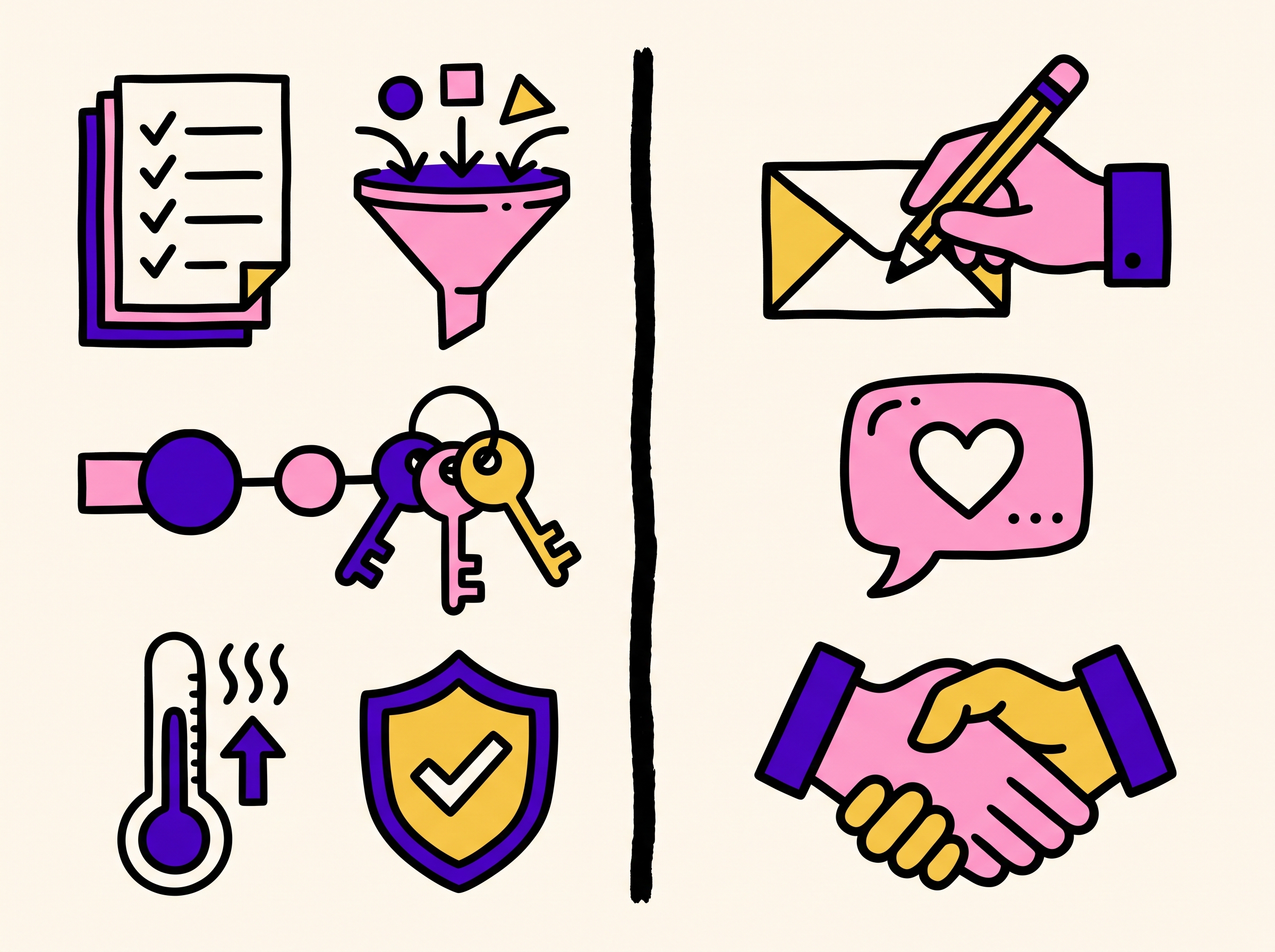
This is also why Ken’s position is easy to misread if you only hear “AI.” Our AI fine-tunes, personalizes, and quality-checks against a fixed bar. A human still owns the framework and the final approval. We reject the pitch that AI authors cold email unsupervised. Details of how personalization and QA actually work live in What Is AI Email Personalization? and How to Write and QA Cold Email at Scale.
What do AI SDRs actually do well?
Put AI on the work humans hate and that scales cleanly:
| Task | Why AI fits |
|---|---|
| Account research at breadth | Synthesizes public signals faster than tab-hopping |
| List building and enrichment | Rules + data joins beat spreadsheet archaeology |
| Email verification and hygiene | Multi-pass checks before the first send |
| Sequence logistics | Cadence, pauses on reply, follow-up discipline |
| First-draft personalization from real data | Fills a human framework with prospect-specific detail |
| Reply classification (first pass) | Sorts OOO / not interested / maybe / interested at volume |
| Coverage across time zones | Does not sleep on inbound or signal spikes |
Used this way, AI is a capacity multiplier: one sharp human supervises far more accounts because they are not copy-pasting LinkedIn headlines all day.
Where do AI SDRs fail?
The failure modes are consistent across 2026 operator write-ups (Leadium, Knowlee, Vantaige, Close, and peers):
- They optimize cost-per-touch, not cost-per-qualified-meeting. Thousands of sends look cheap until you divide by meetings that show and convert.
- Unsupervised personalization is often spam texture. Hype words, em-dashes, stale recency claims — patterns filters and tired buyers reject. We measured naive AI personalization underperforming no personalization on a large internal test; the fix was a second pass that strips machine tells. See Why AI Personalization Gets Your Cold Email Flagged as Spam.
- Meeting quality drops when no human re-qualifies. AI books curiosity. Humans book people who can buy.
- Deliverability is not a feature checkbox. High-volume automated outreach on infrastructure you do not control is unlimited surface area for reputation damage.
- Full autonomy rarely sticks. Operator-reported data keeps showing teams adding humans back into the loop after pure-AI experiments quietly die.
If a vendor’s ROI model assumes cold reply rates well above industry bulk averages without recent customer data, treat the model as a sales deck.
What should a human always own in outbound?
Use this as the extractable split. If a tool claims to “own” a row in the human column unsupervised, you are buying risk.
| Task | Safe to automate heavily | Human must own |
|---|---|---|
| ICP definition and offer | Draft options, cluster accounts | Final ICP, positioning, pricing narrative |
| List building and enrichment | Yes | Spot-checks, exclusions, brand-sensitive accounts |
| Email verification | Yes | Policy on catch-alls / risky data |
| Domains, warmup, inbox placement | Yes (if the platform owns infra) | Escalation when placement tanks |
| Sequence structure and timing | Yes | Strategy: touches and what changes each time |
| Email framework and voice | Draft variants | Authorship of the framework |
| Per-prospect personalization | AI fills inside the framework | QA bar and approval before send |
| First-touch cold email send | Operational sending | Permission to send under your brand |
| Reply handling | Classify and draft | Live conversation and judgment |
| Qualification and booking | Calendar logistics | “Is this a real opportunity?” |
| Enterprise / high-ACV / named accounts | Research assist only | Relationship and multi-thread politics |

Notice what is not in the automate column: unsupervised authorship of the email that represents your company. That is the 10%.
Is an AI SDR cheaper than hiring an SDR?
On sticker price, almost always yes. On cost per qualified meeting, only if quality holds.
Human SDR (fully loaded, US, 2026): roughly $100k–$180k per year once you add base, variable, benefits, tools, management, recruiting, and ramp. Ken’s breakdown lands about $120k–$180k fully loaded, with ~3 months to productivity — full math in Cold Email Agency vs. In-House SDR.
AI SDR software: public tiers commonly run from a few hundred dollars a month to roughly $1,000–$7,000+ for serious platforms (enterprise higher, often annual). That sticker usually excludes data, domains, warmup, and human hours to prompt, QA, and handle replies.
| Cost line | AI SDR path | Human SDR path |
|---|---|---|
| Platform / salary | Software subscription | Fully loaded comp |
| Data and enrichment | Often extra | Tools + rep time |
| Sending infrastructure | Often extra (or shared pools) | Tools + domains + risk |
| Human oversight | Still required | Built into the seat |
| Ramp | Days–weeks to configure | ~3 months to productivity |
| Failure mode | Domain burn, junk meetings | Turnover, empty seat |
A $4,000/month AI stack that produces two qualified meetings is $2,000 per meeting; a $4,500/month managed human program that produces nine is $500. Those counts are illustrative — use your show rate. Cost-per-touch flatters AI. Cost-per-qualified-meeting tells the truth.
Ken’s list prices on /pricing: Core $597/mo or $1,497/quarter, VIP $4,597/mo or $13,497/quarter. Both include 5,000 leads, 1,000 emails/day, 5 LinkedIn seats. Book metrics with methodology on Why Ken and cold email benchmarks: about 3% reply, ~30% of replies positive, ~7 meetings per 10k contacts — not a guarantee for every niche. Tools vs managed motion: Cold Email Tools vs. a Done-for-You Service.
Hybrid is correct — and most “hybrid” pages still sell the wrong half
The SERP consensus in 2026 is hybrid. That consensus is right. The implementation most vendors describe is not.
Weak hybrid: AI writes and sends; a human glances at a dashboard and celebrates volume.
Strong hybrid: AI runs the machinery (list, enrich, verify, sequence ops, draft-inside-framework, classify). A human owns offer, framework, approval, live replies, and qualification. Sending happens on infrastructure someone is accountable for.
That is how high-performing teams settle after the full-replacement hype cycle — and the only version that survives mailbox providers and buyers tired of fake personalization.
How to decide in one afternoon
- Write your Reply Line. Everything before a human reply is a candidate for automation. Everything after needs a person.
- Inventory the 90%. Data, verification, domains, warmup, sequencing, monitoring. Who owns each today?
- Protect the 10%. Who authors frameworks? Who approves sends? If the answer is “the model,” stop.
- Pick the metric before the vendor. Cost per qualified meeting, positive reply share, inbox placement — not emails sent.
- Pilot in parallel. One segment on your current motion, one on the new stack, same offer, 60–90 days.
- Ask four vendor questions. Full replacement promise? Reply rate assumed in the ROI deck? Domain reputation at volume? Which human roles get redeployed rather than deleted?
FAQ
What is an AI SDR?
An AI SDR is software that automates sales-development tasks at the top of the funnel — research, list work, drafting, sequencing, and often first-pass reply sorting — so humans can spend time on judgment and live conversations. It is a product category, not a person.
Can AI replace an SDR in 2026?
It can replace much of the repetitive machinery inside the role. It does not reliably replace judgment, trusted writing, multi-turn conversation, or qualification on complex deals. Most teams that try full replacement add humans back into the loop.
What is the difference between an AI SDR and a cold email platform?
An AI SDR product markets autonomous prospecting and conversation. A cold email platform (or full outbound stack) is infrastructure and workflow for lists, sending, deliverability, and personalization. Overlap is real; the buying question is whether you are purchasing unattended authorship or controlled machinery under human approval.
Is an AI SDR cheaper than a human SDR?
Usually cheaper on subscription versus fully loaded salary. Not automatically cheaper per qualified meeting once you add data, domains, oversight, and meeting quality. Run the math on your show rates.
What should humans always do in outbound?
Own the offer and messaging framework, approve what sends under the brand, handle live replies and objections, and decide whether a meeting is qualified. Automate list ops, enrichment, verification, sequencing logistics, and draft generation inside that human framework.
Does Ken replace SDRs with AI?
No. Ken automates outbound machinery and uses AI to personalize and QA inside human-written frameworks. A human remains the author of the system and approves before anything sends. For pipeline without standing up the stack yourself, start from Why Ken or try Ken Daily for 10 verified ICP leads every morning, free.
Automate the 90. Protect the 10.
The AI SDR vs human SDR debate is only confusing if you treat “SDR” as one blob of work. Split the blob.
Machinery wants automation. Writing wants a human. Hybrid is not a compromise slogan — it is an allocation decision. Allocate automation to the 90% that never required soul. Allocate people to the 10% that decides whether your name is worth reading in a stranger’s inbox.
For a low-commitment pulse on list quality while you redesign the split, Ken Daily sends 10 verified ICP leads every morning, free forever. For the full motion — owned sending infrastructure, human frameworks, AI personalization under QA — start at Why Ken or compare agency vs in-house.