
Cold Email Opt-Out Rules: CAN-SPAM, GDPR and CASL Side by Side
CAN-SPAM, CASL, and GDPR opt-out rules in one table—deadlines, B2B scope, and why a buried unsubscribe becomes a spam-complaint problem.

Yes — commercial cold email needs a working opt-out in every major B2B regime. CAN-SPAM (including B2B) requires a clear stop path honored within 10 business days. CASL requires a readily performed unsubscribe on commercial messages. GDPR/UK GDPR gives an absolute right to object to direct marketing. A buried opt-out turns exits into spam complaints.
Not legal advice. Practical map from primary regulator guidance (FTC, CRTC/ISED, ICO). Confirm with counsel for your jurisdictions.
Most tool blogs restate CAN-SPAM’s 10-day rule and stop. Operators copy sequencer defaults for everything else. Here is the side-by-side: what each regime requires on the unsubscribe itself, how fast you must honor it, whether B2B cold is in scope, and why the same easy exit is a deliverability control.
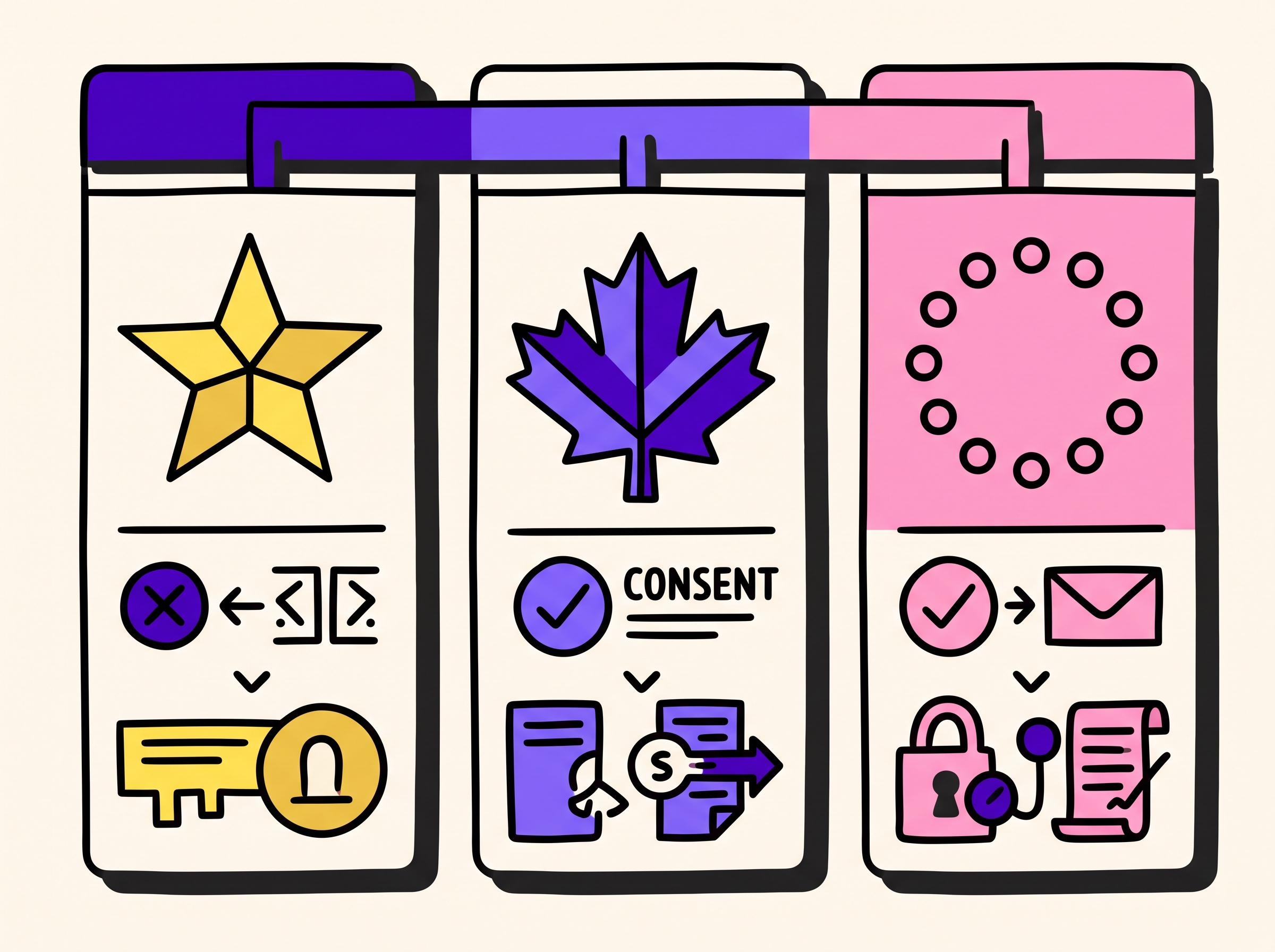
Do cold emails need an unsubscribe link?
For commercial cold email, treat a working opt-out as required infrastructure.
- United States (CAN-SPAM): Covers commercial messages promoting a product or service, including B2B. Clear opt-out on every such message (FTC).
- Canada (CASL): CEMs need consent (express or qualifying implied), identification, and a “readily performed” unsubscribe.
- EU / UK (GDPR / UK GDPR + PECR): Absolute right to object to direct marketing. UK PECR still expects a valid opt-out address for corporate email marketing even where prior consent is not required for corporate subscribers.
Separate from statute, Gmail and Yahoo bulk-sender rules (high-volume senders, commonly ~5,000+/day to the provider) require one-click unsubscribe via List-Unsubscribe / List-Unsubscribe-Post (RFC 8058) on marketing mail, plus a visible body link. Yahoo’s guidance: honor within two days. Providers and statutes both apply.
An easy exit is cheaper than a spam complaint. A complaint burns domain and IP reputation; an unsubscribe removes one person. That is why our deliverability guide lists one-click unsubscribe next to authentication and complaint caps.
What does CAN-SPAM require for opt-outs?
Source of truth: the FTC’s CAN-SPAM Act: A Compliance Guide for Business (reviewed against the live page; penalty figures on the FTC site are updated over time).
Unsubscribe-relevant requirements for commercial email:
- Clear, conspicuous opt-out notice ordinary people can spot.
- Working mechanism — reply email or a single web page.
- Option to stop all marketing from you (preferences allowed, all-stop required).
- Mechanism stays alive ≥ 30 days after send.
- Honor within 10 business days.
- No friction — no fee, no extra PII beyond email, no multi-step maze.
- After opt-out — do not sell/transfer the address for marketing (narrow exception for a compliance vendor).
- Physical postal address in the message.
- B2B is in — no commercial-message carve-out (FTC).
A subscription or membership does not erase the opt-out duty for marketing mail. CAN-SPAM is opt-out for commercial email, not a global “no consent ever” rule — CASL and GDPR/PECR still stack on when those recipients appear.
How quickly must you honour an opt-out?
| Clock | Source | Practice |
|---|---|---|
| 10 business days | CAN-SPAM (FTC) | Max to stop U.S. marketing mail after a valid opt-out |
| 10 business days | CASL (CRTC / ISED) | Max to process a Canadian unsubscribe (“without delay”) |
| 2 days | Gmail / Yahoo bulk guidance | Real deliverability SLA for high-volume marketing mail |
| 1 calendar month | UK GDPR objection response (ICO) | Outer bound to respond to a rights request — stop direct marketing immediately; do not keep mailing for 30 days |
Suppress on receipt, globally, the same day. Meeting the two-day provider bar clears the legal 10-business-day bars. Suppress email at minimum; person + company on a named objection; domain when an authority says “nobody here.” Prefer a suppression list over pure delete so you do not re-import them from a fresh verified list.
Is an unsubscribe link required under GDPR?
Short answer for operators: you must give people a real way to stop direct marketing, and when they object you must stop — no balancing test.
Under Article 21 (GDPR / UK GDPR), the right to object to processing for direct marketing is absolute. The ICO’s guidance is blunt: when someone objects to direct marketing, you must not continue processing their personal data for that purpose. There is no “compelling legitimate interest” override for the marketing use itself.
In practice for cold B2B:
- A personal work address (
[email protected]) is usually personal data — rights travel with the person. - Tell people about the right to object by the first marketing communication when you process for direct marketing or rely on legitimate interests.
- Make objecting easy and free.
- On objection: stop marketing use; prefer suppression over full erase unless they also request deletion and nothing else requires retention.
- UK PECR still expects you not to hide identity and to give a valid opt-out address for corporate email marketing, even where prior consent is not required for corporate subscribers. Honor corporate opt-outs and screen new lists.
This page stays on opt-out mechanics. Lawful basis for first contact is a separate spoke — do not collapse it into one mega-compliance article.
What does CASL require in Canada?
Primary sources: CRTC CASL FAQs and ISED guidance on getting consent.
CASL is a consent-first regime for commercial electronic messages (CEMs). Unsubscribe is one of three standing requirements on almost every CEM:
- Consent (express, or a qualifying form of implied consent such as certain existing business relationships or, in narrow cases, a conspicuously published work address used for a relevant business purpose).
- Identification (who you are, on whose behalf you send, and contact details that stay valid).
- Unsubscribe that is readily performed, free, and simple.
Operators miss the details: the mechanism must be readily performed (CRTC staff call out multi-step login mazes), the link must stay valid ≥ 60 days after send (longer than CAN-SPAM’s 30), requests are honored without delay and within 10 business days, at no cost, with a path to stop all CEMs. Messages to Canada from abroad still count. B2B is not a free pass — a narrow organization-to-organization exemption exists in limited cases; do not assume a cold sequence qualifies.
A U.S.-only footer is the first thing that breaks at the border.
Jurisdiction comparison: CAN-SPAM vs GDPR vs CASL
Scoped to opt-out / objection mechanics for commercial email — not a full privacy program.
| Topic | CAN-SPAM (US) | CASL (Canada) | GDPR / UK GDPR + PECR (EU/UK) |
|---|---|---|---|
| Core model | Opt-out for commercial email | Consent-first for CEMs | Data-protection rights + e-privacy channel rules |
| Does B2B cold count? | Yes — no B2B exception for commercial messages (FTC) | Yes — CEMs to Canada, including from abroad | Yes when personal data of a business contact is processed; PECR treats corporate vs individual subscribers differently on consent, not on basic identity/opt-out hygiene |
| Must the message include an opt-out? | Yes — clear, conspicuous mechanism | Yes — unsubscribe in the CEM | Provide a way to object / opt out; inform of the right to object at latest on first marketing contact; PECR expects a valid opt-out address for corporate email marketing |
| How easy must it be? | Reply email or single web page; no fee; no extra PII beyond email | “Readily performed”; multi-step login walls called out as bad | Easy and free; absolute stop on direct-marketing objection |
| How long must the mechanism work after send? | ≥ 30 days | ≥ 60 days | Not framed as a 30/60 “link life” the same way — but the right to object does not expire because your link did |
| Honor deadline | 10 business days | 10 business days (without delay) | Stop DM processing on objection; ICO allows up to 1 month to respond to the rights request — do not confuse that with “keep mailing for 30 days” |
| Provider overlay (Gmail/Yahoo) | One-click List-Unsubscribe + body link for bulk marketing; honor ~2 days | Same if you hit bulk thresholds to those inboxes | Same if you hit bulk thresholds to those inboxes |
| After they opt out | No selling/transfer of the address for marketing (narrow compliance-vendor exception) | Stop CEMs; keep proof of consent/unsub records as part of a compliance program | Suppress for DM; minimum data to honor preference; erasure is a separate request |
| Primary sources to bookmark | FTC CAN-SPAM guide | CRTC FAQs, ISED consent guide | ICO right to object, ICO B2B marketing |
Design one global footer for the strictest row you actually send into: one-click header, visible human opt-out, postal identity where CAN-SPAM needs it, CASL identification for Canada, same-day global suppression. A footer built only for the loosest row fails at the first border.
Does adding an unsubscribe reduce reply rates?
Hiding the exit to “protect” reply rate is backwards. When opt-out is hard, people hit Report spam. Complaint rate drifts toward the 0.3% bulk-sender danger zone (aim far lower, often cited around 0.1%), inbox placement drops for the whole domain fleet, and your benchmarks tank on replies and meetings because half the sequence never arrives.
A low-friction opt-out does two jobs: rights compliance and complaint substitution. You do not need a screaming marketing footer. Pair one-click headers with one plain line in the signature (“If this isn’t relevant, reply stop or use this link and I’ll remove you.”). Do not force logins, multi-page preference mazes, or phone calls — that is what CRTC staff flag under CASL and what CAN-SPAM bars as extra steps.
List quality still dominates. A sharp ICP list plus verified-safe emails means fewer angry exits. The footer does not fix targeting; it keeps a targeting mistake from becoming a reputation event.
Operator checklist: ship an opt-out that works
Use this as a pre-send gate, not a yearly audit.
In the message: visible body opt-out; one-click List-Unsubscribe / List-Unsubscribe-Post headers on marketing mail; CAN-SPAM identity (honest From, physical address) where U.S. commercial mail applies; CASL identification when messaging Canada; first-touch notice of the right to object where GDPR/UK GDPR direct-marketing rules apply.
In the stack: one global suppression list across every sending domain; same-day processing (alert near 48 hours); live unsub endpoints for the full 30- or 60-day window; reply keywords (“stop”, “unsubscribe”, “remove”) on the same path as the link; domain-level suppress when an authority asks for the whole company; re-import screening so new lead lists cannot revive suppressed people.
After they leave: optional one-line confirmation with no pitch; keep minimum suppression data; watch complaint rate the same week — a spike after a hard-to-find unsub is a product bug.
If you want verified contacts so fewer people need the exit, Ken Daily sends 10 ICP-matched, verified leads each morning free.
FAQ
Do cold emails need an unsubscribe link?
Plan on yes for commercial cold email in the U.S. (CAN-SPAM, including B2B), Canada (CASL), and under GDPR/UK GDPR direct-marketing rules plus PECR identity/opt-out expectations. Bulk Gmail/Yahoo sending adds one-click headers on top.
What does CAN-SPAM require exactly for opt-out?
A clear opt-out explanation, a working Internet-based or reply mechanism that stays usable at least 30 days, the ability to stop all marketing from you, honor within 10 business days, no fees or extra hoops, plus the rest of the commercial-email rules (honest headers/subjects, physical address). See the FTC guide.
How quickly must I honour an opt-out?
Legally, 10 business days is the common CAN-SPAM and CASL outer bound. For deliverability under Gmail/Yahoo bulk rules, treat about two days as the real SLA. Under UK GDPR, stop direct-marketing processing when someone objects — do not wait out the separate one-month rights-response window before suppressing.
Is an unsubscribe link required under GDPR?
GDPR frames an absolute right to object to direct marketing, not a magic footer HTML snippet. You must tell people about that right, make objecting easy, and stop marketing use when they object. In the UK, PECR still expects a valid opt-out path for corporate email marketing even where prior consent is not required for corporate subscribers.
What does CASL require in Canada?
Consent (where required), identification, and a readily performed unsubscribe in CEMs; keep the mechanism valid at least 60 days; process requests within 10 business days; no cost to the recipient. Messages to Canada from other countries still need to comply.
Does adding an unsubscribe link reduce reply rates?
Hiding it usually raises spam complaints and hurts inbox placement for everyone on the domain. Reply rate is driven by ICP, offer, and copy — not by whether a one-line exit exists.
Bottom line: Design one footer for the strictest jurisdiction you send into, honor opt-outs the same day, and treat easy exits as deliverability infrastructure. Details for authentication and complaint caps live in the deliverability guide; clean contacts start with verified B2B leads or Ken Daily.
Not legal advice — primary sources linked above.