
Offshore SDR vs Done-for-You Outbound: The Real Cost per Meeting
An offshore SDR beats a $450 pay-per-meeting price only past 6-12 held meetings a month. Our reply data shows why time zone matters more than salary.
Cristian Frunze · Nov 09, 2026 · 13 min read
- offshore sdr
- philippines sdr cost
- latam sdr salary
- outsourced sdr vs agency
- cost per meeting
- pay per meeting lead generation
- done-for-you outbound

An experienced Filipino SDR working for a US company earns about ₱50,000 a month, roughly $800. A mid-level SDR in Colombia or Mexico earns about $2,000. That 2.5x gap is the first number founders compare, and it decides far less than you'd think. An offshore SDR from the Philippines or Latin America beats a $450 pay-per-meeting price only above about 6-7 held meetings a month in cash, or 10.5-12 once your own management time counts at $100 an hour. That's above the median SDR quota of 10.
The SDR also has to be awake when US buyers reply, and our reply data shows a Manila day shift almost never is.
We sell done-for-you outbound, so read this with that in mind. I built the model to be fair to offshore hires, and in plenty of cases they win. The US SDR math is in cold email agency vs. in-house SDR. This piece is only about offshore.
What does an SDR earn in the Philippines vs Latin America?
| Where | Monthly pay, USD | Source, checked October 2026 |
|---|---|---|
| Philippines, local BDR average | ₱37,612, about $600. Range ₱21,895-64,610 | Indeed PH, 208 salaries, updated Oct 1, 2026 |
| Philippines, experienced B2B SDR for foreign clients | $875-1,050 base | Hire Overseas |
| Philippines, appointment setter through an outsourcing firm | $8-15 an hour all-in, about $1,400-2,600 | Outsource Accelerator |
| Colombia | $1,200-2,500 base | Lupa |
| Mexico | $1,300-2,800 base | Lupa |
| Argentina | $1,200-2,500 base | Lupa |
| Latin America, by level | $1,500-2,000 junior, $2,000-2,500 mid, $2,500-3,500 senior | Near |
I converted pesos at ₱62.81 per dollar, the rate on October 8, 2026.
English is less of a gap than the stereotype says, especially among people who sell. EF's 2025 English Proficiency Index scores each country overall and by job. Across these four countries, national scores span 135 points. Among people in sales jobs, they span 77.
| Country | National EF score | People in sales jobs |
|---|---|---|
| Argentina | 575 | 594 |
| Philippines | 569 | 572 |
| Colombia | 480 | 517 |
| Mexico | 440 | 553 |
Source: EF EPI 2025 fact sheets for the Philippines, Argentina, Colombia and Mexico. Global average 488.
Mexico's salespeople score 113 points above Mexico as a whole. EF's test takers choose to take it, so treat this as a rough guide. Interview the person, not the country.
What does an offshore SDR cost once you add everything?
Salary is only part of the bill. Here's the rest:
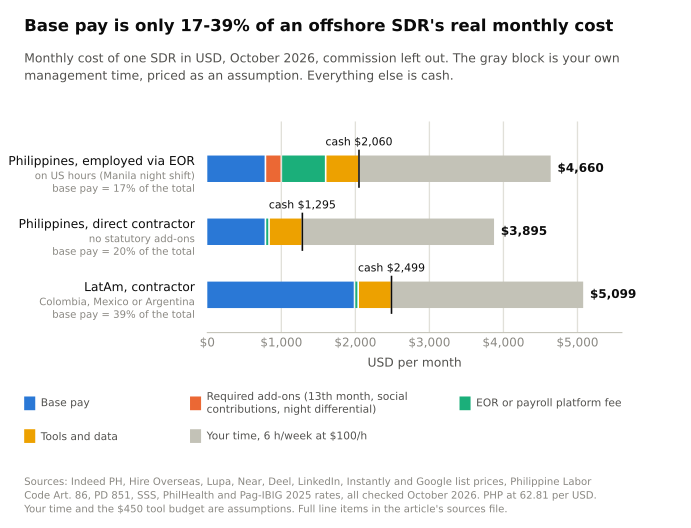
- Required add-ons in the Philippines. An employee gets a 13th-month bonus worth one-twelfth of yearly basic pay under PD 851, plus employer contributions to SSS, PhilHealth and Pag-IBIG. An SDR covering US hours from Manila works nights, and Article 86 of the Labor Code adds at least 10% for every hour between 10pm and 6am. On a ₱50,000 salary, all of that comes to about $215 a month, 27% on top of base.
- Payroll. An employer of record, or EOR, is a company that legally employs the person for you. Deel lists $599 a month for that, or $49 a month to pay a contractor.
- Tools and data. A lean stack in October 2026 is Sales Navigator Core at $119.99, Instantly Hypergrowth at $97 plus $47 of lead credits, ten Google Workspace inboxes at €6.80 each, domains and a basic CRM. That's about $365. I used $450 to leave room for a dialer or better data.
- Your time. Someone writes the playbook, checks the lists and coaches the rep. Leadle estimates 8-10 manager hours a week for an in-house SDR and 3-5 hours to manage an agency. I used 6 hours a week at $100 an hour, which is generous to the SDR. Swap in your own numbers.
I left commission out, which flatters every offshore option.
Source: the pay sources above, Deel, LinkedIn, Instantly and Google list prices, the Philippine Labor Code, PD 851 and 2025 contribution rates, checked October 2026. Your time and the $450 tool budget are assumptions.
Add it all up and the 2.5x salary gap mostly disappears. With your time counted, a LatAm contractor costs 9% more a month than a Philippine employee on an EOR, and 31% more than a Philippine contractor. Even in cash alone, the gap is 1.2x and 1.9x, not 2.5x.
A contractor is the cheapest route because none of the add-ons apply. It's also the least protected. Philippine courts use a four-part test, and the factor that weighs most is whether you control how the work gets done, per a 2024 summary by the law firm Villaraza & Angangco. Colombia's labor code presumes that any personal work relationship is an employment contract (Article 24), and once the work has the marks of a job, the name on the contract doesn't change that (Article 23). So a "contractor" on your hours, under your direction, can end up counted as an employee. This is general information, not legal advice. Check your hire's country with an EOR or a local lawyer before you choose.
Why does the time zone matter more than the salary?
Buyers reply during their own workday, and they reply fast.
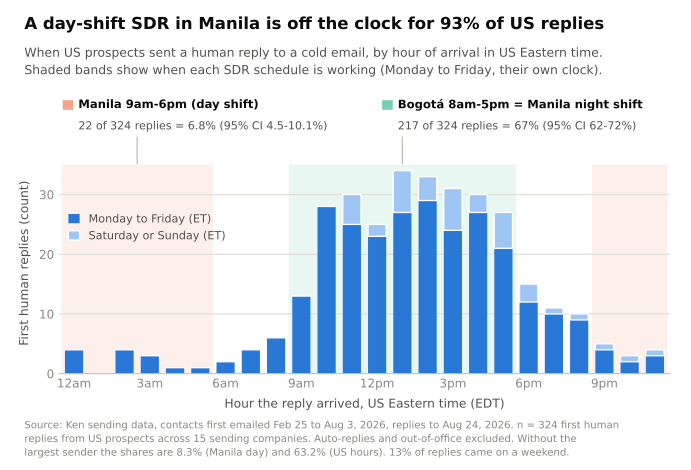
We pulled every first human reply from a US prospect to cold emails sent through Kenso between February and August 2026, with auto-replies and out-of-office messages removed. That's 324 replies across 15 sending companies. 67% landed between 9am and 6pm Eastern on a weekday. Only 6.8% landed while an SDR working 9am to 6pm Manila time would be at their desk. Without our largest sender, it's 8.3%.
A day-shift SDR in Manila is off the clock for 93% of the replies US prospects send.
Source: Kenso sending data, contacts first emailed Feb 25 to Aug 3, 2026, replies to Aug 24, 2026. n = 324 first human replies from US prospects, 15 sending companies. Shares carry 95% Wilson intervals.
Across all 686 first human replies in the same data, from every country, the median reply came in under two hours after the email that prompted it, and 42% within the hour. Without one fast-replying sender, the median is 3.2 hours. Either way, the prospect is at their desk thinking about you right then.
A Manila day-shift SDR makes them wait. A US reply sits a median 7.5 hours before that SDR logs on, and one in four waits 12 hours or more. The answer then goes out around 9pm New York time, and the prospect reads it the next morning. Manila is 12 hours ahead of New York in summer and 13 in winter, so every back-and-forth to pick a meeting time costs a day.
How fast you answer matters too. In a Harvard Business Review study, firms that answered a web lead within an hour were nearly 7 times as likely to qualify it as firms that waited an hour longer. That was inbound leads in 2011, not cold email, but I'd bet the direction holds. Interest cools.
Nobody covers everything. Even an SDR on US hours is offline for a third of US replies, mostly evenings and weekends. But a reply waits about 7 hours for that SDR on average, against 15 for a Manila day shift.
The fix is routine in the Philippines. Staffing firms schedule SDRs on US hours, which means nights in Manila. The night differential on a ₱50,000 salary is about $70 a month, the cheapest fix in this article. The harder part is the person, so ask about past night shifts and whether they want nights long term. Latin America gets the overlap for free. Bogotá matches New York in winter and runs one hour behind in summer. Mexico City dropped daylight saving time in 2022 and sits one to two hours behind. Buenos Aires is one to two hours ahead.
One finding softens the clock problem. In our data, a reply that took 6 hours or more to arrive was 1.65 times as likely to be positive as a faster one from the same sending company. A no takes ten seconds to write. A yes often means checking a calendar first. So the replies worth the most aren't always the fastest, but they still deserve an answer the same day.
Pick the country for the hours it covers, not for the salary. Whoever answers, the rules in how to handle cold email replies apply.
How long until an offshore SDR books meetings?
Longer than the staffing pitch says. Dialing for Dollars, which sells offshore SDRs, says they reach full speed on day 14 to 21. The Bridge Group's 2025 report, a survey of 351 B2B companies, puts the average SDR ramp at 3.0 months, median yearly turnover at 40% and average tenure at 1.9 years. New sending domains also need 2-4 weeks of warmup before they carry real volume.
So in my model an SDR books nothing in month one, a third of full speed in month two and two-thirds in month three. Then I ran the year 200,000 times with random quits at a 40% yearly rate. Each quit leaves the seat empty for a month, and the next hire starts the ramp from zero. Out of 12 months, you get about 8.9 months of full-speed meetings. Even if nobody ever quit, the ramp alone would cost two.
Bridge Group also gives you a sanity check. The median SDR quota is 10 held meetings a month, and 60% of SDRs hit it.
What does a meeting cost with an offshore SDR, done-for-you or pay-per-meeting?
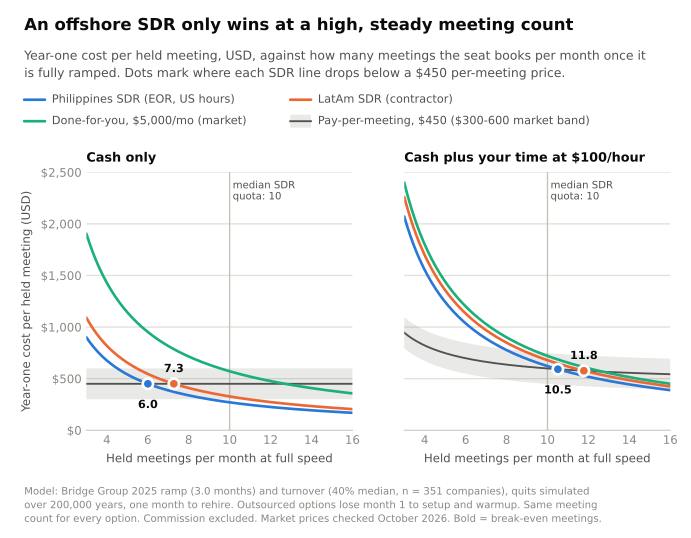
For the outside options I used market prices, not ours. That's $5,000 a month for a done-for-you retainer and $450 per held meeting for pay-per-meeting. Leadium lists mid-market meetings at $300-600 and basic retainers at $2,000-5,000 a month. Outbound Pros lists $250-500 per meeting for SMB targets and $3,000-5,000 for basic retainers. In the model, outside teams lose month one to setup and warmup and run at half speed in month two. Every option books the same number of meetings at full speed, so this compares cost structure only. It says nothing about who runs outbound better.
Source: Kenso cost model, inputs checked October 2026. Ramp and turnover from Bridge Group 2025 (351 companies), quits simulated over 200,000 years. Commission excluded.
| Held meetings a month at full speed | Philippine SDR | LatAm SDR | Done-for-you, $5,000/mo | Pay-per-meeting, $450 |
|---|---|---|---|---|
| 4 | $676 / $1,554 | $818 / $1,696 | $1,429 / $1,800 | $450 / $821 |
| 8 | $338 / $777 | $409 / $848 | $714 / $900 | $450 / $636 |
| 12 | $225 / $518 | $273 / $565 | $476 / $600 | $450 / $574 |
Year-one cost per held meeting. The first number is cash. The second adds your time at $100 an hour, 6 hours a week for an SDR and 3 for an outside provider.
An offshore SDR is a fixed cost chasing a variable outcome. Pay-per-meeting is the reverse. At 4 meetings a month, the Philippine SDR costs 1.5 times the per-meeting price in cash. At 12, it costs half. Pay-per-meeting moves the ramp, the quits and the slow months onto the vendor, so your cash cost per meeting stays put.
Your own time decides it. This table shows how many held meetings a month the SDR has to book at full speed to be cheaper in year one.
| Pay-per-meeting price | Your time free | Your time at $50/hour | Your time at $100/hour |
|---|---|---|---|
| $300 | 9.0 / 10.9 | 12.4 / 14.3 | 15.8 / 17.7 |
| $450 | 6.0 / 7.3 | 8.3 / 9.5 | 10.5 / 11.8 |
| $600 | 4.5 / 5.5 | 6.2 / 7.1 | 7.9 / 8.8 |
Philippine SDR / LatAm SDR, same model and inputs as the chart.
At a $450 price and $100 an hour for your time, an offshore SDR has to book 10.5-12 held meetings a month to win. That's above the median quota of 10, which 40% of SDRs miss.
A retainer only wins if it books more than one SDR would. At the same meeting count, the $5,000 retainer costs more per meeting than either SDR in this model. You're paying for a team with its own data and sending setup, so ask any agency for its typical meetings per month before you compare. Also check whether a per-meeting price counts booked or held meetings. Outbound Pros puts no-show rates anywhere from 10% to 35%.
So should you hire an offshore SDR or use an outside team?
Hire an offshore SDR when all four of these are true:
- You already know who buys and which message gets replies, so there's a playbook to hand over.
- You can give about 6 hours a week, every week, for the first six months.
- They'll work your buyers' hours, which means a LatAm SDR or a Philippine SDR on nights.
- You're committing for at least a year, because the first three months are mostly cost.
Go done-for-you or pay-per-meeting first when you're still finding the buyer and the message, when nobody in-house can manage a rep, or when you need meetings this quarter. Plenty of teams do both, in that order. They outsource to find what works, then hire someone to run the proven playbook.
Done-for-you is what we do. Kenso runs cold email and LinkedIn outreach for B2B companies, done for you, on infrastructure we own. Human copywriters build the frameworks, AI fills them with real prospect data, and a human approves before the first send. Our team handles the replies too, which matters given the clock above. Plans are on the pricing page, and what done-for-you cold email includes walks through how it works.
Frequently asked questions
Is a Philippine or a LatAm SDR better for selling to US companies?
For US buyers, Latin America is simpler because the workday overlaps without night shifts. In our data, 67% of US replies land in Bogotá working hours. A Philippine SDR can cover the same hours on a night shift for about $70 a month in night differential, and Filipino salespeople score higher on EF's English index than Colombian or Mexican ones.
How much does an offshore SDR cost per month in total?
About $1,300-2,500 in cash before commission, in this model. That's $1,295 for a Philippine contractor, $2,060 for a Philippine night-shift employee on an EOR and $2,499 for a LatAm contractor, tools included. Your management time adds about $2,600 a month at 6 hours a week and $100 an hour.
How much commission should an offshore SDR get?
Lupa suggests about 65-70% base and 30-35% variable for LatAm SDRs, and HireLATAM estimates $5,000-15,000 a year in variable pay. Tie it to held, qualified meetings.
How many meetings should an offshore SDR book each month?
Plan around 10 held meetings a month once they're ramped. That's the Bridge Group's median quota, and 40% of SDRs miss it. If someone promises much more from one rep, ask to see it in a past client's calendar.
Do I need an employer of record to hire an SDR in the Philippines?
Not to pay a contractor. But Philippine courts look mainly at whether you control how the work gets done, so a contractor on set hours under your direction can look like an employee. An EOR employs them properly, with 13th-month pay, social contributions and the night differential, for $599 a month at Deel. This is general information, not legal advice.
The bottom line
Salary is the easiest number to compare, and it rarely decides what a meeting costs. Put a price on the time zone, the ramp and your own hours, then compare cost per held meeting. If you want to see what done-for-you outbound books before you hire anyone, your first campaign is free.