
Catch-All Email Verification: Why 'Maybe Valid' Is a Reputation Bet
A catch-all domain accepts every address, so unknown is not valid. Park those rows in a separate pool — do not mix them into your primary send.
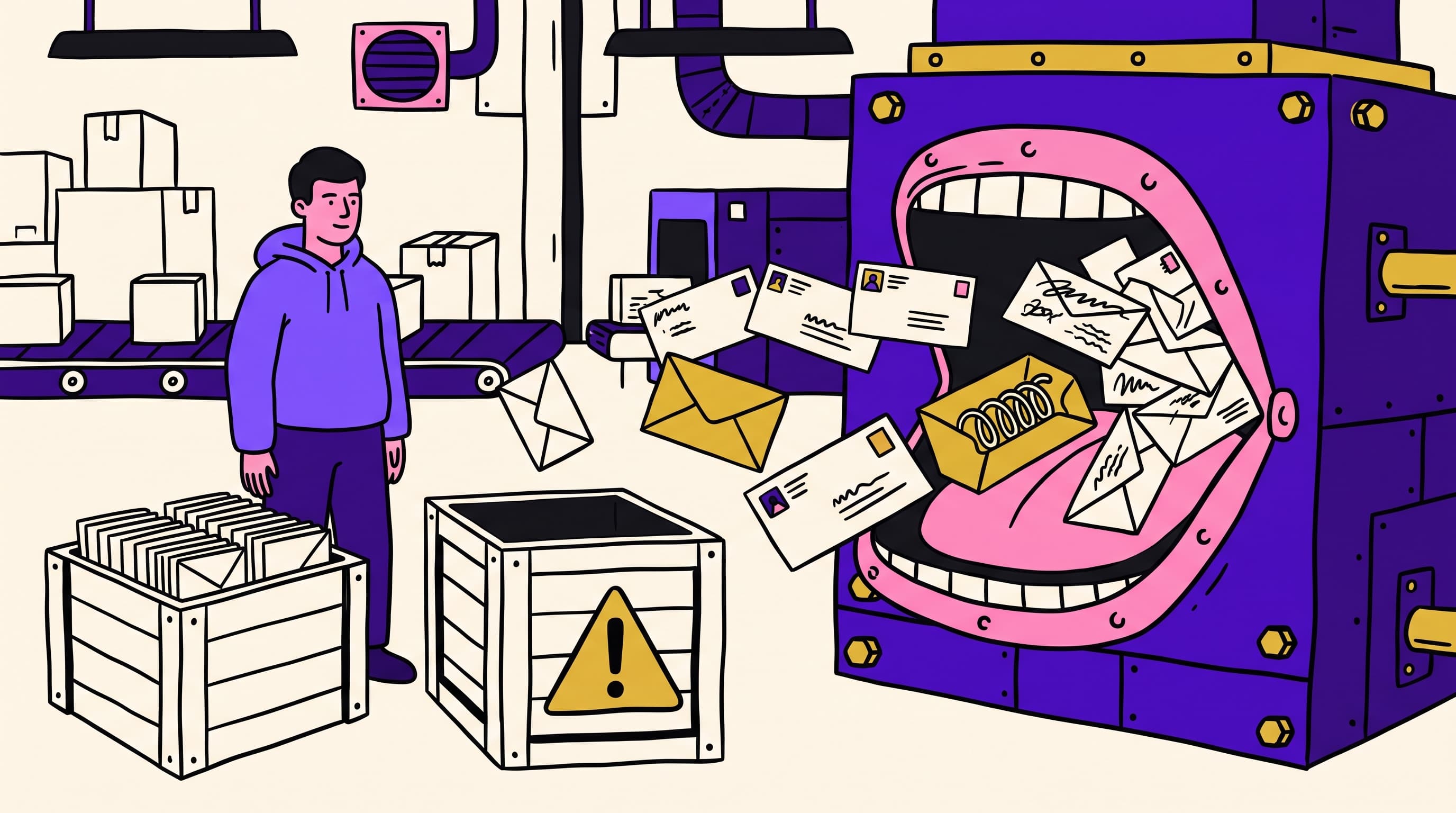
A catch-all domain accepts every address at SMTP time, so a verifier cannot confirm the mailbox. Treat “unknown,” “risky,” or “accept-all” as not sendable on your primary list. Park those rows in a separate pool, corroborate that a real person exists, and only then test from spare inboxes — never mixed with mail you already proved valid.
That is the whole decision. Most tools stop at the definition. Operators get hurt in the two weeks after they treat the yellow column as a soft yes.
What is a catch-all email?
A catch-all (also called accept-all) is a domain setting, not a special inbox. The receiving mail server is configured to return 250 OK for any local-part at that domain — [email protected], [email protected], and [email protected] all look the same at the handshake.
Companies do this on purpose. Small teams route typos and departed-employee mail into one bucket. Enterprises put a security gateway in front so outsiders cannot enumerate which mailboxes exist. Microsoft 365 tenants set to Internal relay can look identical to a verifier, even when Directory-Based Edge Blocking would have rejected unknowns on an Authoritative domain — MailBeast walks through that wrinkle.
Two things share the name and should not. IT’s “catch-all inbox” is an internal routing choice. A verifier’s “catch-all” label is the server refusing to answer a mailbox-existence question. Same word, different object.
A server saying yes is not a person reading mail. The message can land in a real inbox, sit in a folder nobody opens, bounce hours later after internal routing fails, or drop silently. Bouncer is explicit that delayed bounces are the hard ones to suppress, because the first SMTP conversation already looked like a delivery.
Why do verifiers return unknown on catch-alls?
Standard verification is a conversation, not a delivery. The tool checks syntax, looks up MX records, then issues RCPT TO for the address. On a normal domain, 250 means the mailbox exists and 550 means it does not.
A competent verifier adds a control: it also probes a deliberately fake address on the same domain. CUFinder describes the test cleanly. If the fake is accepted too, the accept signal is worthless. The honest result is catch-all, accept-all, unknown, or risky — vendor branding for “we do not know.”
That is not a lazy tool. It is the tool refusing to lie. Any product that marks a catch-all domain “valid” because the server said yes is overstating certainty. You paid for a mailbox answer. You received a domain-behavior answer.

Role-based addresses (info@, sales@, admin@) are a different problem that often rides along. They may accept mail. They almost never produce a personal reply to cold outreach, and they get filtered harder. Do not lump them into the catch-all pool as if they were named humans behind a locked gate. The broader verification pipeline — syntax, MX, SMTP, catch-all, role, disposable — lives in how to get verified B2B email leads. This page is only the unknown column.
Should you send cold email to catch-all addresses?
Not on the same campaign, the same domain, or the same inbox as addresses a verifier already confirmed.
The SERP splits into two bad defaults: delete the whole bucket, or upload it because you already paid for the row. Deleting throws away real people at the companies that most often run accept-all — serious IT, not garage Gmail. Blasting treats a coin flip as a lead. A lead, in Ken’s definition, is a qualified contact with a valid email. An unresolved catch-all is not that. It is a name you have not finished.
Use this as the extraction table. It is a treat-as rule, not a bounce-rate claim.
| Verifier result | What it actually means | Treat as | Primary send? |
|---|---|---|---|
| Valid / deliverable / safe | Mailbox confirmed on a domain that rejects fakes | Confirmed inbox | Yes |
| Invalid / undeliverable | Server or DNS said no | Hard-bounce waiting to happen | Never |
| Catch-all / accept-all / unknown / risky | Domain accepts everything, so this mailbox was not confirmed | Unresolved. Own pool only | Not until you resolve it |
| Role-based (even if the domain is clean) | Shared box, not a person | Skip for cold | No |
“Should you send” is not one decision for the CSV. It is a per-row decision after you know how the address was found.
- High-trust source, named person, pattern matches the company’s known format — candidate for the isolated pool, not for the primary list.
- Permutation guess with no LinkedIn, no team page, no second source — skip. You invented the local-part and the server will not tell you that you were wrong until it is too late.
- Warmup in progress, or you are already near a ~2% hard-bounce ceiling — skip. Catch-alls are how a “clean” list still trips the line we treat as the hygiene floor in the deliverability guide.
- Dream account, one contact — verify the human by hand or reach them on LinkedIn. Do not burn a domain to learn whether
firstname.lastnamewas a lucky guess.
Vendor blogs will quote bounce multiples and “send anyway if the deal is big.” Some of those numbers are from their own tests; none of them are yours. Do not import a 23% or a 27× into your dashboard. Watch your hard bounces on an isolated segment, or do not send the segment.
How do you verify a catch-all email?
You cannot verify it the way you verify a normal address. The server has opted out of that test. What you can do is raise confidence with signals SMTP will not give you, then confirm in the real world with a tiny, watched send.
Ken’s operating version is triple verification that includes catch-alls — not a single SMTP pass that quietly greens the yellow column. Across the book we still throw out a large share of risky or invalid rows before anything sends (on the order of ~65% in the hygiene pass described in the deliverability guide). The point of the extra passes is not a magical “valid” stamp on an accept-all domain. It is refusing to pretend.
A workable catch-all pass, if you run it yourself:
- Flag, do not guess. Export every catch-all / unknown / risky row into its own list. If your sequencer only has “in campaign” and “not,” it will treat the maybe pile as a blind send. That is a product limitation, not permission.
- Second verifier, different method. A second SMTP tool that uses the same handshake will repeat the same “we don’t know.” Specialist catch-all tools try identity, pattern, historical activity, or send-and-watch probes. Treat a “resolved valid” on a catch-all domain as a probability, not a guarantee.
- Identity before inbox. Does this local-part belong to a person you can see on the company site or LinkedIn? Does it match the pattern of other confirmed addresses at that domain? No identity, no send.
- Role and disposable still lose.
info@on a catch-all is not a clever enterprise contact. It is two skip reasons stacked. - Re-check before the campaign, not last quarter. People leave. Tenants change from Internal relay to Authoritative. A catch-all you baby-sat in March is not a catch-all you understand in August.
None of that produces certainty. Domain-level catch-all detection is reliable. Per-address “this reaches a human” is a confidence band. Anyone selling 100% catch-all accuracy is selling a label.
Do catch-alls hurt deliverability?
They hurt the way unverified mail always hurts: hard bounces, delayed bounces, and the occasional spam trap you cannot see from the handshake.
Mailbox providers read a burst of “this mailbox does not exist” as the behavior of a sender who does not know their audience. That is why we treat under ~2% hard bounce as the hygiene floor — under 1% is the real target — and why mixing a maybe-pile into a verified list is how a campaign that “looked clean” at upload crosses the line a week later. The damage is not theatrical. It is the next campaign to confirmed inboxes, on the same domain, landing in spam.
Three failure modes are specific to catch-alls:
Delayed bounce. The server accepts at SMTP, then rejects after internal lookup. If you only watch the send window, you undercount. Check again the next morning.
Silent drop. Accepted, then discarded. No bounce, no reply, no lesson — except you spent inbox capacity on a void.
Spam-trap camouflage. A trap on an accept-all domain accepts during verification like every other address. Bouncer flags this as a reason not to treat the whole domain as a cheap extra list. You find out from reputation, not from the CSV.
Catch-alls also concentrate in the accounts you actually want. That is why deleting the column feels expensive. The cost of keeping it mixed in is not “a few extra bounces.” It is teaching Gmail and Outlook that this sending domain guesses.
List construction is upstream of this whole mess. Pattern-generated addresses on accept-all domains all look plausible. Lists built from ICP plus a real buying signal, then verified, produce fewer yellow rows than a permutation dump. Your raw match list is already smaller than it looks once finding, verification, and qualification have run. Catch-alls are the verification gate pretending to be a maybe.
What should you do with catch-all leads instead of sending?
Park them. Do not delete the humans. Do not feed them to the domain that carries your best copy.
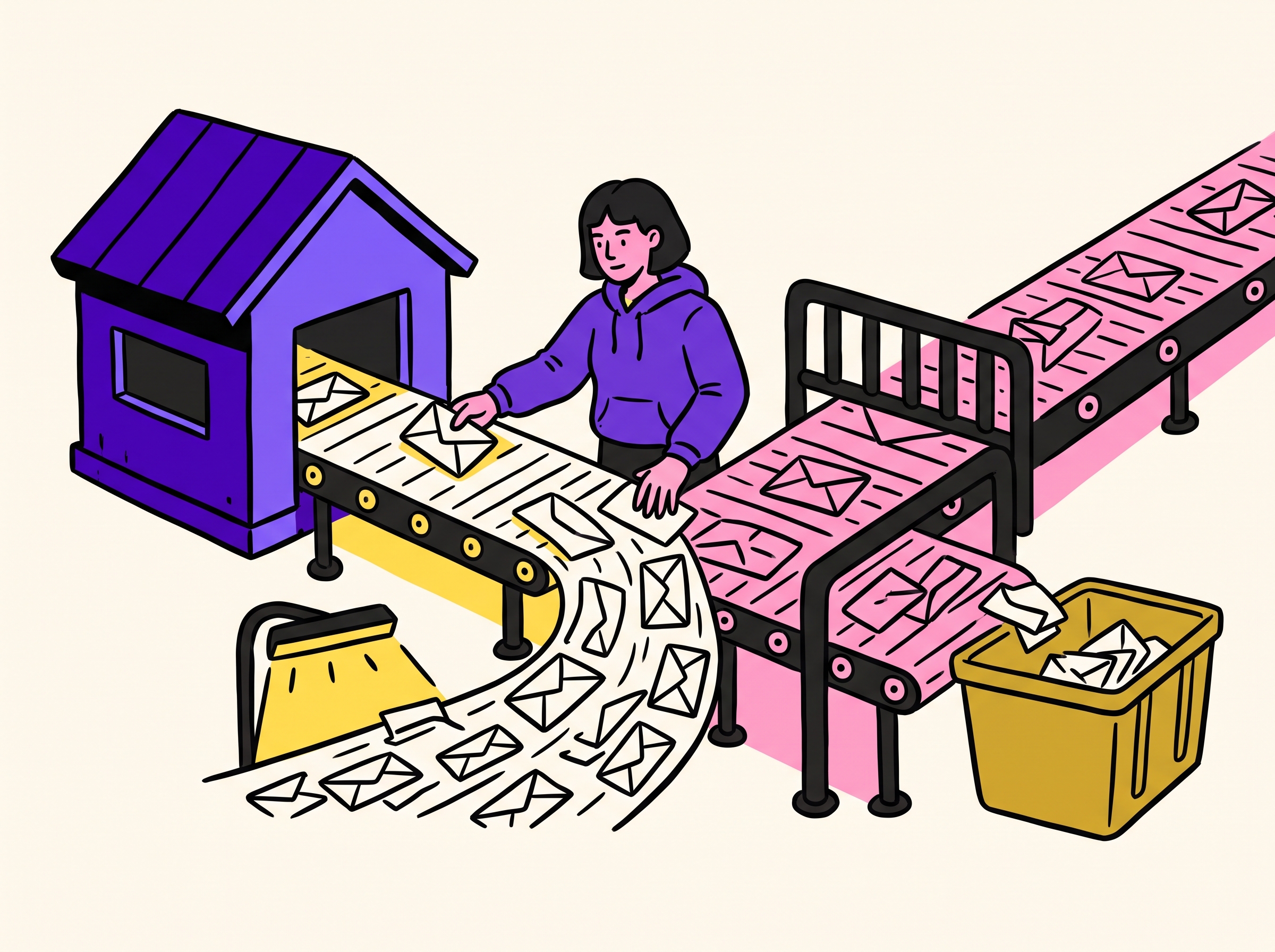
The workflow that does not light the primary domain on fire:
- Quarantine the bucket the moment verification returns. Primary campaign = confirmed-valid only.
- Score the parked rows with identity, pattern, source trust, and whether the company is even still alive. Low score goes to skip or to a better contact path.
- If you send at all, send from spare infrastructure — a secondary domain and inboxes you can afford to cool. Never the warmed pair that books meetings.
- Throttle. A small watched batch, then read hard bounces before you scale. Pull the segment the moment hard bounces on that pool stop looking like hygiene.
- Prune by engagement. No reply after a short sequence is usually an unmonitored or fake box. Remove it. Do not “just add more follow-ups.”
- Promote only what you learned. An address that accepted mail, did not hard-bounce, and produced a human reply can graduate. Until then it is inventory, not a lead.
If that already sounds like a second job, it is. Ken Daily is the skip: 10 verified ICP leads every morning, free, no card. The yellow column never reaches you. Paying Core ($597/mo) or VIP ($4,597/mo) is the done-for-you version of the same motion — list, copy, infra, send, replies — and you can also run it in the app.
Frequently asked questions
What is a catch-all email?
An address on a domain whose mail server accepts every recipient, including ones that do not exist. The catch-all lives at the domain. The individual mailbox was never confirmed.
Should I send cold email to catch-all addresses?
Not mixed with verified mail. Only after you corroborate a real person, and only from an isolated pool you are willing to watch — or not at all, if you are still warming or already near a ~2% hard-bounce ceiling.
How do you verify a catch-all email?
You don’t, not with SMTP alone. Flag the domain, add identity and pattern signals, optionally run a specialist second pass, then confirm with a tiny isolated send. Anything labeled “valid” on an accept-all domain is a confidence score.
Why do email verifiers return unknown on catch-alls?
Because they probed a fake address on the same domain and the server accepted that too. Valid would be a guess. Unknown is the true result.
Do catch-alls hurt deliverability?
Unresolved ones do, through hard bounces, delayed bounces, silent drops, and the odd hidden trap. The hurt shows up on the next send to good addresses, which is why the primary list stays clean.
What should I do with catch-all leads instead of sending?
Keep the people, drop the gamble. Park the rows, find a confirmed address or another channel, or leave them out of the campaign that protects your domain.
The short version
Catch-all is a server saying “I will not tell you.” It is not a soft valid. Primary send = confirmed mailboxes only. Park the rest, prove the human, test from spares, or skip. Mixing the columns is how a list that looked fine at upload becomes a reputation problem after the delayed bounces land.
If you want the unknown column handled before it reaches a sequencer, start with Ken Daily. Ten verified ICP leads a morning, free, no card — and none of them are a maybe wearing a green check.