
How to Cold Email with No Customers or Case Studies Yet
No case studies? Lead with a specific insight, a small free deliverable and honest founder credibility. Randomized tests show proof matters less than you think.
At 13, I sent 275 cold emails to land my first freelance client. It was UX design work, I was in Moldova, and I had zero clients. So I had zero case studies too.
If you have no customers or case studies, don't fake proof and don't apologize for it. Open with one specific thing you noticed about the prospect's business, give a small piece of real work up front, say plainly who you are, and ask for something tiny. Randomized tests on unsolicited emails back that order. Relevance, gifts and short asks raised responses. "Others already did this" lines, startup traction and a better-known sender didn't clearly move anything.
Most guides tell you to "add social proof" and move on. The better ones say be honest and offer something useful. None I read checked either idea against evidence, so I went looking for experiments where strangers got an unsolicited email and researchers changed one thing at a time.
Proof is the thing founders worry about most and the thing the experiments support least.
Does a cold email need social proof to get replies?
No. Social proof helps a little at best, and it isn't the first lever to pull.
The best evidence comes from an odd place. Survey researchers have spent decades testing how to get strangers to answer an unsolicited request. That's the cold email problem with a different label. A 2023 Cochrane review pooled 758 randomized trials on it, 88 of them on surveys sent by email or online.
The review reports results as odds ratios. An odds ratio of 1 means the change did nothing. 1.5 means the odds of a response went up by half. Each one comes with a 95% confidence interval, the range where the true effect probably sits.
Telling people that others had already responded is pure social proof. Across three email trials with 23,777 people, it didn't clearly raise completed responses. The odds ratio was 1.14, and the interval ran from 0.83 to 1.56, so it includes "no effect". One trial did find the line got more people to open the survey, so it isn't useless. Just weak.
Status didn't do much either. In six email trials with 28,162 people, a survey sent or signed by a more senior or better-known person scored 1.09, with an interval of 0.96 to 1.25. Eleven trials of paper surveys found the same non-result.
These changes from the same review did work:
- A more personal email, like greeting people by name: 1.24, across 12 trials and 48,910 people.
- A shorter ask: 1.51, across 5 trials.
- A non-cash gift, like a gift card or a prize draw: 1.60, across 16 trials.
- A more interesting topic, with questions that matter to the reader: 1.85, in one trial of 2,176 people.
The second experiment is closer to a founder's world. In a randomized field experiment later published in the Journal of Finance, two Stanford researchers and AngelList sent 16,981 emails about 21 startups to 4,494 investors. Each email randomly showed or hid parts of what AngelList knew about the startup. Among investors who opened the email, showing the founding team raised clicks by 2.6 percentage points on a 16.5% base. That's about a 16% lift. Showing traction or well-known investors didn't significantly change clicks. The most experienced investors reacted to the team and nothing else.
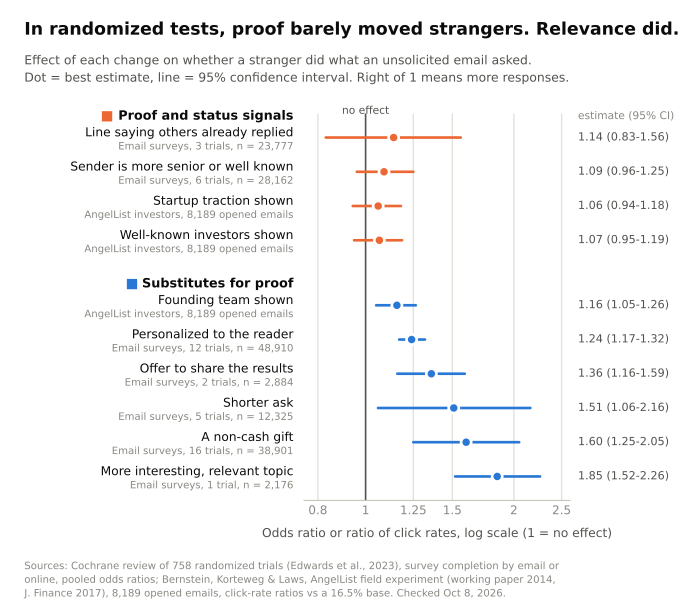 Source: Cochrane review MR000008 (Edwards et al., 2023), survey completion by email or online, pooled odds ratios; Bernstein, Korteweg and Laws, AngelList field experiment, 8,189 opened emails out of 16,981 sent to 4,494 investors (2014 working paper, Journal of Finance 2017). Lines show 95% confidence intervals. Checked October 2026.
Put the two studies side by side and a pattern shows up. Proof about other people, like who already replied, who already invested or how much traction a startup has, sits near the "no effect" line. So does proof about status, like a more senior or better-known sender. What moved people was relevance, a gift, a smaller ask, and concrete facts about the people behind the email.
Strangers don't reply to proof that others trust you. They reply to proof that you looked at them.
Two caveats. Survey takers and angel investors aren't your buyers. And being known does help. In RAIN Group's prospecting study, sellers at well-known companies reported 31 meetings, conversations or demos per 100 target contacts, against 21 at little-known ones. But a brand takes years to build, and the first email has faster levers.
What do buyers say gets them to take a meeting?
Buyers say the same thing the experiments show. RAIN Group asked 488 B2B buyers which kinds of content get them to take a meeting with a seller. Client case studies came 8th of 11. Testimonials came 10th. Research data relevant to their business came first, and content tailored to their exact situation tied for second.
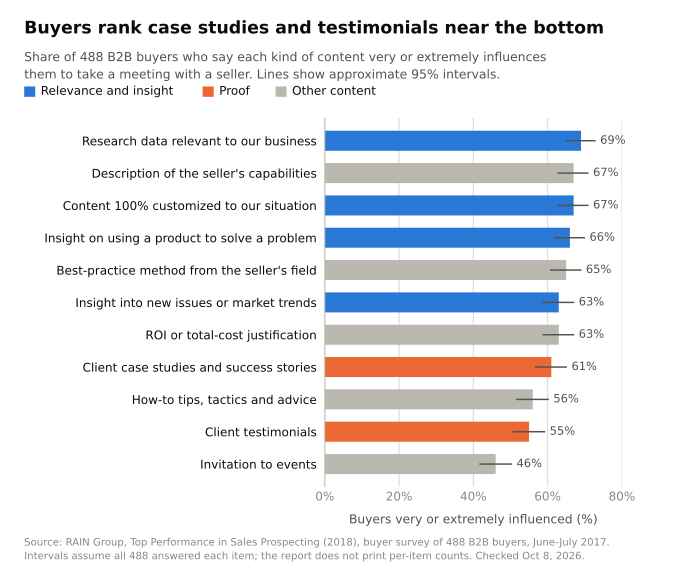 Source: RAIN Group, Top Performance in Sales Prospecting (2018), survey of 488 B2B buyers, June to July 2017. Lines show approximate 95% intervals.
Look at what else tied for second. A plain description of what the seller does. Buyers aren't asking you to hide the pitch. They want it pointed at their situation. The gap between case studies at 61% and the top item at 69% is modest, so proof isn't worthless. It just isn't what earns the first reply.
What should you use instead of case studies?
Here's what I'd lead with, ranked by how strong the evidence is.
| Rank | What to lead with | What it looks like | Best evidence | Strength |
|---|---|---|---|---|
| 1 | A specific insight about their business | One thing they can check, plus what it probably costs them | More interesting, relevant topic: odds ratio 1.85 (1 trial). Personal email: 1.24 (12 trials). Buyers rank research relevant to their business first (69%) | Strong |
| 2 | A small piece of work, given up front | A short teardown, 10 sample leads, a mock-up, an audit of one page | Non-cash gift: 1.60 (16 email trials). Bigger gifts did no better than smaller ones (10 trials). Offer to share results: 1.36 (2 trials). Paper-mail surveys: gifts sent up front +7.9%, promised rewards no clear effect | Strong |
| 3 | A short email with a small ask | A few lines, asking if it's worth a look instead of asking for 30 minutes | Shorter ask: 1.51 (5 trials). Asking for interest was Gong's best cold email call to action across 304,174 emails (not a controlled test) | Medium to strong |
| 4 | Specific founder credibility | Why you: the job you did, the thing you built, what you've seen | Founding team shown: about +16% clicks (AngelList). A more senior or well-known sender: no clear effect (6 email trials). A "Founder" title alone: 0.98x the replies in our data | Medium |
| 5 | A pilot or risk reversal | Two weeks, one success test, they keep the output | No cold email trial found. Nearest: retail studies where easy returns raised purchases more than returns | Weak, indirect |
| 6 | Proof: "others like you use us" | Logos, customer counts, case studies | "Others already responded": 1.14, interval includes no effect (3 trials). Traction and notable investors: no significant effect | Weak |
Sources: Cochrane review, Bernstein et al., RAIN Group, Church (1993), Gong Labs, Journal of Retailing meta-analysis, via UT Dallas, Ken sending data. All checked October 2026.
How do you write the insight line?
Pick one thing you noticed that the prospect can check, and say what it probably means for them. That's the whole move.
Our own campaigns show how little proof a good opener needs. Ken runs cold email and LinkedIn outreach for B2B companies, done for you, on infrastructure we own. We read the first emails sent in 52 campaigns from 16 sending workspaces between late February and early August 2026. Only 1.2% mentioned the sender's own customers, and one workspace sent 85% of those. Only 0.3% had a result-style number like "booked 40 meetings", and when we read them, the numbers were nearly always the prospect's own, like their funding round or a claim from their homepage.
So if your first email has no proof in it, you aren't behind. In our data, that's normal.
The trap is thinking "make it about them" means saying "you" a lot. Our first emails already used "you" words about twice as often as "I" or "we" words, 5.9 against 3.1 per email. Seven in ten were at least 60% "you". We then compared emails inside the same campaign, so the list and the offer were the same. Emails that were 80% or more "you" got 0.81 times the human replies of the rest, with a 95% confidence interval of 0.61 to 1.09. No lift, and maybe a small dip. Saying "you" more isn't the same as knowing something about them.
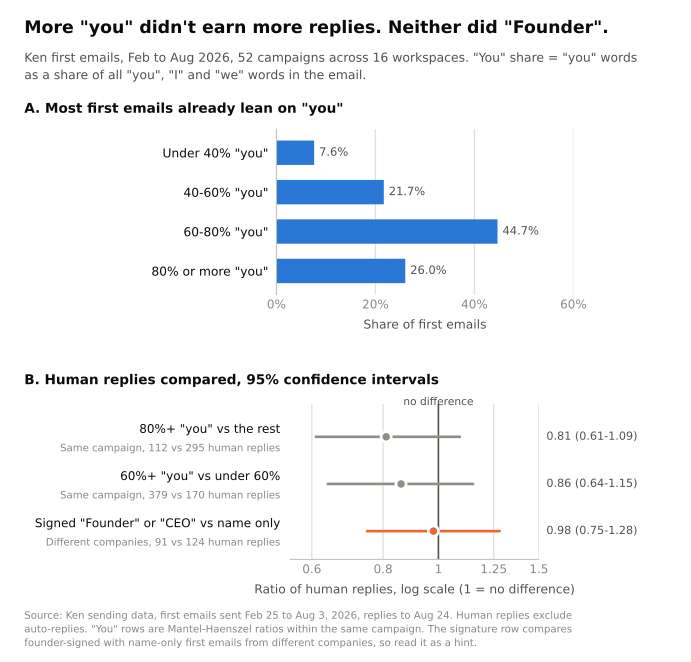 Source: Ken sending data, first emails sent February 25 to August 3, 2026, in 52 campaigns across 16 workspaces, replies to August 24. Human replies exclude auto-replies and out-of-office. Lines show 95% confidence intervals.
Here's the shape, written for a made-up company:
Your careers page lists four SDR roles, all posted in the last month. That usually means outbound is the Q4 plan, and ramp time is the risk.
I'm building a tool that gets new reps sending in their first week instead of their second month. We're early, so I'm looking for three teams to try it with.
Worth sending you a two-minute teardown of your current sequence?
Observation, implication, one honest line about you, a small ask. To do this past a handful of emails, you need AI personalization built on real prospect data and a lead list built on your ideal customer profile, meaning the kind of company that gets the most from what you sell.
How do you use founder credibility without a track record?
Make it specific. In the AngelList experiment, facts about the founding team were the one thing that moved investors on average. A title isn't a fact about you, though, and survey trials found no clear lift from a more senior or better-known sender. In our data, first emails signed "Founder" or "CEO" drew 0.98 times the human replies of emails signed with just a name. The 95% confidence interval runs from 0.75 to 1.28. Those emails came from different companies, so read it as a hint, not a verdict.
What carries weight is a reason to listen that only you can give. "I ran outbound at a 40-person SaaS company for two years" says more than "Founder & CEO". So does "I've talked to 30 finance leads about month-end close this year." If you're early, say so. One founder guide says having no logos is normal at your stage, and "pretending otherwise reads worse."
At 13, I didn't have a title worth signing. I had a skill and the stubbornness to send 275 emails.
Should you offer a free pilot or a free deliverable?
Give the work first. Don't just promise it.
Allan Church's 1993 meta-analysis of 38 mail survey experiments found that gifts sent with the first mailing raised response rates by 7.9%, and cash by 19.1%. Rewards promised for replying showed no evidence of any effect. Three email trials showed a smaller gap that could be zero, so don't lean on timing alone.
The gift also doesn't need to be big. In 10 email trials with 37,382 people, a larger non-cash gift did no better than a smaller one, at 1.07 with an interval of 0.87 to 1.32. So put a slice of the deliverable inside the email: three findings from their website, or five leads that match their best customers.
A pilot is a bigger ask, so it has to feel small. Give it a time box, one success test you both agree on, and say what they keep if it doesn't work. I couldn't find a single cold email trial on risk reversal. The nearest evidence is retail, where a meta-analysis of 21 studies in the Journal of Retailing found that easy return policies raised purchases, and raised returns by less. That's shoppers, not B2B buyers, so treat it as a hint. We run our own offer this way. The first campaign is free, and it runs for two weeks.
How many emails does it take without proof?
More than you'd like, and fewer than you fear. My 275 emails turned into one client, a hit rate of about 0.4%. Small, but it was enough to get started.
People also underestimate how often strangers say yes. In Francis Flynn and Vanessa Lake's experiments, people overestimated by about 50% how many strangers they'd have to ask before enough said yes. That's the hidden cost of having no proof. Founders expect a no, so they send too few emails to find out.
When you judge the results, compare like with like. Published benchmarks disagree a lot, and what counts as a good cold email reply rate depends on what's being counted.
Frequently asked questions
Is it okay to say "we're early" in a cold email?
Yes. It costs less than it feels like, and it explains why you're asking for feedback instead of a contract. Pair it with something useful so "early" doesn't read as "untested and asking for a favor."
Can I use results from a previous job or side project?
Yes, if they're true and you say where they came from. A specific result from your last role is real credibility. Check your old employment agreement before you name clients or numbers.
Should I work for free to get my first case study?
A short, scoped pilot is fine. Agree in writing on the time box, the success test, and whether you can name them afterward. Open-ended free work tends to turn into a favor nobody measures.
Can I make up a testimonial or borrow a logo?
No. Beyond the trust you'd burn, the US Federal Trade Commission's rule on fake reviews and testimonials, in force since October 21, 2024, bans testimonials that misrepresent whether the person exists or ever used the product. This is general information, not legal advice, but the safe rule is simple. Show what's true, even if it's small.
Where should proof go once I have it?
Add it as one line after your insight, not in place of it, or save it for a follow-up. When we read the written sequences of 55 campaigns, only 2 put the sender's customers in the first email, and 7 more used them only in later emails. Then test the email with and without proof on the same list, judge it on replies, and use our guide to cold email A/B testing to size the sample.
The short version
Proof is nice to have. It isn't the price of entry. Lead with something true about them, give before you ask, and keep the ask small. If you'd rather have us build and send that first campaign with you, the first campaign is free.