
Cold Email Sequence: A 4-Email Template Backed by Reply Data
Send four emails, 3-6 days apart. In our data the fourth email drew 0.99x the first one's human replies per send. Template, timing and stop rules.
Cristian Frunze · Nov 27, 2026 · 18 min read
- cold email sequence
- cold email sequence template
- cold email sequence example
- email cadence
- email sequence examples
- cold email follow-up
- how many follow-up emails
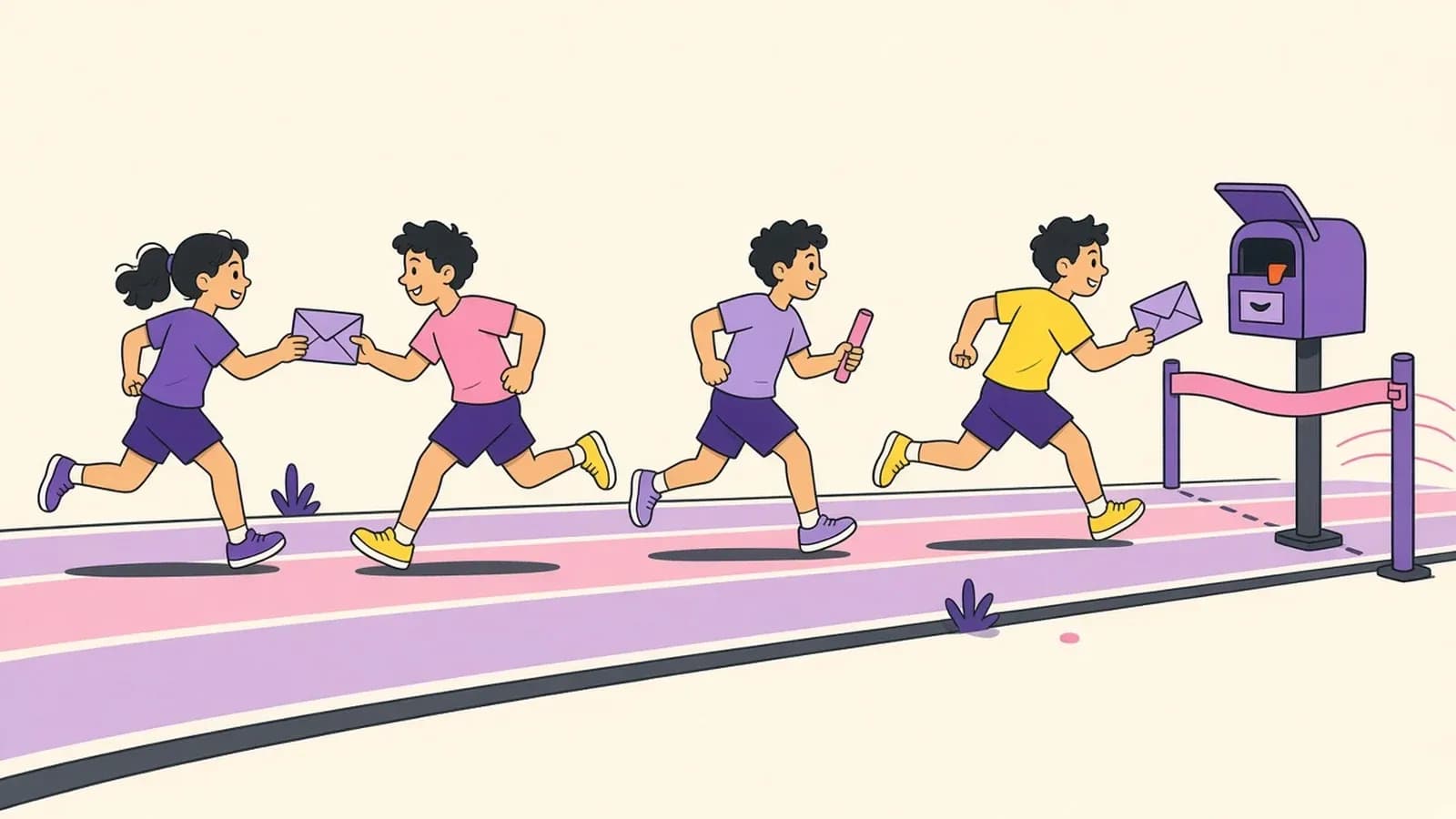
A cold email sequence is a set of pre-written emails to one prospect who doesn't know you yet: an opener plus follow-ups on a fixed schedule, which stops the moment they reply. The version our reply data supports is four emails, sent three to six days apart over about two weeks, each with a different job. In our sending data, the fourth email earned 0.99x the human replies per send of the first, and 59% of the people who replied answered a follow-up, not the opener.
Most guides on this topic hand you templates. Templates help, but they don't tell you which step is weak, how long to wait, or when to stop. So this guide gives you one sequence, the job of each email, and the reply numbers behind every step.
The numbers come from three analyses of Kenso sending data across 17 workspaces (a workspace is one sender's account on our platform), each linked where we use it. Unless we say otherwise, they cover contacts first emailed from February 25 to August 3, 2026, and leave out-of-office replies out.
What is a cold email sequence?
It's a set of pre-written emails that goes to someone who doesn't know you yet, on a fixed schedule. Each prospect moves through the steps on their own clock, and the sequence ends for that person when they reply, book a meeting or ask to be removed. Our glossary entry on email sequences has the short definition.
Sequence, cadence and drip: what's the difference?
People use these words loosely, so here's how we use them:
| Term | What it means | Ends when |
|---|---|---|
| Cold email sequence | The emails themselves, in order, to one cold prospect | The person replies, books or opts out |
| Email cadence | The rhythm: how many touches, how many days apart, on which channels | Same as the sequence it times |
| Drip campaign | Marketing emails to people who opted in, often for weeks or months | The person converts or unsubscribes |
A sequence is after one reply from one person. A drip is after attention from many people. That's why a sequence stops on a reply and a drip usually doesn't.
Why send a sequence instead of one email?
Because most people who reply don't answer your first email. In our data, the opener drew 41% of first human replies. The other 59% came from follow-ups.
Replies rarely trickle in late. People answer fast, and they answer the email that moves them. Our median human reply arrived 1 hour 46 minutes after the email it answered, and 95% arrived within three days of it (how long cold email replies take). So a follow-up isn't collecting stragglers from email 1. It's a new chance, on a different day, with a different reason to answer.
How many emails belong in a cold email sequence?
Four: one opener and three follow-ups. This is the share of human replies you'd keep if you stopped early, measured on our campaigns that had at least four emails:
| Stop after | Human replies kept (95% CI) |
|---|---|
| Email 1 | 37% (33-42%) |
| Email 2 | 56% (52-61%) |
| Email 3 | 76% (72-80%) |
| Email 4 | 94% (91-96%) |
Source: campaigns on Kenso with four or more steps, 10 workspaces, first emails sent February to August 2026, from our reply data by sequence step.
A two-email sequence leaves 44% of those replies on the table. A one-email "campaign" leaves 63%.
The guides that show up in web search for this term land in a similar range, with more spread at the long end. As of November 2026, their pages say:
| Guide (read November 21, 2026) | Emails or touches | Over |
|---|---|---|
| Instantly | 3-4 | Roughly two weeks |
| Smartlead | 3-4 | About 14 days (day 1, 3, 7, 14) |
| Saleshandy | 4 for SMB, 5-7 for enterprise | 14-21 days for SMB, 30-45 for enterprise |
| Tomba | 4-6 touches | 10-21 days |
| Mixmax | 7 touches | 28 days |
| Apollo | Up to 5 touches, then switch channel | 3-4 touches over 10 days for SMB |
| Kenso (this guide) | 4 | 12 days, judged a week after email 4 |
For enterprise accounts with several buyers, we'd still send four emails per person. Instead of stretching one person's sequence to seven steps, we'd run it to two or three people at the account who share the problem.
Does a fifth email help?
Maybe, but we can't show it, and it isn't free. Our sequences rarely went past four emails, so we have too few human replies on step 5 and later to measure.
What we can see is the cost. Measured per send, emails 3 and later matched the opener on human replies (0.90x, range 0.75-1.07) and came close on yeses (0.83x, range 0.56-1.23). But they drew 1.97x the "remove me" replies (range 1.34-2.89). Most of that rise came from one large sender, so read it as a warning, not a law.
Some people who want out never write back. They hit the spam button instead, and that never shows up in reply data. Google's sender guidelines (checked November 21, 2026) ask senders to keep the spam rate in Postmaster Tools below 0.10% and never reach 0.30%. A fifth and sixth email to people who ignored four is where that budget goes. If email 5 has nothing new to say, don't send it.
How many days should you wait between emails?
Three to six days from one email to the next. This is the cadence part of the question, and it's where our data is clearest.
We matched follow-ups by sender, step number and weekday. Sent three to six days after the email before, they earned 1.44x the human replies of follow-ups sent sooner than three days (range 1.14-1.81). Drop our largest sender and the ratio is 1.31x (range 0.98-1.76): smaller, same direction. Gaps longer than six days showed no measurable gain (1.02x).
The reason is the three-day reply window. 95% of the human replies an email gets come within 72 hours of it. Give each email those three days. A follow-up sent earlier lands on top of one that's still working.
That puts us at odds with a common schedule. Smartlead's guide (as of November 2026) sends email 2 two days after the first. In our data, a follow-up that close to the last email is the weaker choice.
Several guides also widen the gaps at each step. We don't see a reason to, except before the final judgment. A schedule that fits the data:
| Day | What happens |
|---|---|
| 1 | Email 1 |
| 4 | Email 2, if no reply |
| 8 | Email 3, if no reply |
| 12 | Email 4, if no reply |
| 19 | Anyone still silent counts as a non-responder |
Count business days when a gap crosses a weekend. Emails that landed on a Saturday or Sunday got their median human reply after 7.2 hours, against 1.0 hour for weekday mornings.
What day and time should each email land?
At 7-9am in the prospect's own time zone, any day but Sunday. In our reply-timing data, the 7-9am slot earned 1.84x the human replies of other slots and Sunday earned 0.60x. Thursday drew 1.43x, though that edge shrank without our largest sender. Each two-hour slot from 9am to 5pm landed between 0.98x and 1.01x: whether you send at 10am or 2pm makes no difference. Set the window once, then spend your time on the list and the offer.
The 4-email cold email sequence template
Here's the sequence we'd run, with the job of each email and how that step performed in our data:
| Day | Its job | Human replies per send, vs email 1 (95% CI) | Share of all human replies | |
|---|---|---|---|---|
| 1 | 1 | Show why you're writing to this person now | 1.00 | 41% |
| 2 | 4 | Add one useful thing the first email didn't have | 0.71 (0.58-0.86) | 22% |
| 3 | 8 | Try a different problem or a different proof | 0.85 (0.69-1.04) | 20% |
| 4 | 12 | Make the ask smaller and make "no" easy | 0.99 (0.76-1.28) | 12% |
Source: Kenso sending data, first emails February 25 to August 3, 2026, 17 workspaces. Each ratio compares a step with email 1 of the same workspace.
Read the two right-hand columns together. Email 4 gets the smallest share of replies only because it reaches the fewest people: by then the audience had shrunk by 72%, since people replied, bounced, got removed or sat in shorter campaigns. Per email that actually went out, it matched the opener. And it reached the hardest crowd, people who had ignored three emails in a row.
The examples below use one scenario: you sell software that shortens the month-end close, and you're writing to controllers at 100-500 person companies that just posted a staff accountant job. Brackets are what you fill in. Braces are merge fields.
Email 1, day 1: show why them, why now
The opener carries the targeting. Name the thing that's true about them, connect it to one problem, and ask one question that's easy to answer.
Subject: staff accountant role
Hi {firstName},
Noticed {company} is hiring a staff accountant. At your size, that hire often follows a close that keeps running into the second week of the month.
[Similar company] got close down from [X] days to [Y] without adding anyone, by automating [one reconciliation].
Is close the reason for the hire, or is it something else?
{sender_first_name}
Keep it short enough to read on a phone. One link at most, or none.
Email 2, day 4: add one thing, don't bump
Email 2 is our weakest step, 0.71x the opener per send. We suspect it gets the least effort: a "just bumping this up" sent two days later. Wait the three days and give them a reason to answer that wasn't in email 1.
Hi {firstName}, one thing I should have said: the step that usually eats the most time for teams like yours is [specific task]. [Similar company] fixed it by [one sentence on how]. Want the checklist they use?
Send it as a reply in the same thread, so email 1 sits right under it. Our sales follow-up templates give you more ways to write this step.
Email 3, day 8: change the angle
If email 1 was about time, email 3 is about risk, cost or a different person's pain. The third email drew 0.85x the opener per send, and its range includes 1.0.
Different question, {firstName}: when your auditors came in last year, how long did pulling support for [account] take? That's the part [similar company]'s controller said changed most for them.
A new angle also tells you something. If email 3 beats email 1 per send on a sample big enough to trust, your second guess about their problem was the better one, and it belongs in email 1.
Email 4, day 12: make the ask smaller
Many guides, Smartlead's among them, end on a "breakup" email that announces it's the last one ("should I close your file?"). We don't. Email 4 matched the opener per send, so treat it as a real email: one more reason to reply, a smaller ask and a plain way out. Keep it to 35-45 words, as our breakup email templates recommend.
If close isn't on your list this quarter, no problem. If it is, I can send the one-page version of what [similar company] changed. And if someone else owns close at {company}, who should I ask?
Asking who owns the problem gives a busy person a reply that takes five seconds.
Rules for every step
- One new thing per email. If a follow-up could be replaced by the word "bump", rewrite it.
- Same thread inside the sequence. Nearly all our follow-ups (about 97%) kept the opener's subject line, so our data can't compare new threads with old ones. We'd keep the thread anyway, for the context.
- One ask per email, and a small one. We'd rather ask a question than send a calendar link.
- Short subject lines about them. Two to four words that could come from a colleague, like "staff accountant role". Follow-ups keep the first subject because they reply in the thread.
- Write it like a person typed it. Plain sentences. No images, logos or banner signatures.
How personal does each email need to be?
Personal in the reason, not just the greeting. A first name is expected now. In our review of 12 famous persuasion effects (132 sources, published October 2026), using the recipient's name held up in one large email experiment, lifting sign-ups from about 12.5% to 15.6%. But a 2023 replication of the best-known subject-line test found no effect, and the edge may be fading now that every sender merges in first names.
What earns the reply is a line that only this person could get: the job post, the new leader, the tool they use, the result a company like theirs got. We'd rather have one specific line that's true than three compliments that could go to anyone. If you can't find that line for a contact, they may not belong in the sequence yet.
The same four jobs in other situations
The example above opens on a trigger event. The jobs stay the same when the reason for writing changes. Only what fills each step does:
| Situation | Email 1 | Email 2 | Email 3 | Email 4 |
|---|---|---|---|---|
| Trigger event (hire, funding, new leader) | The event and the problem it usually brings | One useful thing about that problem | A different problem the event brings | Smaller ask, or who owns it |
| Referral | Who sent you and why they thought of this person | The result you got for the person who referred you | A second use case | Smaller ask, or a better contact |
| Second sequence, 30-90 days later | What changed since you last wrote | Proof from a company like theirs | Smaller ask, plain way out | Skip it. Two or three emails is enough |
| A colleague of someone who went quiet | Their part of the problem, in their words | One useful thing for their role | Proof from a company like theirs | Smaller ask, or who owns it |
When should a cold email sequence stop?
On any human reply, including a "no". After that it's a conversation, not a step. Here's what each kind of reply should do to the sequence:
| What came back | What the sequence does |
|---|---|
| Any human reply (yes, no, question) | Stops. Answer it yourself, the same day for a yes |
| "Remove me" or an unsubscribe | Stops for good, in every sequence |
| Out-of-office with a return date | Pauses, then picks up once they're back |
| "Not now" or "try me in Q2" | Stops. Write again on the date they gave, and quote it |
| "Wrong person, talk to X" | Stops. X gets a new sequence that mentions the referral |
| Hard bounce | Stops. Find a valid address or a colleague |
Out-of-office replies matter more than they look. The typical one arrives 25 seconds after the email, and more than half of our auto-replies (55%) answered the opener. A follow-up that lands while they're away is a step spent on nobody. In Kenso Inbox, replies are tagged as they land (positive, negative, out of office or wrong person), and out-of-office leads are re-engaged on the day they return. For what to write back, see how to handle cold email replies.
After email 4, give the sequence a week before you call anyone a non-responder. No's come back sooner than yeses: three days after an email, 89% of its yes replies were in, against 97.5% of its no replies.
When should you email non-responders again?
30 to 90 days after the last email, with a new reason, and to a colleague before the same person. In our re-contact data (17 workspaces, sends from February 25 to August 24, 2026), a second sequence to the same person drew 0.67x the replies of a similar contact we'd never emailed (range 0.48-0.90). Sent to a colleague at that company who hadn't heard from us, it drew 0.90x (range 0.71-1.12), which we can't distinguish from a fresh contact.
Waiting longer didn't raise replies. Against comparable first-time contacts, second attempts sent under 30 days later drew 0.82x, and 30 to 90 days later 0.79x. The wait protects your spam complaint budget, not your reply rate. So we'd use the 30-day floor anyway, and 60 to 90 days by default.
The second sequence is shorter: two or three emails. If that one gets nothing too, stop until something real changes at the company: a new leader, new funding or new hiring in the area you sell into.
Should a cold email sequence include LinkedIn?
Yes, next to the emails, not instead of them. A LinkedIn touch reaches the same person in a second inbox, and it gives the people who never answer email a different way to say yes. Apollo's guide (as of November 2026) makes the same call at the long end: after five touches with no reply, switch channel rather than add a sixth email. We'd keep the four emails and add LinkedIn alongside them, or right after email 4, instead of stretching the email sequence to seven steps. In Kenso Campaigns, one campaign can mix email and LinkedIn steps. We cover the trade-offs in LinkedIn vs cold email.
How do you know if your sequence is working?
Measure each step per email sent, count only human replies, and compare against your own email 1. Outside benchmarks don't help much here, because each one counts replies differently.
The out-of-office trap is the big one. With auto-replies counted, our first email's share of replies was 52%. Humans only, it was 41%. With robots included, our follow-ups seemed to earn roughly half the opener's replies per send (0.46x to 0.57x). Humans only, they earned 0.71x to 0.99x. Count the robots and your step report makes your follow-ups look far weaker than they are.
Don't use opens either. Apple Mail's privacy protection fetches tracking images on its own, read or not, which is why we turned open tracking off. In Kenso, campaign emails never carry an open-tracking pixel. Opens are not tracked and are never reported.
Then read each step like this:
| What you see | What it likely means | What to do |
|---|---|---|
| No replies of any kind, not even out-of-office | Mail isn't landing | Check delivery before touching the copy |
| Out-of-office replies, almost no human ones | Mail lands, the message misses | Rewrite email 1: the targeting or the reason |
| Email 2 far below 0.7x email 1 | It's a bump | Give it one new useful thing |
| One step well below the steps around it | That step's angle is wrong | Fix that step before deleting it |
| Remove-me replies climbing on late steps | The late emails feel like pressure | Make them shorter and the ask smaller, or cut step 5+ |
| Lots of "no", few yeses, on day 1 | Normal. No's arrive first | Wait a week after email 4 to judge |
Two rules keep you from fooling yourself. First, wait. Counted from the first email, 71% of a sequence's human replies were in by day 7, 93% by day 14 and 96% by day 17. Judge a four-email sequence seven days after email 4, which is day 19 on the schedule above. Second, get volume. With a few hundred contacts, the gap between a good and a bad sequence is a few replies, which is noise. The A/B test calculator shows how many sends a real difference needs, and cold email A/B testing explains how to set the test up.
What are the most common cold email sequence mistakes?
These are the mistakes we'd check for first. Each one takes minutes to catch before launch:
| Mistake | What it costs | Check before you launch |
|---|---|---|
| Unverified list | Bounces hurt the domain your whole sequence sends from | Run new addresses through an email verifier |
| Empty merge fields | Hundreds of emails that open with "Hi ," | The merge tag checker finds those rows |
| Follow-ups that only bump | Email 2 is already the weakest step | Each step adds one new thing. The cold email grader scores each email and explains every lost point |
| Sending from your main domain | One bad campaign hurts the email your whole company sends | Send from inboxes on separate sending domains. If one picks up a bad reputation, you retire it and your main domain is untouched. The sending domain generator finds free ones close to your brand |
| Sequence keeps going after a reply | The fastest way to turn a "maybe" into a complaint | Any human reply stops it. A remove-me ends it everywhere |
| No opt-out | Complaints instead of polite removals | A plain opt-out line in every email. The compliance checker shows what each law asks for |
FAQ
How long does a full sequence take?
Twelve days for four emails, on day 1, 4, 8 and 12. Then give it a week, to day 19, before you judge it or move anyone to a later sequence.
Should every follow-up go in the same thread?
Yes, within one sequence: the prospect sees your first email under the follow-up. Use a new subject line only for a second sequence weeks later, built on a new reason.
Should I end with a breakup email?
End with a short email that has one more reason to reply and an easy way out. In our data the fourth email matched the opener per send, so it deserves a real reason, not just a goodbye.
Is there a cold email sequence template I can copy?
The four emails above are a starting point, but copy the jobs, not the words. The sales follow-up and breakup email templates give you more versions of steps 2 and 4.
The short version
Four emails, spaced three to six days apart, arriving at 7-9am where the prospect is, and each follow-up with one new thing in it. Stop on any human reply. Judge the sequence a week after the last email, and come back to the company in 30 to 90 days, colleague first. Kenso Campaigns runs sequences like this across email and LinkedIn, with every reply in one inbox, and the 14-day free trial needs no card to start.