
How Many Cold Emails Can You Actually Send Per Day Per Inbox?
Safe cold emails per day is a reputation function, not a 30–50 folklore integer. Scale sideways with fleet math and real metrics.
There is no universal safe number of cold emails per day per inbox. Provider technical caps (often ~2,000/day on Google Workspace) are not deliverability limits. What actually caps you is domain and mailbox reputation shaped by bounce rate, spam complaints, engagement, and volume shape — so the honest answer is a limiting function, not the folklore “30–50 forever” line every tool blog repeats without telemetry.
This guide replaces the magic integer with the real constraint stack, shows the sideways volume math operators actually use, and separates provider rules from reputation rules. We send 1M+ cold emails a month on infrastructure we own; the numbers below that are Ken’s are labeled as such, and third-party ranges are attributed to the pages that publish them.
How many cold emails per day is safe?
Safe cold volume is the highest daily send rate where inbox placement, bounce rate, and complaint rate stay healthy on that specific domain and mailbox — not the highest number your ESP will accept.
In 2026 public operator write-ups, fully warmed Google Workspace / Microsoft 365 mailboxes used for true cold outreach are usually described somewhere in the roughly 20–50 cold emails per day per mailbox band, with some operators tighter (~20–30) and some looser (~25–65). Examples from pages checked August 2026:
| Source (checked Aug 2026) | Stated per-inbox cold band | Notes |
|---|---|---|
| LeadHaste | ~25–30 (warmed); also cites 30–50 elsewhere on-page | Emphasizes multi-mailbox rotation |
| Alchemail | ~30–50 at steady state | Scale by adding mailboxes |
| Mailtester Ninja | ~20–50 warmed; 5–10 week one | Separates technical vs safe limits |
| UnifyGTM | ~25–65 warmed | Wide band; ramp over ~3 weeks |
| Revenue Boost | ~20–30 preferred operating | Often runs lower (10–20) with large fleets |
Those bands are industry folklore with a wide confidence interval, not a shared dataset. None of those pages publish a full distribution of per-inbox volume against measured inbox placement. Treat them as starting ceilings to earn, not rights you are owed on day one.
Ken’s book-level context (not a per-inbox histogram): we send 1M+ emails per month with a target of 80%+ inbox placement and about a 3% reply rate when list quality, owned sending infrastructure, and copy are healthy. We do not publish a verified per-inbox daily distribution from send logs in this article — if someone sells you a single “correct” integer without metrics attached, they are selling certainty, not operations.
Is the limit per inbox or per domain?
Both — and the domain is usually the scarcer resource.
- Per mailbox: filters watch the pattern of one From address: volume spikes, bounce density, complaint density, and engagement mix.
- Per domain / IP neighborhood: reputation also aggregates across mailboxes that share a domain or IP. Four mailboxes at 40/day on one domain is not four independent free rides if the domain’s bounce or complaint curve goes red.
- Per provider path: Gmail, Microsoft, and Yahoo score you somewhat independently. Burning Gmail placement does not automatically fix Microsoft.
Practical operator habit (again, convention — not a law of physics): keep a small number of cold mailboxes per sending domain (often on the order of a few, not dozens on one root) and scale with more domains when daily volume grows. Never send cold from your primary company domain; protect invoices, recruiting, and product mail. That separation is table stakes in our cold email deliverability guide.
How many inboxes do I need to send 1,000 emails a day?
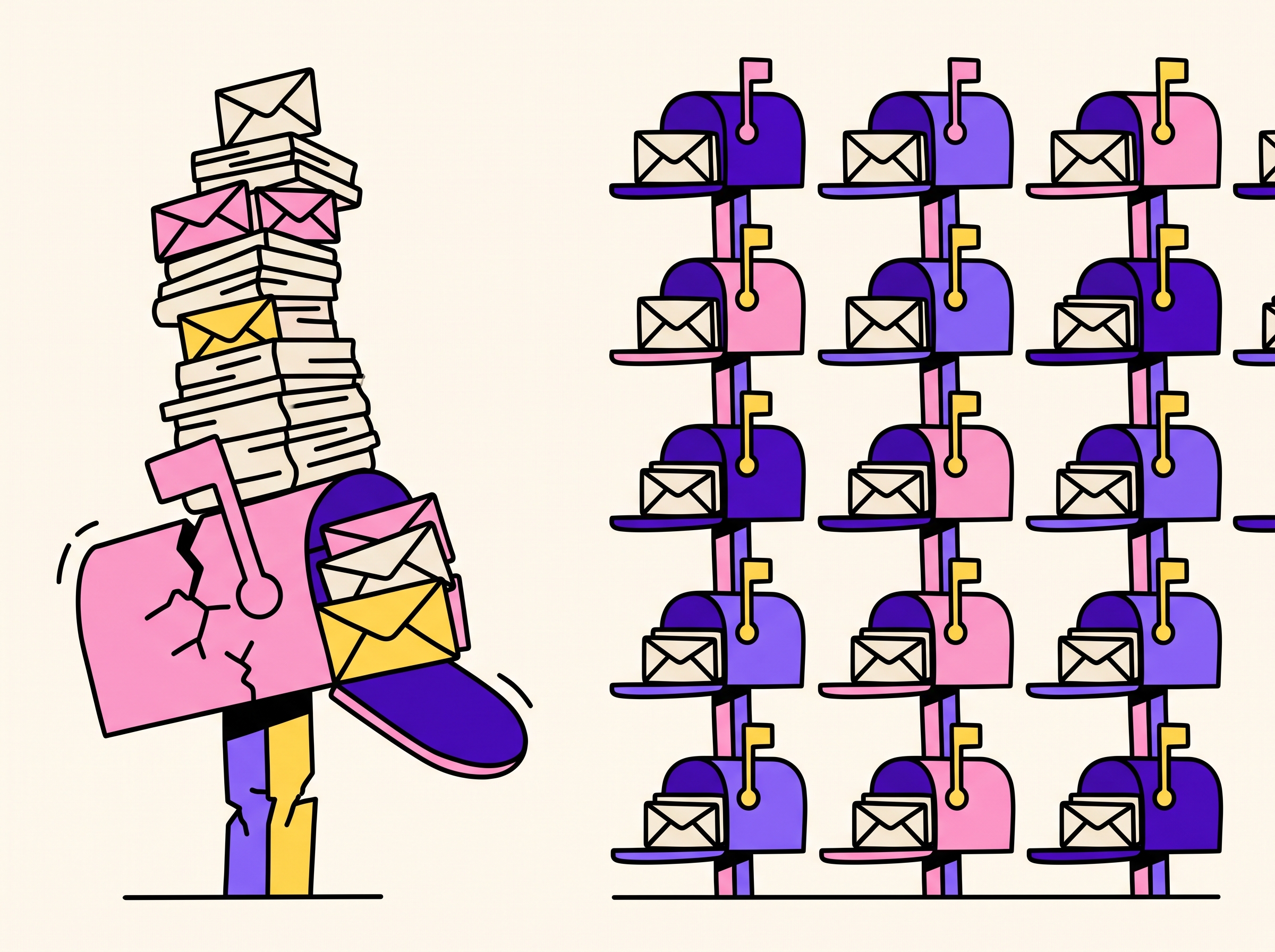
Scale sideways: more warmed mailboxes and domains, not one hero inbox at 1,000.
Use this as a planning worksheet, not a guarantee. Pick a conservative operating rate per mailbox after warmup, then solve for fleet size:
| Target cold sends / day | If each mailbox runs ~25/day | If each mailbox runs ~35/day | Rough domain sketch (e.g. ~3 mailboxes/domain) |
|---|---|---|---|
| 100 | ~4 mailboxes | ~3 mailboxes | 1–2 domains |
| 250 | ~10 mailboxes | ~7–8 mailboxes | 3–4 domains |
| 500 | ~20 mailboxes | ~14–15 mailboxes | 5–7 domains |
| 1,000 | ~40 mailboxes | ~29 mailboxes | 10–14 domains |
| 2,500 | ~100 mailboxes | ~70–75 mailboxes | 25–35 domains |
Formula: mailboxes ≈ daily_goal ÷ sustainable_per_mailbox. Domains ≈ mailboxes ÷ mailboxes_per_domain.
What “sustainable” means on your stack is proven by metrics, not by the table. If bounces cross ~2%, complaints climb toward the bulk-sender danger zone (~0.3%, with healthy programs often aiming under ~0.1%), or seed tests drop into spam, the table is wrong for you — lower volume or fix list/auth before buying more inboxes.
New mailboxes are not instantly worth their row in the table. They need authentication, a real ramp (see email warmup: private vs pooled networks), and clean verified lists. Buying 40 mailboxes and blasting 40 × 50 on day one is how fleets die together.
Does sending more automatically hurt deliverability?
Volume alone is not the villain. Unmatched volume is.
Raising sends while the following stay green is how healthy programs grow:
- Bounce rate under ~2% (ideally under ~1%) after real verification — not “the ESP accepted the address”
- Spam complaint rate well under provider bulk thresholds (Google/Yahoo publish 0.3% as a hard line; operators usually treat ~0.1% as the working ceiling)
- Stable or improving inbox placement on seed tests across Gmail, Microsoft, Yahoo
- Human reply rate that does not collapse when volume rises (if replies fall while sends rise, you are buying noise)
Raising sends while any of those redline is how you train filters that you are bulk unwanted mail. The same absolute volume can be fine on a tight ICP with verified addresses and painful on a scraped list. That is why list quality is part of the volume equation — see why your cold email list is smaller than you think and verified B2B email leads.
Copy still matters for replies. It does not override a reputation hole. Arrival is upstream of subject lines.
What happens when you exceed a safe volume?
You usually do not get a polite error that says “you sent 51.” Failure modes are quieter:
- Silent spam / promotions placement — dashboards still show “sent”; humans never see the mail.
- Provider throttling — temporary deferrals, slower acceptance, partial delivery.
- Reputation debt — days or weeks of recovery after one aggressive week; sometimes cheaper to retire a domain than rehab it.
- Blocklists and bulk-sender scrutiny — especially if complaints or authentication failures ride along.
Recovery is slower than the spike that caused it. That is why serious senders keep spare capacity (extra warmed domains/inboxes) rather than running every identity at the folklore ceiling every day. Failover thinking beats “max every inbox” thinking.
Do Google and Yahoo bulk sender rules cap how many cold emails you can send?
They set authentication and complaint rules. They do not hand you a safe cold-email daily quota.
As of the post-2024 Gmail/Yahoo requirements and Microsoft’s high-volume sender enforcement path (Outlook/Hotmail/Live, with bulk-style auth expectations widely treated as aligned by 2025–2026):
- The much-cited ~5,000 messages/day to a provider line is about when bulk sender requirements (SPF + DKIM + DMARC with alignment, low complaints, one-click unsubscribe where required, valid DNS identity) are formally enforced — not a blessing to send 5,000 cold emails from one inbox.
- Crossing bulk status is sticky; many operators meet the full checklist from day one even under 5,000.
- Provider technical caps (e.g. Google Workspace’s published daily send limits for the account) sit far above safe cold volume. Hitting the technical cap is an infrastructure failure mode; safe cold volume is a reputation problem that fails silently first.
So: bulk rules are a floor for how you authenticate and handle unsubscribes. They are not a ceiling that says “50 is legal.” For the authentication and monitoring stack, stay inside the deliverability playbook.

The limiting function (replace the magic number)
If you want one mental model instead of a meme:
Sustainable daily cold volume ≈ f(domain/IP reputation, list cleanliness, engagement quality, authentication health, ramp history).
| Input | What “good” looks like in practice | What breaks volume |
|---|---|---|
| Authentication | SPF, DKIM, DMARC aligned to visible From | Misalignment, missing DMARC |
| List hygiene | Bounce under ~2%, ideally under ~1% | Unverified or aged lists |
| Complaints | Stable low; treat ~0.1% as ops ceiling, 0.3% as crisis | Hidden unsubscribe, bad targeting |
| Engagement | Real replies; suppress OOO / dead threads | Pure open vanity, no replies |
| Volume shape | Gradual ramp; no cliff spikes | Zero → full throttle overnight |
| Infrastructure | Secondary domains, monitored placement, backups | One primary domain, no monitoring |
When any input worsens, the safe output falls — even if last month’s “40/day” felt fine. That is the opposite of a static integer.
For how we think about book-level KPIs once mail actually arrives, see cold email benchmarks 2026 and what a good reply rate really means.
A sane operating checklist
- Authenticate every sending domain before volume.
- Warm and ramp; do not buy a folklore ladder and ignore seed tests (warmup guide).
- Verify every address every campaign.
- Start below the public 20–50 band; raise only while placement, bounce, and complaints stay green.
- Scale with more identities, not hero inboxes.
- Cap domain-level concentration; keep spares for failover.
- Monitor Postmaster / SNDS / placement weekly — volume is a control loop, not a set-and-forget preference.
If you would rather not assemble domains, inboxes, warmup, and monitoring yourself, Ken runs outbound on owned sending infrastructure as part of the platform, done-for-you from the pricing page, or you can run the same software yourself. Prefer a lighter start? Ken Daily sends 10 verified ICP leads to your inbox every morning, free.
Frequently asked questions
How many cold emails can I send per day per inbox?
There is no single safe integer. Public 2026 operator ranges for warmed Workspace/M365 cold mailboxes often land around 20–50/day, but the real limit is the volume where your bounce, complaint, placement, and reply metrics stay healthy. Start lower; earn increases.
Is the limit per inbox or per domain?
Both. Mailboxes have patterns; domains and IPs accumulate reputation across mailboxes. Plan fleet math with both constraints, and never cold-send from your primary corporate domain.
How many inboxes do I need for 1,000 cold emails a day?
Roughly 1000 ÷ sustainable_per_mailbox. At ~25/day that is about 40 mailboxes; at ~35/day closer to 30 — after warmup, on clean lists, across enough domains that one failure does not take the whole day offline. Prove the per-mailbox rate with metrics before you buy the fleet.
Does sending more automatically hurt deliverability?
Only when volume outruns reputation and list quality. Matched increases with green bounce/complaint/placement metrics are normal growth. Blind increases on dirty data are how domains go to spam.
What happens if I exceed a safe volume?
Usually silent spam placement and reputation debt first — not a hard “over limit” banner. Recovery can take weeks; keep spare warmed capacity instead of redlining every identity.
Do Google and Yahoo bulk sender rules set my daily cold cap?
No. They require authentication, low complaints, unsubscribe handling, and related bulk standards (with a commonly cited ~5,000/day-to-provider enforcement threshold). They do not define a safe cold-email-per-inbox number. Technical ESP caps are also not safe cold caps.
The short version
Stop hunting for the one true daily number. The industry’s 30–50 line is a rough public band with no shared telemetry behind it. Safe cold volume is a function of reputation, list quality, engagement, and ramp — measured on your domains. Scale sideways with warmed mailboxes and secondary domains; raise volume only while bounce, complaints, and inbox placement stay green. Provider bulk rules and technical caps are not the same thing as a deliverability budget.
If you want the infrastructure side handled inside one system, start at Ken or grab Ken Daily and ship from a clean list first.